

Ledger vs Trezor vs Tangem: Complete 2026 Comparison for Crypto Self-Custody

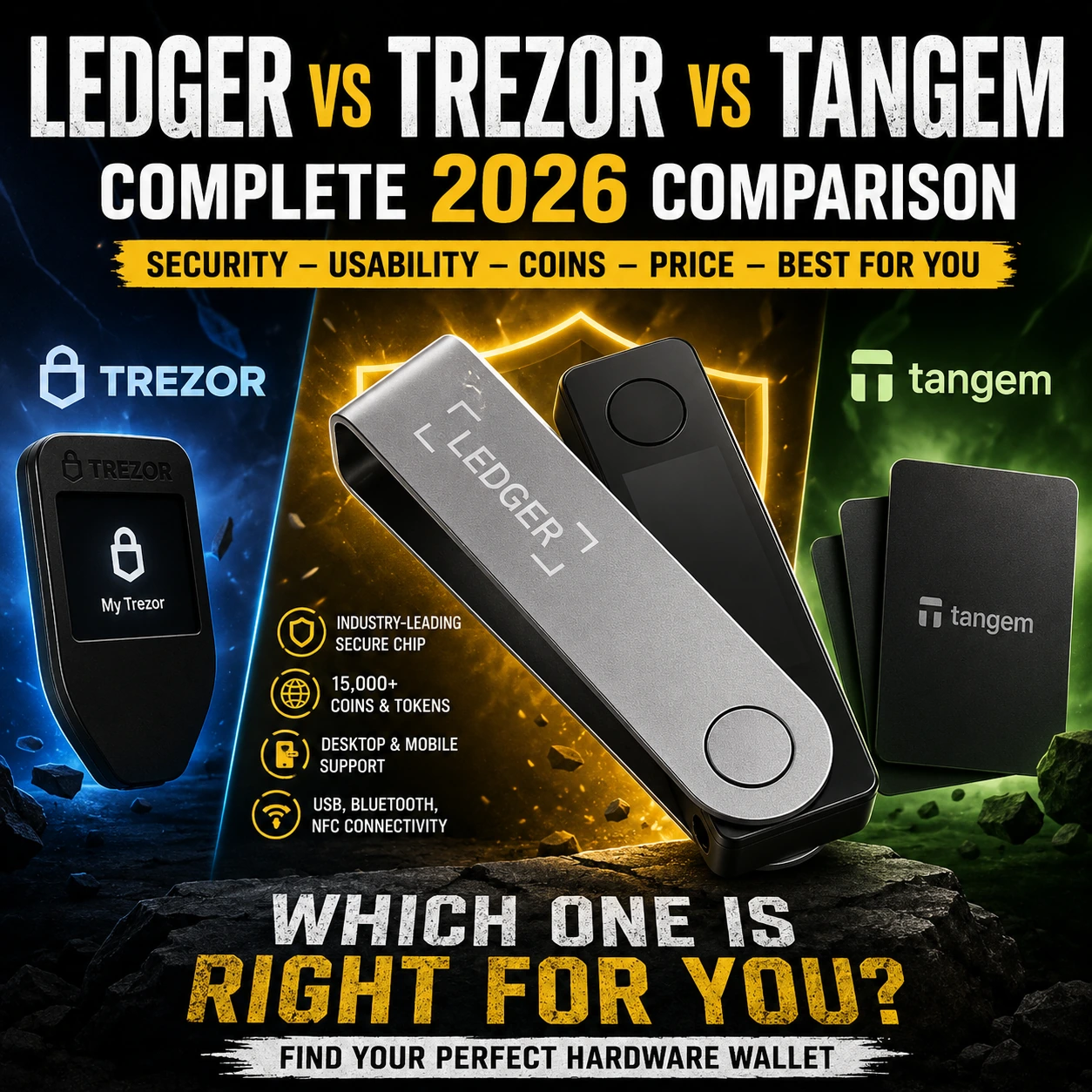
Ledger, Trezor and Tangem are all designed to help you hold crypto without leaving private-key control with an exchange. But they reach that goal through three substantially different security architectures.
Ledger centers its modern security model around a Secure Element, Ledger OS and a trusted hardware display. Trezor emphasizes open-source transparency, increasingly sophisticated Secure Element designs and flexible SLIP39 recovery. Tangem takes a more minimalist approach: an NFC card with no screen, cable or battery, combined with an optional seedless multi-card backup model.
That means the right question in 2026 is no longer simply “Which hardware wallet is safest?”
The better question is:
Which security architecture best protects me from the mistakes and threats I am actually likely to face?
This complete Ledger vs Trezor vs Tangem comparison looks beyond marketing claims and compares transaction verification, Secure Elements, firmware, recovery, seed phrases, mobile use, physical security and long-term self-custody.
Ledger vs Trezor vs Tangem: Which Is Best in 2026?
Ledger
Best suited to users who prioritize independent hardware transaction verification, broad multi-chain compatibility and a mature ecosystem spanning compact Nano devices and larger secure touchscreens.
- Secure hardware display
- Ledger OS application isolation
- Broad third-party wallet compatibility
- Multiple device tiers and form factors
Trezor
Best suited to users who strongly value open-source firmware, inspectable security architecture and advanced recovery options such as SLIP39 Multi-share Backup.
- Open-source software philosophy
- Secure Elements in current Safe devices
- 20-word SLIP39 backup by default
- Multi-share recovery support
Tangem
Best suited to mobile-first users who want a compact NFC wallet and would rather protect several physical cards than maintain a conventional written recovery phrase.
- EAL6+ Secure Element
- Default seedless option
- Two- or three-card redundancy
- No screen, battery or USB port
There is no honest universal winner. Ledger has the strongest all-round fit for users who prioritize transaction verification and ecosystem depth. Trezor is particularly compelling for users who value verifiability and sophisticated backup architecture. Tangem solves a different problem exceptionally well: reducing seed-phrase handling and making hardware self-custody feel almost as simple as tapping a bank card.
The Fundamental Difference Between Ledger, Trezor and Tangem
All three brands are non-custodial hardware-wallet systems. Your crypto remains recorded on its blockchain; what the hardware protects is the secret key material required to authorize transactions.
But the three brands make very different assumptions about where users are most likely to fail.
Protect the signing process
Ledger emphasizes hardware isolation, Secure Element execution and a trusted device screen. Its philosophy is that even if your computer or phone is untrusted, the signer should give you an independent place to verify what you are approving.
Make security inspectable
Trezor places unusual emphasis on transparency. Its wallet software and firmware are designed to be publicly auditable, while newer Safe devices add Secure Elements and more advanced physical-security architecture.
Remove unnecessary complexity
Tangem removes the display, buttons, cable and battery entirely. Instead, a secure NFC card performs signing while the phone provides the user interface. Its default multi-card setup can also remove the conventional written seed phrase.
Ledger vs Trezor vs Tangem 2026 Comparison Table
| Category | Ledger | Trezor | Tangem |
|---|---|---|---|
| Core design | Secure Element signer with hardware display | Open-source hardware signer with Safe-series Secure Elements | Screenless NFC Secure Element card |
| Current examples | Nano Gen5, Flex, Stax, Nano X, S Plus | Safe 7, Safe 5, Safe 3 | Tangem Wallet / Card / Ring ecosystem |
| Hardware screen | Yes | Yes | No |
| Secure Element | Yes | Yes on current Safe series | Yes, EAL6+ |
| Default backup model | Recovery phrase; newer models add Recovery Key option | 20-word SLIP39 on current Safe devices | Two or three physical devices in seedless configuration |
| Seed phrase | Standard recovery model | Standard recovery model | Optional on current generation |
| Multi-share backup | Not the primary native model | Yes, via SLIP39 | Physical card redundancy |
| Firmware | Upgradeable | Upgradeable | Non-updatable card firmware |
| Open-source approach | Mixed; apps and substantial components open, core SE firmware includes closed elements | Strongest full-stack open-source philosophy of the three | Mobile app open source; card firmware closed and independently audited |
| Wireless | Bluetooth on selected devices; NFC on newer touchscreen models | Safe 7 adds wireless connectivity | NFC only |
| Best fit | Multi-chain users and verification-focused self-custody | Transparency-focused and advanced backup users | Mobile simplicity and seedless recovery users |
Which Has the Strongest Hardware Security?
This is where outdated hardware-wallet comparisons often become misleading.
The old framing of “Ledger has a Secure Element while Trezor does not” is no longer accurate for Trezor’s current Safe lineup.
Ledger: Secure Element + Ledger OS
Ledger’s security architecture places a Secure Element at the center of sensitive operations. Ledger OS runs on the Secure Element and isolates blockchain applications from one another.
The practical benefit is compartmentalization. A Bitcoin, Ethereum or other supported application does not simply run as ordinary software on the connected computer.
Current Ledger models do not all use identical chips or certification levels. Nano X remains based on an EAL5+ Secure Element, while several newer Ledger models use EAL6+ components.
Trezor: Secure Elements Meet Open Architecture
Trezor Safe 3 and Safe 5 use an OPTIGA Trust M V3 Secure Element for functions including PIN protection, authenticity verification and additional entropy.
Trezor Safe 7 goes substantially further. Its current hardware architecture combines an OPTIGA Trust M V3, a TROPIC01 auditable Secure Element and the main microcontroller.
This is an important evolution in Trezor’s security model: the company is no longer choosing between transparency and dedicated secure hardware in the simplistic way older comparisons imply.
Tangem: Minimalist Secure Element
Tangem strips the physical wallet down to a secure chip and NFC interface. Private keys are generated and used within its EAL6+ Secure Element.
The device has no traditional display, charging circuitry, buttons or USB connector. Fewer components create a smaller physical and communications footprint.
Ledger offers a mature isolated signing environment. Trezor combines strong physical protections with unusually high transparency. Tangem minimizes the hardware attack surface. The better architecture depends on which threat model you care about most.
The Screen Is One of the Biggest Differences
A hardware wallet does more than keep a private key offline. It also gives you a chance to verify what you are signing before the signature is released.
Dedicated hardware verification
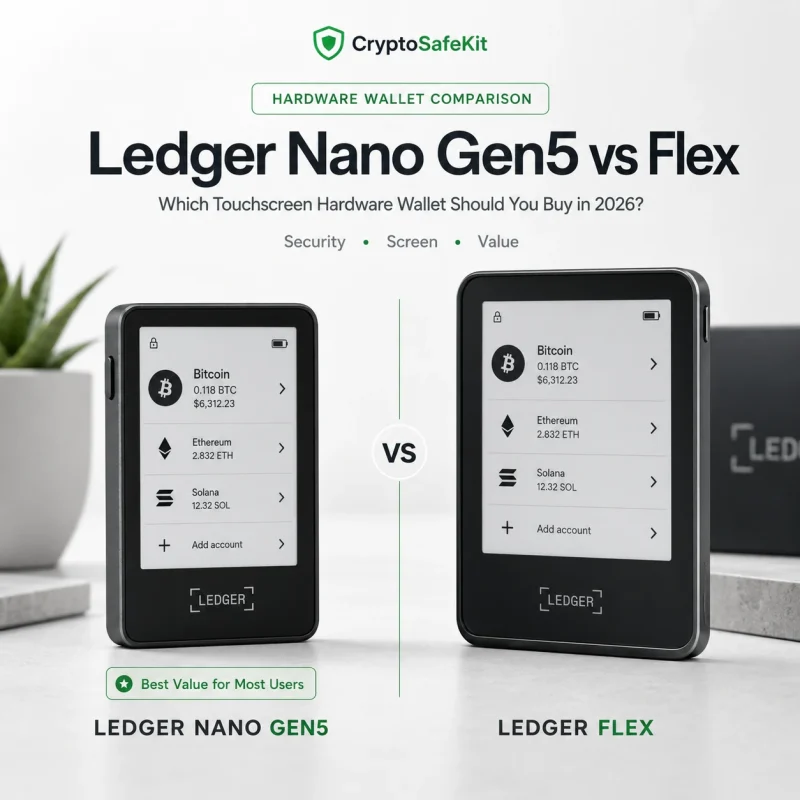
Ledger devices display transaction information on the signer. Newer Nano Gen5, Flex and Stax models use secure E Ink touchscreens and support Ledger’s Clear Signing and Transaction Check features for supported workflows.
Dedicated on-device display
Trezor also provides an independent display and physical or touchscreen confirmation depending on the model. Safe 5 and Safe 7 give users larger touchscreen interfaces than button-based devices such as Safe 3.
Screenless by design
Tangem relies on the smartphone display for transaction information while the physical card performs cryptographic authorization via NFC.
This is Tangem’s most important architectural trade-off.
A compromised smartphone should not automatically reveal the private key stored inside a Tangem card. But because the card has no independent screen, the user cannot compare the phone’s proposed transaction against information displayed on a separate hardware interface.
For users frequently sending substantial amounts, interacting with DeFi or approving smart-contract transactions, an independent signer display is a meaningful security feature.
For a deeper two-device analysis, see our Ledger Nano X vs Tangem security comparison.
Seed Phrase vs SLIP39 vs Tangem Cards
Recovery architecture may be the most important difference between these three brands because it determines what must survive after the physical wallet is lost or destroyed.
Protect the recovery secret
Traditional Ledger setups use a recovery phrase that can recreate the wallet if the signer is unavailable.
Newer Ledger touchscreen signers also support Ledger Recovery Key, an optional PIN-protected NFC backup card included with current supported models.
StrengthStrong recovery portability and a familiar industry-standard model.
Primary riskThe recovery phrase becomes an extremely valuable independent secret.
Build a flexible recovery architecture
Current Trezor Safe devices default to a 20-word SLIP39 Single-share Backup.
Users can move toward Multi-share Backup, dividing recovery across several shares and defining how many are required to recover the wallet.
StrengthAdvanced redundancy without requiring one complete recovery phrase to exist in every backup location.
Primary riskMore sophisticated backup structures require users to understand and document their recovery plan correctly.
Back up the hardware instead
In Tangem’s seedless configuration, the private key is backed up across additional Tangem devices during setup.
Two- and three-card sets therefore provide physical redundancy without requiring the user to write down a conventional seed phrase.
StrengthNo recovery words exist for a fake support agent or phishing site to steal.
Primary riskIf every valid backup device is permanently lost or destroyed in a seedless setup, there is no separate mnemonic waiting to restore the wallet.
Which recovery model is safer?
None is universally safer.
A seed phrase provides portability but creates a human-readable master secret. Multi-share recovery reduces single-point failure but adds operational complexity. Seedless card redundancy removes mnemonic exposure but ties long-term recovery to the survival of the physical backup devices.
The right model is the one you can actually maintain for ten years—not merely the one that feels easiest during the first ten minutes.
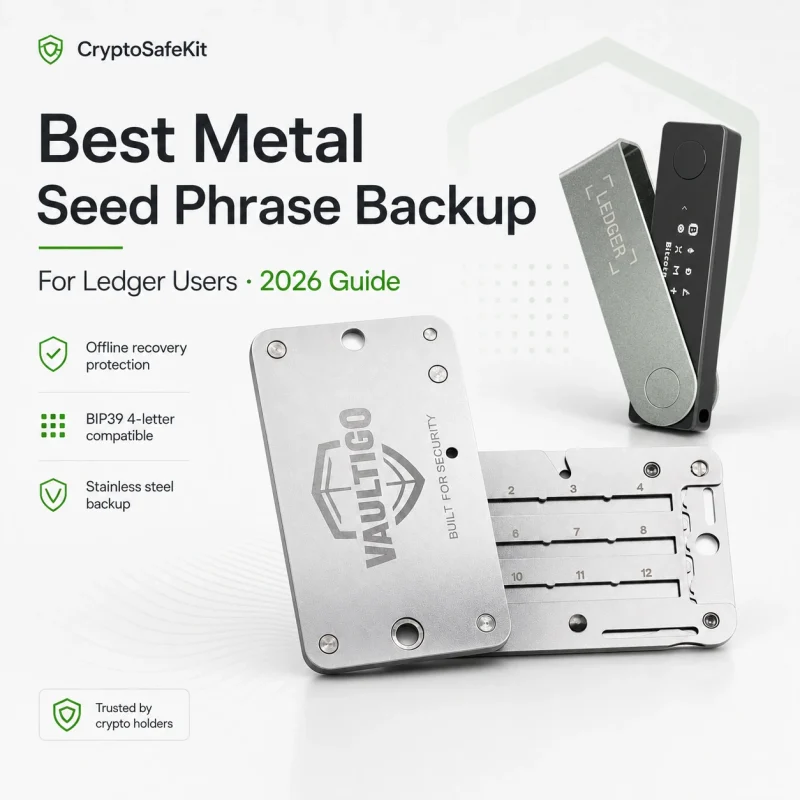
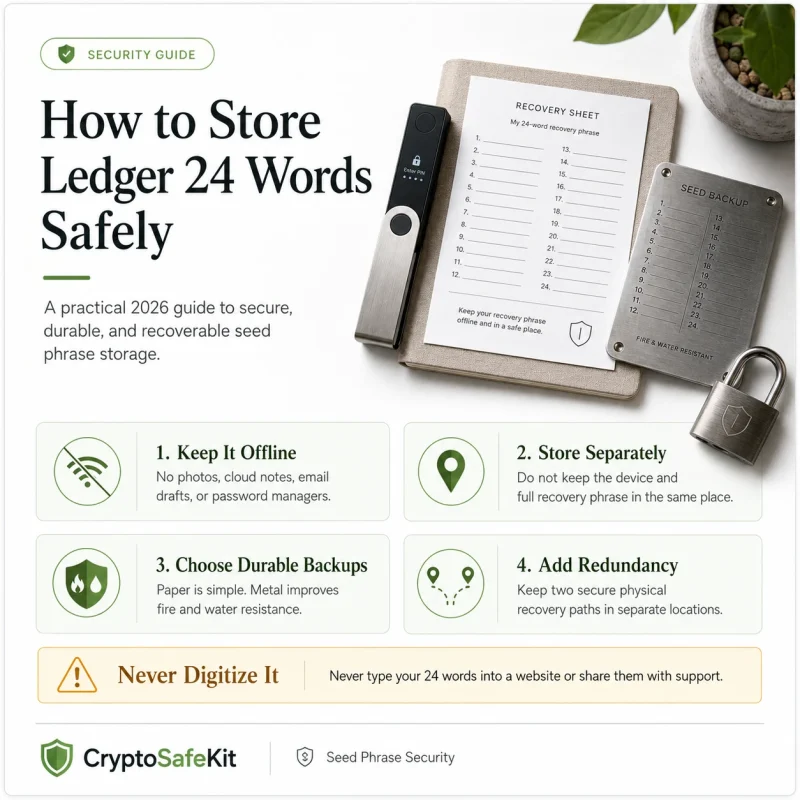
If you use a traditional recovery phrase, see our metal seed phrase backup guide for long-term physical storage considerations.
Your Backup Can Be More Dangerous Than Your Hardware Wallet
A hardware wallet may contain Secure Elements, PIN protection and tamper-resistant hardware. A recovery phrase written on paper has none of those protections.
If someone obtains a complete usable recovery phrase, they may not need the original Ledger or Trezor at all.
Camera backups and cloud synchronization turn an offline secret into digital data.
Legitimate wallet support should not require your full recovery phrase.
One burglary or disaster should not remove every recovery layer.
A backup you have never checked may contain an unnoticed transcription error.
Trezor vs Ledger vs Tangem: Which Is Most Transparent?
Trezor has the clearest open-source position
Trezor’s software has historically been designed around public inspection and reproducibility. Users and security researchers can inspect the code used by current devices, and the company explicitly treats transparency as part of its trust model.
Ledger is more nuanced
Ledger publishes substantial portions of its developer stack and device applications, but its architecture also contains proprietary Secure Element firmware covered by chip-vendor restrictions and NDAs.
Ledger’s argument is that security should be evaluated not merely by whether code is public but by how secrets are isolated inside secure hardware.
Tangem separates app transparency from card firmware
Tangem’s mobile application is open source. Its card firmware is closed source and deliberately non-updatable.
Tangem instead points to third-party reviews of the hardware and firmware, including audits by Kudelski Security and Riscure, while a 2026 Cure53 review covered its mobile software stack.
Upgradeable vs Immutable Firmware
Ledger & Trezor
UPDATABLEFirmware can be updated to patch security issues, improve compatibility and support new capabilities.
AdvantageNewly discovered problems may be mitigated without replacing every physical device.
Trade-offThe update mechanism and firmware-signing process become part of the wallet’s security model.
Tangem
IMMUTABLE CARD FIRMWARETangem’s card firmware is installed during manufacturing and is not designed to be updated later.
AdvantageThe card cannot later receive an unexpected software update.
Trade-offA future hardware-level or firmware-level problem cannot necessarily be fixed by simply updating an existing card.
Again, this is a design trade-off rather than an automatic winner.
Which Hardware Wallet Is Easiest to Use?
Tangem: the simplest learning curve
Tangem is difficult to beat for basic mobile usability. The user opens the app, taps the card to an NFC-enabled smartphone and authorizes the operation.
There is no cable to find, battery to charge or miniature menu to navigate.
Ledger: the broadest range of workflows
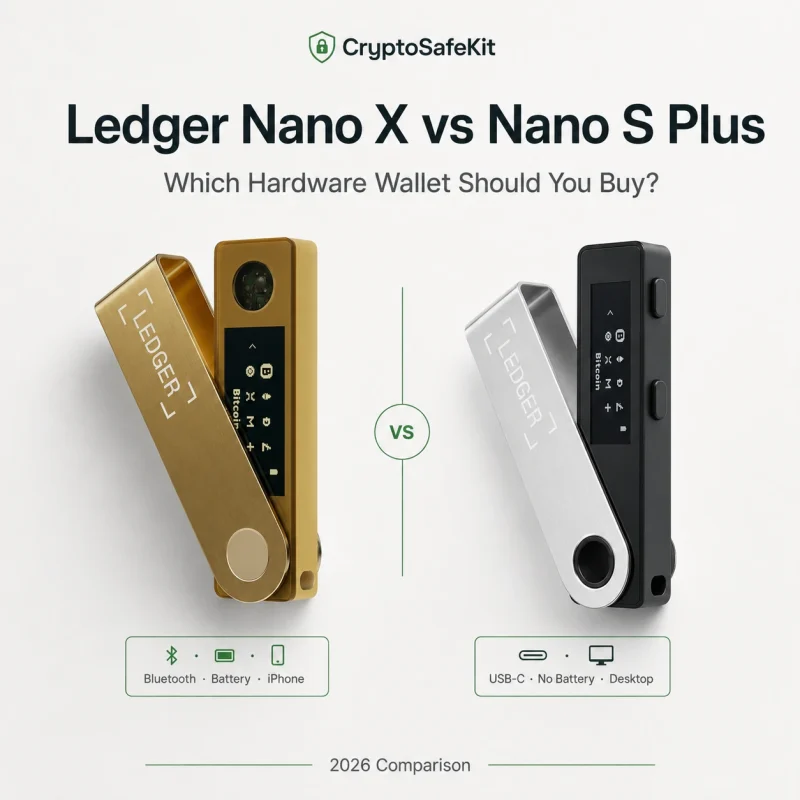
Ledger spans several usage styles. Nano S Plus offers a wired experience, Nano X adds portable Bluetooth functionality, while Nano Gen5, Flex and Stax provide substantially larger secure touchscreen interfaces.
That allows users to choose between simplicity, portability and more advanced transaction readability.
If you’re specifically considering the older mobile-friendly model, see our Ledger Nano X review for 2026.
Trezor: increasingly modern hardware
Trezor Safe 3 retains a traditional button-driven approach, while Safe 5 provides a color touchscreen and Safe 7 moves the flagship line toward a larger touchscreen and wireless workflow.
Tap-to-use mobile workflow.
Wired, Bluetooth, NFC and multiple display sizes depending on model.
Strong Trezor Suite integration with increasingly modern hardware.
Which Is Best for Travel and Physical Durability?
Tangem has an obvious advantage in mechanical simplicity.
A card has no display glass, buttons, battery or charging port. Tangem’s current card design carries an IP69K rating and operates passively through NFC.
Ledger and Trezor devices provide screens and richer interfaces, but those interfaces naturally introduce additional physical components.
This does not mean a broken screen equals lost crypto.
If a seed-based wallet fails physically but the correct recovery backup remains secure, the accounts can generally be restored on compatible hardware.
Physical durability therefore matters, but it should not be confused with recoverability.
Coins, DeFi and Third-Party Wallet Compatibility
Asset-count marketing is often less useful than it appears.
A wallet may advertise thousands of tokens because many tokens share the same underlying network. What matters is whether the device supports the specific network, account type, staking workflow, NFT standard or third-party application you actually use.
Ledger
Ledger has one of the broadest mature third-party ecosystems and is frequently used with external wallet interfaces for Bitcoin, Ethereum, Solana and other networks.
Trezor
Trezor provides strong native support through Trezor Suite while also integrating with compatible third-party wallets. Support varies by device, network and firmware.
Tangem
Tangem prioritizes the mobile application as the central interface. Its architecture can support broad token coverage without requiring users to install individual blockchain applications on the card.
Which Is the Best Hardware Wallet for Beginners?
Choose Tangem
The tap-to-phone workflow and multi-card seedless option remove several concepts that often confuse first-time hardware-wallet users.
Choose Ledger
A conventional hardware-wallet workflow teaches device verification, recovery management and independent signing while maintaining a highly polished ecosystem.
Choose Trezor
Trezor offers a strong educational ecosystem and a transparent architecture while still providing approachable Safe-series hardware.
The easiest wallet is not necessarily the best first wallet if its architecture hides concepts you eventually need to understand.
Regardless of brand, new users should understand private keys, backups, transaction verification and recovery before storing meaningful value.
Which Is Best for Long-Term Crypto Self-Custody?
For long-term storage, the hardware itself is only part of the system.
A ten-year storage plan should consider:
Where does signing key material live?
What happens when the device disappears?
Can transactions be checked independently?
Can one disaster destroy every backup?
Can recovery move to other compatible tools?
Can a trusted future beneficiary understand the system?
Ledger for conventional long-term portability
A properly secured recovery phrase offers a widely understood path to device replacement and recovery.
Trezor for sophisticated recovery planning
SLIP39 Multi-share can be attractive where eliminating a single complete backup location is more important than keeping the setup simple.
Tangem for users who reject written seed management
Multiple physical cards can create an elegant long-term system, provided they are geographically separated and the owner accepts the trade-off of seedless recovery portability.
Continue Building Your Self-Custody Setup
Ledger vs Trezor vs Tangem: Which Should You Buy?
You want the strongest all-round ecosystem
- You regularly transact rather than only hold.
- An independent hardware screen matters to you.
- You use multiple blockchains and third-party wallets.
- You want several hardware tiers to choose from.
- You are comfortable securing recovery credentials properly.
You want transparency and advanced backup design
- Open-source firmware is a major purchasing criterion.
- You want SLIP39 Single-share or Multi-share Backup.
- You prefer Trezor Suite and its security philosophy.
- You want current Secure Element protection without abandoning open architecture.
You want the simplest mobile-first self-custody
- You want NFC tap-to-sign simplicity.
- You dislike managing recovery words.
- You prefer physical card redundancy.
- You value compactness and lack of batteries or cables.
- You accept the trade-off of having no dedicated transaction screen.
There Is No Single “Safest Hardware Wallet”
Ledger, Trezor and Tangem are not three versions of the same idea.
They represent three different answers to the self-custody problem.
Ledger: Protect the signing process and let the user verify transactions on dedicated hardware.
Trezor: Make the wallet architecture inspectable and give users sophisticated recovery options.
Tangem: Reduce the number of components—and potentially eliminate the written seed phrase entirely.
For a technically engaged user managing several assets and regularly signing transactions, Ledger is arguably the most balanced overall ecosystem.
For someone who treats open-source transparency and flexible recovery architecture as first-order security requirements, Trezor is exceptionally compelling.
For a user who wants self-custody without cables, tiny screens and handwritten recovery phrases, Tangem provides one of the cleanest consumer experiences.
The safest hardware wallet is not the one that wins the most specification rows. It is the one whose security model still works after your phone fails, your device disappears, a phishing attack reaches you, and several years have passed since setup.
Ledger vs Trezor vs Tangem FAQ
Is Ledger better than Trezor in 2026?
Ledger is particularly strong in secure transaction displays, application isolation and ecosystem breadth. Trezor has the advantage for users who place greater weight on open-source transparency and SLIP39 recovery. Neither is universally better.
Is Tangem safer than Ledger?
Tangem reduces seed-phrase exposure in its seedless configuration and has an EAL6+ Secure Element, but it does not provide an independent hardware screen. Ledger provides stronger transaction-verification architecture, while Tangem provides a simpler seedless recovery model.
Is Trezor safer because it is open source?
Open-source software allows independent inspection and can improve transparency, but it does not automatically make an entire device safer. Hardware design, Secure Elements, recovery architecture, transaction verification and user behavior also matter.
Does Trezor have a Secure Element now?
Yes. Current Trezor Safe-series devices use Secure Elements. Safe 3 and Safe 5 use OPTIGA Trust M V3, while Safe 7 adds a TROPIC01 Secure Element alongside OPTIGA and the main microcontroller.
Does Tangem use a seed phrase?
A current-generation Tangem wallet can be configured without a conventional seed phrase using multiple backup cards. It also supports optional seed-phrase generation or import for users who prefer traditional BIP39 recovery.
What happens if I lose my Tangem card?
If you created a multi-device Tangem backup, another valid backup card can still access the wallet. In a seedless setup, losing every valid backup device may result in permanent loss of access.
Which wallet is best for beginners?
Tangem generally has the lowest operational learning curve. Ledger provides a more traditional self-custody experience with strong device verification, while Trezor is attractive to beginners who value transparency and want to learn a more advanced recovery model.
Which wallet is best for long-term Bitcoin storage?
Ledger, Trezor and Tangem can all be used for long-term storage. The more important consideration is your complete recovery architecture: backup durability, geographic redundancy, recovery portability and whether future users can understand the system.
Which is best for DeFi?
Ledger generally has one of the strongest third-party wallet ecosystems for multi-chain and DeFi workflows. However, users should verify exact network and application compatibility before purchasing any hardware wallet.
Which hardware wallet is best if I hate seed phrases?
Tangem is the clearest fit because its default architecture can use multiple physical devices rather than a written recovery phrase. Users should understand that this changes rather than eliminates the recovery responsibility.
Should I buy more than one hardware wallet?
For larger or operationally important holdings, separating long-term savings, active DeFi accounts and smaller spending wallets can reduce the impact of a single mistake. Multiple devices only help if each recovery system is documented and protected correctly.
Sources & Editorial Method
This comparison evaluates complete self-custody architectures rather than ranking hardware wallets solely by Secure Element certification, coin count or marketing claims.
Current device and security information was checked against manufacturer documentation covering Ledger’s 2026 signer lineup and Ledger OS architecture, Trezor Safe-series hardware and SLIP39 backup documentation, and Tangem’s current Wallet 2.0, backup architecture and published security audits.
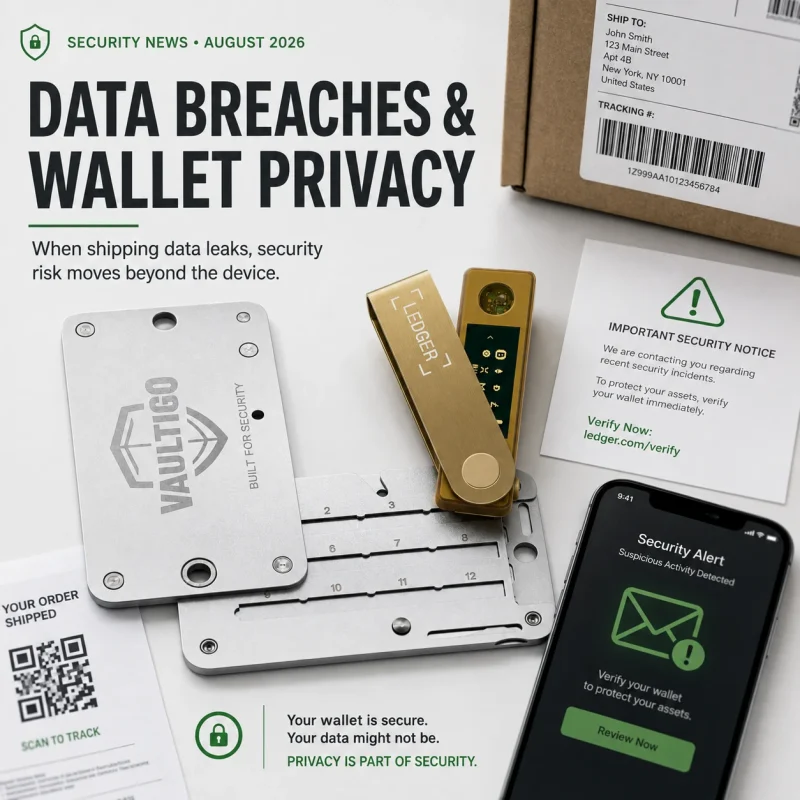
Security notice: Never send a recovery phrase, private key, PIN or passphrase to CryptoSafeKit, Ledger, Trezor, Tangem or an unsolicited support representative. Never enter a recovery phrase into a website simply to “verify” or “activate” a hardware wallet.
Editorial note: Product features, software support, regional availability and pricing can change. Always verify current support for your specific cryptocurrency and intended wallet application before purchasing.