

Ledger Nano X vs Nano Gen5 2026: Is the Touchscreen Upgrade Worth It?

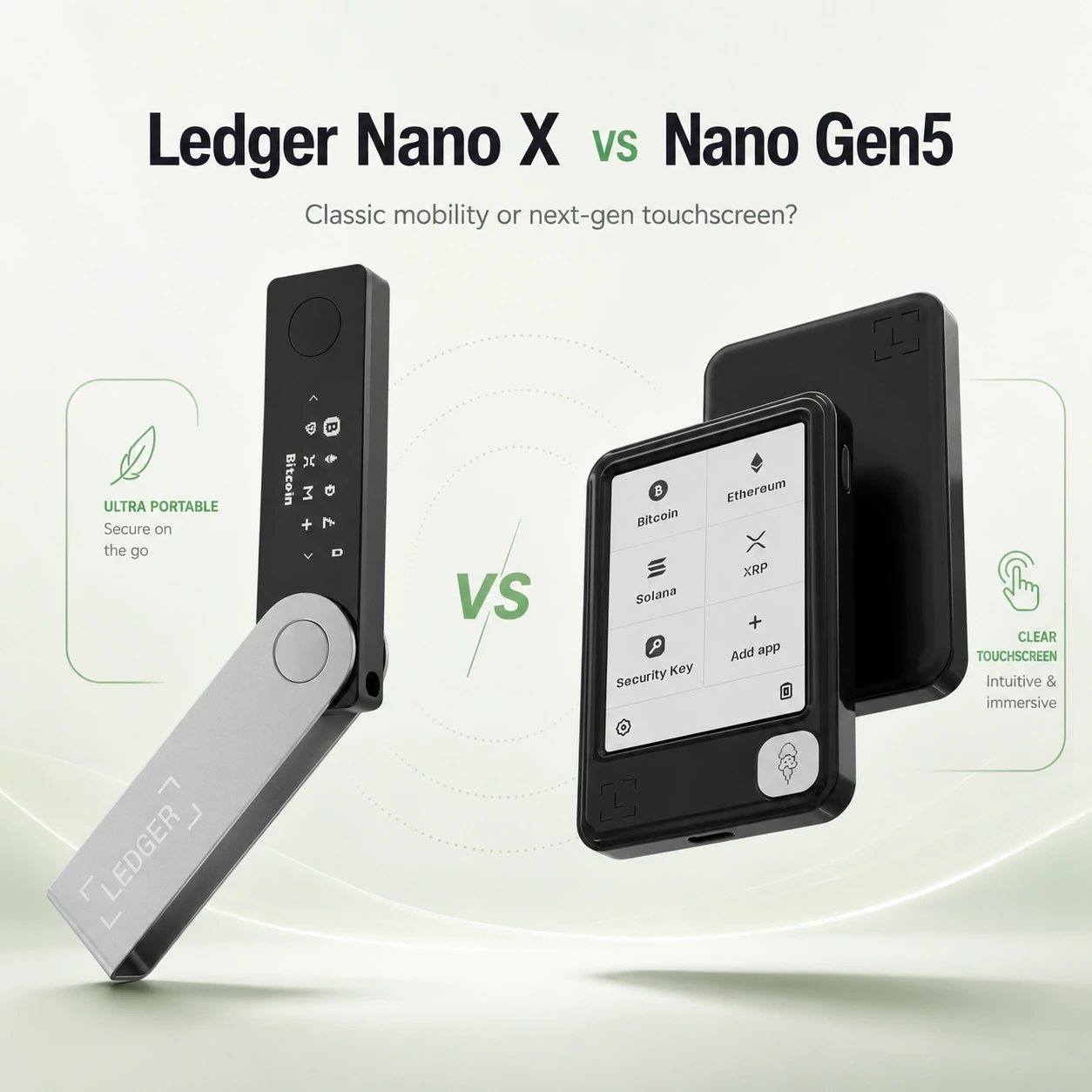
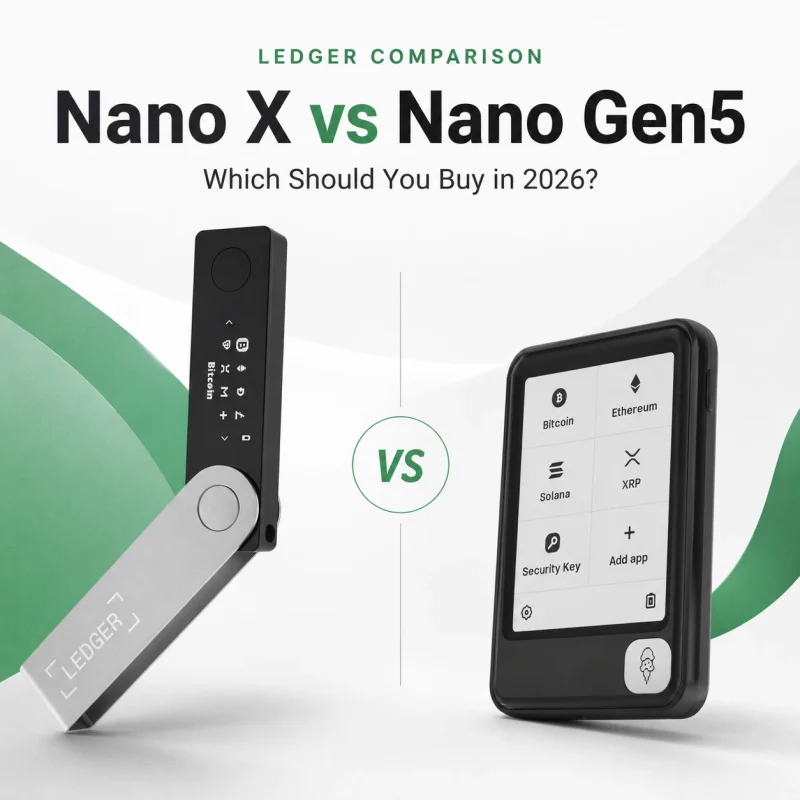
Ledger Nano X and Nano Gen5 can both keep private keys isolated from your everyday phone or computer, connect wirelessly to a smartphone and manage the same broader Ledger ecosystem. But they belong to two very different generations of hardware wallet design.
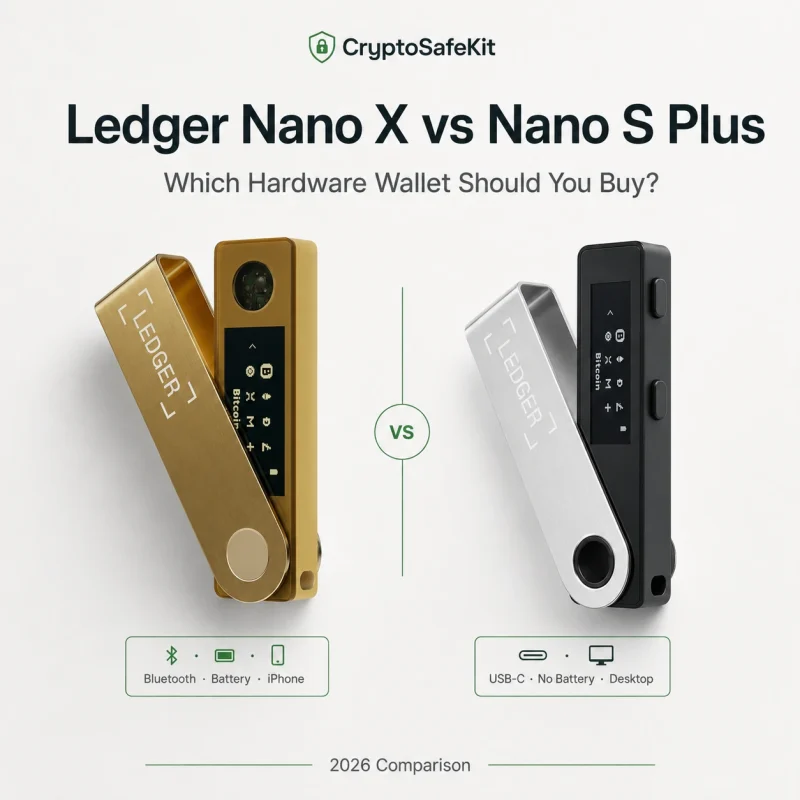
Nano X is Ledger’s compact classic: a small OLED screen, two physical buttons, Bluetooth, USB-C and a proven mobile-first form factor.
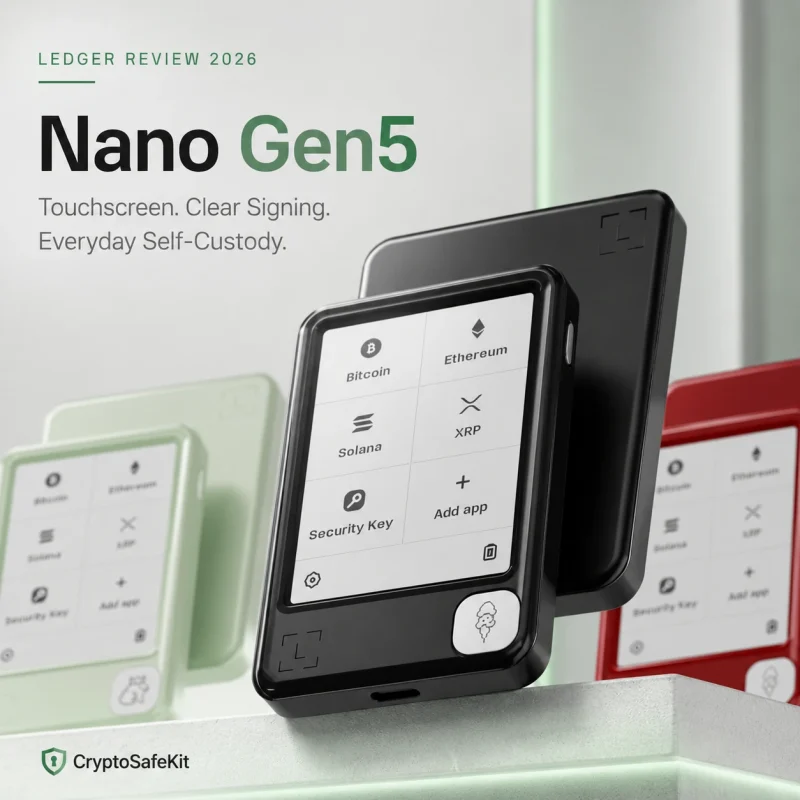
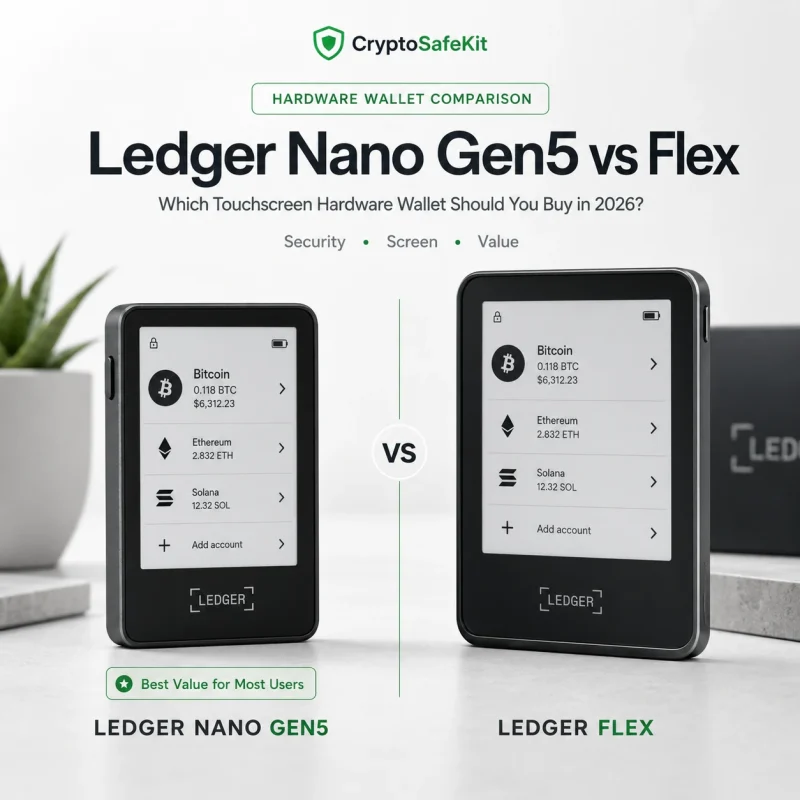
Nano Gen5 takes the same basic self-custody idea and modernizes almost every part of the user interaction: a 2.8-inch secure E Ink touchscreen, EAL6+ Secure Element, NFC, Transaction Check, Ledger Recovery Key and significantly more readable transaction review.
So the real question is not simply whether Nano Gen5 is newer.
It is whether those upgrades materially improve the way you use a hardware wallet enough to justify paying more and carrying a larger device.
In this Ledger Nano X vs Nano Gen5 comparison, we look at security, screen quality, Bluetooth, NFC, battery life, transaction verification, recovery, portability, DeFi use and long-term value to determine which model makes more sense in 2026.
Ledger Nano X
Choose Nano X if you mainly sign straightforward transactions, want Bluetooth in the smallest possible Ledger form factor and prefer paying less for features you will actually use.
Ledger Nano Gen5
Choose Nano Gen5 if you want a much larger trusted touchscreen, stronger transaction visibility, NFC, Transaction Check and Ledger’s newer recovery and digital-security features.
Ledger Nano X vs Nano Gen5: Key Differences
| Feature | Ledger Nano X | Ledger Nano Gen5 |
|---|---|---|
| Generation | Classic Nano | Next-generation touchscreen |
| Display | 1.1″ monochrome OLED | 2.8″ monochrome E Ink touchscreen |
| Resolution | 128 × 64 px | 300 × 400 px |
| Navigation | Two physical buttons | Touchscreen |
| Secure Element | ST33J2M0 | ST33K1M5 |
| Certification | CC EAL5+ | CC EAL6+ |
| Ledger OS | Yes | Yes |
| Bluetooth | BLE 5.2 | BLE 5.2 |
| USB-C | Yes | Yes |
| NFC | No | Yes |
| Clear Signing | Supported, but limited by small display | Designed for full touchscreen review |
| Transaction Check | No | Yes, on supported transactions |
| Recovery Key included | No | Yes |
| Security Key / passkey workflows | Limited classic-signer functionality | NFC passkey / 2FA support |
| Battery | Up to ~5 hours normal use | Up to ~10 hours or 150 transactions |
| Size | 72 × 18.6 × 11.7 mm | 79.4 × 53.3 × 8.6 mm |
| Weight | 34 g | 46 g |
| Official price | About $99 | About $179 |
| Best for | Compact Bluetooth use / backup | Primary everyday signer |
The biggest misconception is that Nano Gen5 is simply a Nano X with a larger screen.
The display is the most visible upgrade, but the more important change is that Ledger designed the entire next-generation workflow around making transaction information easier to understand before you approve it.
Ledger Nano X vs Nano Gen5: Which Is More Secure?
Both devices use Ledger’s foundational security architecture: private keys are generated and stored inside a dedicated Secure Element, Ledger OS controls sensitive operations, and transactions require physical approval.
That means Nano X did not suddenly become unsafe when Nano Gen5 launched.
However, Nano Gen5 has two meaningful advantages.
1. Newer EAL6+ Secure Element
Nano X uses Ledger’s ST33J2M0 Secure Element certified to CC EAL5+.
Nano Gen5 uses the ST33K1M5 with CC EAL6+ certification.
Common Criteria levels describe the rigor and depth of a defined security evaluation. Both EAL5+ and EAL6+ are serious Secure Element certifications, but Gen5 belongs to Ledger’s newer evaluated hardware generation.
2. Better protection against human signing mistakes
In practice, this may be the more important upgrade.
Nano X’s tiny display can show transaction details, but reviewing long addresses or complex smart-contract information often requires several screens.
Nano Gen5 gives you a much larger Secure Screen driven by the Secure Element, making it easier to understand what the hardware is actually asking you to approve.
Both isolate private keys inside certified Secure Element hardware.
Larger secure display plus current-generation transaction safety features.
The Screen Is Not Just a Convenience Upgrade
Nano X uses a 128 × 64 monochrome OLED operated with two physical buttons.
For Bitcoin transfers, basic Ethereum sends and occasional wallet management, the interface still works perfectly well.
Nano Gen5 uses a 300 × 400 E Ink touchscreen with scratch-resistant glass and an anti-glare coating.
That is a completely different interaction model.
Excellent when the device is used occasionally for relatively simple transactions.
Better suited to frequent signing, DeFi, NFTs and more complicated onchain interactions.
A larger trusted screen makes transaction verification materially easier, not merely more attractive.
Transaction Check Is One of the Most Important Gen5 Upgrades
Modern hardware-wallet risk has moved beyond simple private-key theft.
Many losses now happen because a user still controls the private key but signs a transaction they do not fully understand.
Nano Gen5 is designed around Ledger’s current Clear Signing and Transaction Check workflows.
Clear Signing
Where supported, Clear Signing presents transaction intent in human-readable information instead of asking the user to approve opaque hexadecimal or difficult-to-interpret data.
Transaction Check
Transaction Check can analyze supported transactions for known scam patterns and provide additional warnings before approval.
No automated system can prove that every contract, address or dApp interaction is safe. You still need to verify what you are signing.
Nano X can still display supported transaction information, but it does not provide the same Transaction Check experience, and the smaller screen naturally limits how much information can be reviewed at once.
Our Ledger address-verification security guide explains why trusted hardware verification matters before transferring significant value.
Both Have Bluetooth — Nano Gen5 Adds NFC
Bluetooth is not a major reason to choose between these two devices because both support it.
Nano X and Nano Gen5 both support Bluetooth Low Energy for compatible iOS and Android smartphones, as well as USB-C for desktop and supported Android workflows.
Nano Gen5 adds NFC.
Ledger uses NFC for features including:
- Ledger Recovery Key
- Ledger Security Key workflows
- Supported passwordless/passkey logins
- Hardware-based two-factor authentication
Everything many crypto users actually need for mobile and desktop signing.
Expands the signer beyond crypto into recovery and digital-identity workflows.
Nano Gen5 Roughly Doubles the Rated Everyday Battery Use
Nano X has an internal rechargeable battery designed for roughly five hours of normal use under Ledger’s current comparison specifications.
Nano Gen5 is rated for up to around ten hours of normal use, or up to approximately 150 transactions depending on conditions.
Enough for normal occasional mobile signing.
Better suited to a primary everyday signer.
Battery life should not be confused with wallet longevity.
Your crypto does not live inside the battery or even inside the physical Ledger. Long-term recovery ultimately depends on your valid recovery credentials.
If device loss concerns you, read what happens if a Ledger Nano X is lost or stolen .
Nano Gen5 Adds Ledger Recovery Key in the Box
Both devices can use a Secret Recovery Phrase as the fundamental self-custody backup.
Nano Gen5 adds another option: Ledger Recovery Key.
Recovery Key is a PIN-protected NFC card that stores an encrypted backup and can assist with restoring a compatible Ledger signer.
Traditional physical recovery-phrase workflow.
Provides an additional supported physical recovery path.
You still need to understand where recovery credentials are stored, who can access them and what happens if the device itself is lost.
For long-term backup planning, see our guide to storing Ledger recovery words safely .
Do Nano X and Nano Gen5 Support Different Coins?
Not enough to make this the deciding factor.
Both operate within Ledger’s broader ecosystem and can manage major assets through Ledger Wallet and compatible third-party wallets.
Ledger currently lists support for hundreds of assets directly inside Ledger Wallet and thousands more through third-party integrations.
That includes major ecosystems such as:
- Bitcoin
- Ethereum
- Solana
- XRP
- Stablecoins
- Many EVM and non-EVM networks
The real upgrade is transaction visibility and next-generation functionality, not a completely different coin list.
Check your exact networks in our Ledger supported-assets guide .
Nano X Is Still the Better Pocket Wallet
This is one category where newer is not automatically better.
Nano X weighs approximately 34 grams and keeps the familiar USB-stick-style Nano design.
Nano Gen5 weighs approximately 46 grams and is much wider because it needs space for the touchscreen.
If you want the smallest Bluetooth Ledger to carry as a travel signer or backup device, Nano X still has a very clear role.
This is one reason existing Nano X owners do not necessarily need to throw the old device away after upgrading.
A practical setup can use Nano Gen5 as the primary signer and keep Nano X as a compact secondary or travel device.
Nano Gen5 Is the Clearer Choice for DeFi
DeFi creates a more demanding hardware-wallet environment than simply receiving Bitcoin and holding it for years.
Users may regularly approve:
- Token approvals
- Swaps
- Staking operations
- Smart-contract calls
- NFT interactions
- Cross-chain transactions
In these workflows, the screen becomes part of the security architecture.
Nano Gen5’s larger display, Clear Signing workflow and Transaction Check make it much better suited to frequent onchain activity.
Nano X remains perfectly usable for supported DeFi workflows, but if complex signing is a regular activity rather than an occasional event, Gen5 is easier to justify.
Should Existing Nano X Owners Upgrade to Nano Gen5?
Not automatically.
If you currently use Nano X primarily to:
- Store Bitcoin long term
- Receive funds occasionally
- Make simple transfers a few times per year
- Use Bluetooth with your phone
then Nano X may continue to meet your needs.
The upgrade becomes much more meaningful if you:
- Use DeFi regularly
- Frequently sign smart-contract interactions
- Want larger on-device transaction details
- Want Transaction Check
- Want NFC-based Recovery Key support
- Want passkey / Security Key functionality
- Use your Ledger as a primary everyday signer
Why Nano Gen5 Makes Sense as a Primary Upgrade
Nano Gen5 is not trying to replace Nano X by making the classic Nano slightly faster.
The main improvement is giving the user substantially more information at the moment where security matters most: before approving a transaction.
For users moving beyond simple cold storage into regular self-custody, DeFi, staking and mobile portfolio management, that makes Gen5 a much more meaningful upgrade than specifications such as weight or battery alone suggest.
Secure E Ink touchscreen, EAL6+ Secure Element, Bluetooth, USB-C, NFC, Transaction Check and Ledger Recovery Key.
If you are still deciding whether Nano X itself is enough for your needs, read our full Ledger Nano X Review 2026 .
Is Nano Gen5 Worth Paying More Than Nano X?
At Ledger’s current official pricing, Nano X sits around $99 while Nano Gen5 is around $179.
That is roughly an $80 difference.
Ledger Nano X
- Secure Element
- Bluetooth
- USB-C
- Compact OLED display
- Excellent portability
Ledger Nano Gen5
- Newer EAL6+ Secure Element
- 2.8″ secure E Ink touchscreen
- Bluetooth + USB-C + NFC
- Transaction Check
- Recovery Key included
- Security Key / passkey features
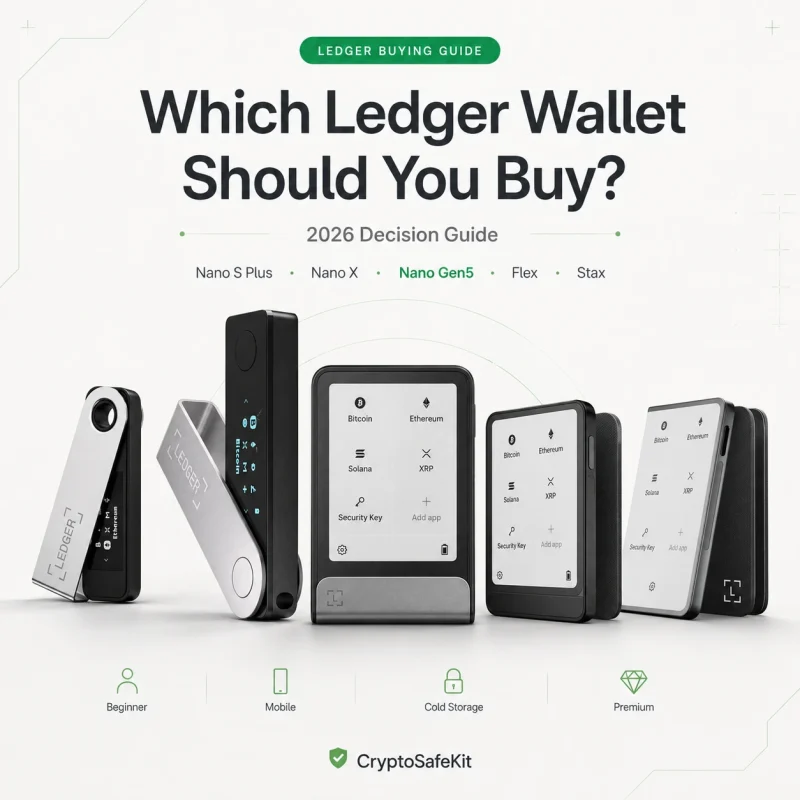
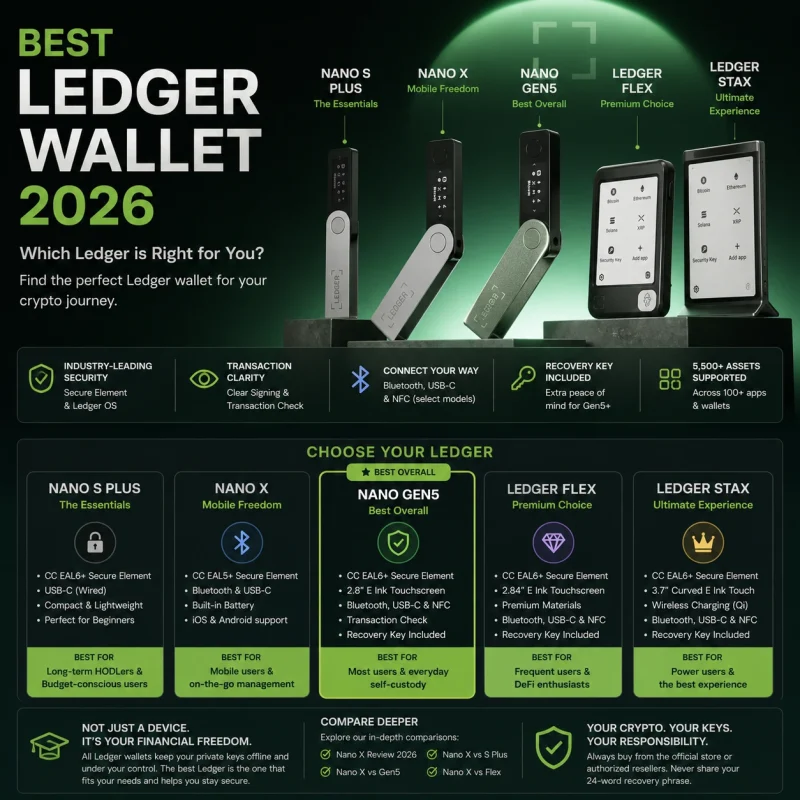
Ledger Nano X vs Nano Gen5: Which One Should You Buy?
You want the lowest-cost Bluetooth Ledger
Nano X still provides strong hardware key isolation, phone connectivity and a compact format.
This will be your primary wallet
The touchscreen and newer transaction-verification features make it better suited to frequent use.
You mostly hold Bitcoin long term
If transactions are infrequent and simple, the larger Gen5 interface may provide limited additional value.
You use DeFi and dApps
Larger trusted transaction review and Transaction Check become much more useful.
You need a compact backup signer
Its small size and Bluetooth support make Nano X particularly useful as a secondary device.
You want the newer Ledger platform
NFC, Recovery Key, passkeys and current-generation touchscreen workflows provide more room to grow.
Ledger Nano X vs Nano Gen5: Which Is Better in 2026?
Nano Gen5 is the better overall hardware signer.
Its larger secure touchscreen, EAL6+ Secure Element, NFC, Transaction Check, Recovery Key and longer rated battery life make it significantly better suited to modern everyday self-custody.
But that does not make Nano X obsolete.
Nano X remains smaller, lighter and substantially less expensive. It still provides Bluetooth mobile signing and dedicated Secure Element key protection, making it a strong choice for simple transactions, travel, cold-storage access or backup duty.
If simplicity and portability win
Lower cost, smaller size and Bluetooth make it an excellent classic signer.
If verification and longevity win
The secure touchscreen and current-generation features make it the stronger primary device.
Nano X protects your keys well. Nano Gen5 makes it much easier to understand what those keys are being asked to sign.
Ledger Nano X vs Nano Gen5 FAQ
Is Ledger Nano Gen5 better than Nano X?
Overall, yes. Nano Gen5 adds a secure E Ink touchscreen, EAL6+ Secure Element, NFC, Transaction Check, Recovery Key and a more modern transaction-review workflow. Nano X remains smaller and less expensive.
Is Nano Gen5 more secure than Nano X?
Both use Ledger’s Secure Element and Ledger OS architecture. Nano Gen5 uses a newer CC EAL6+ Secure Element and provides stronger transaction visibility through its secure touchscreen and Transaction Check.
Does Nano Gen5 have Bluetooth?
Yes. Nano Gen5 supports Bluetooth BLE 5.2 for compatible iOS and Android smartphones.
Does Nano X have NFC?
No. Nano X supports Bluetooth and USB-C but does not include NFC. Nano Gen5 uses NFC for compatible Recovery Key and Security Key workflows.
Does Nano Gen5 support more coins than Nano X?
Both operate within Ledger’s broader asset ecosystem. The main differences are interface, connectivity and transaction-verification features, not a completely different list of supported cryptocurrencies.
Is Nano X still worth buying in 2026?
Yes. Nano X remains a strong value option for users who want Bluetooth, simple hardware signing and a compact form factor without paying for a touchscreen.
Should Nano X owners upgrade to Nano Gen5?
Upgrade if you regularly use DeFi, sign complex transactions, want clearer on-device verification or want NFC and Recovery Key support. Simple long-term holders may not need to upgrade immediately.
Which is better for Bitcoin?
Both are capable Bitcoin hardware signers. Nano X is sufficient for straightforward long-term Bitcoin storage, while Nano Gen5 provides a more comfortable transaction-review experience.
Which is better for DeFi?
Nano Gen5. Its larger trusted touchscreen, Clear Signing workflow and Transaction Check are better suited to frequent smart-contract interaction.
Can I keep Nano X as a backup after buying Nano Gen5?
Yes. Many users may find Nano X useful as a secondary or travel signer while using Nano Gen5 as the primary everyday device. Make sure you fully understand the recovery configuration before operating multiple devices.
Sources & Methodology
This comparison was prepared using Ledger’s current August 2026 product specifications and signer-comparison documentation. Specifications, pricing and software features may change with future firmware and product revisions.
- Ledger — Which Ledger Signer Is Right for You? (August 2026)
- Ledger — Ledger Nano Gen5 Technical Specifications
- Ledger — Ledger Nano X Technical Specifications
- Ledger — Introducing Ledger Nano Gen5
- Ledger — Current Hardware Wallet Comparison