

How to Store Ledger 24 Words Safely: 2026 Seed Phrase Storage Guide

Your Ledger’s 24-word Secret Recovery Phrase is more important to protect than the hardware wallet itself. A damaged Ledger can be replaced. A stolen device still has PIN protection. But anyone who obtains your complete recovery phrase can potentially recreate your wallet and control the accounts derived from it.
That is why most real-world seed risks do not require an attacker to break Ledger hardware. Phishing, unsafe digital copies, physical access and poor recovery practices can expose the backup directly. Our guide to seven real Ledger seed phrase attack vectors explains how these compromises usually happen.
Seed phrase storage is therefore a balancing problem: your backup must be difficult for an attacker to find, steal or photograph, while still surviving fire, water, accidental disposal and your own future need to recover the wallet.
This guide explains how to store Ledger 24 words safely, when paper is sufficient, when metal storage makes sense, how many copies to keep, why your Ledger and recovery phrase should normally be separated, and which popular backup ideas create more risk than they solve.
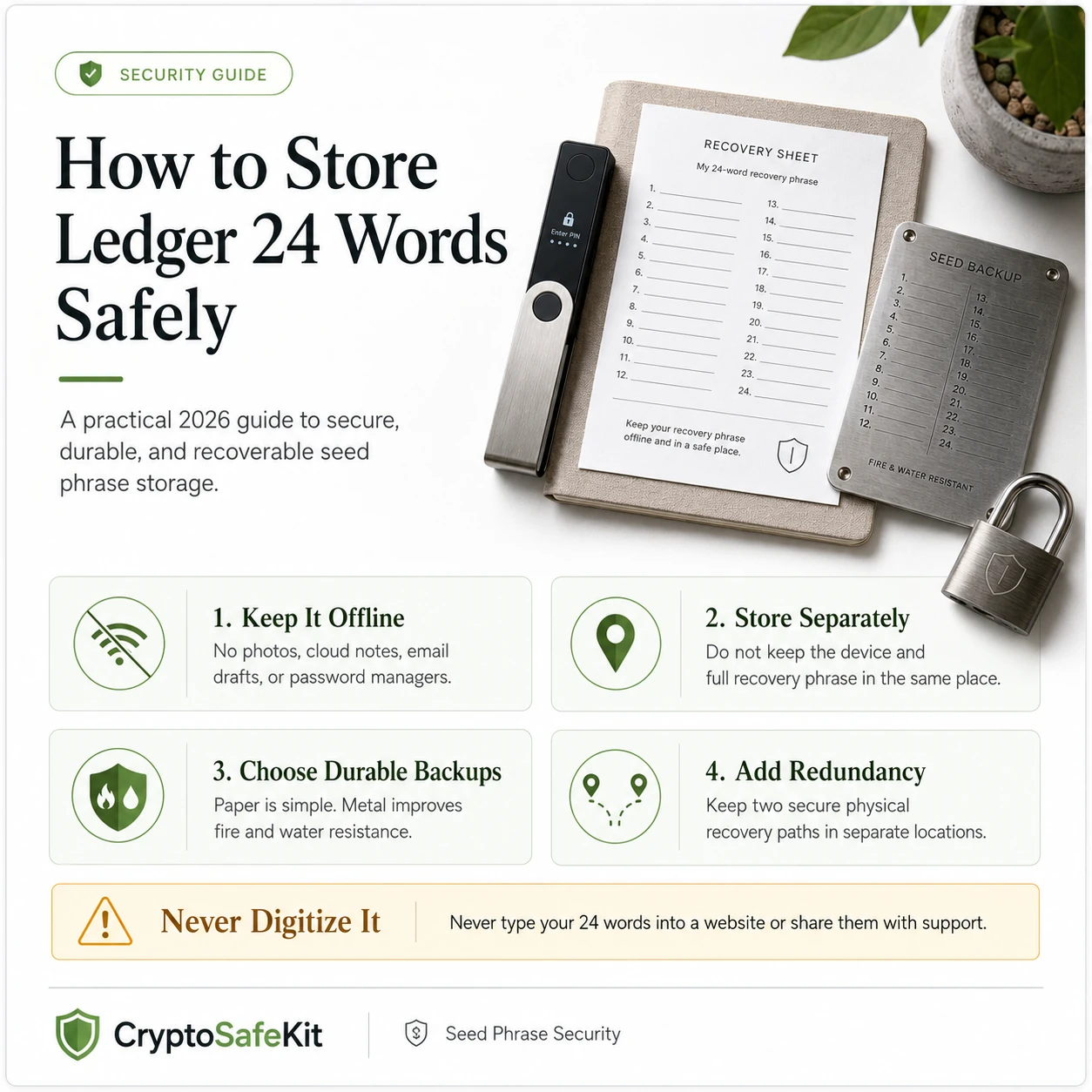
No photos, cloud notes, email drafts, password managers or ordinary computer files.
Your backup must survive both unauthorized access and physical destruction.
Do not automatically store the Ledger device and complete recovery phrase together.
What Do Your Ledger 24 Words Actually Protect?
Ledger devices generate a 24-word Secret Recovery Phrase during wallet initialization. The phrase represents the master backup from which the wallet’s private keys and blockchain accounts can be derived.
Your Bitcoin, Ethereum or other crypto assets do not physically live inside the Ledger device. They exist on their respective blockchains. The Ledger protects the private keys required to authorize transactions.
The recovery phrase exists so those keys can be recreated if your original device is lost, destroyed or reset.
Protects private keys and approves transactions.
Can recreate the wallet on a compatible device.
Records balances and transaction history.
The PIN protects the physical Ledger device. It does not protect a recovery phrase that has already been copied or stolen.
What Is the Best Way to Store Ledger 24 Words?
For most self-custody users, a sensible baseline is a fully offline physical backup stored in a secure location separate from the everyday Ledger device.
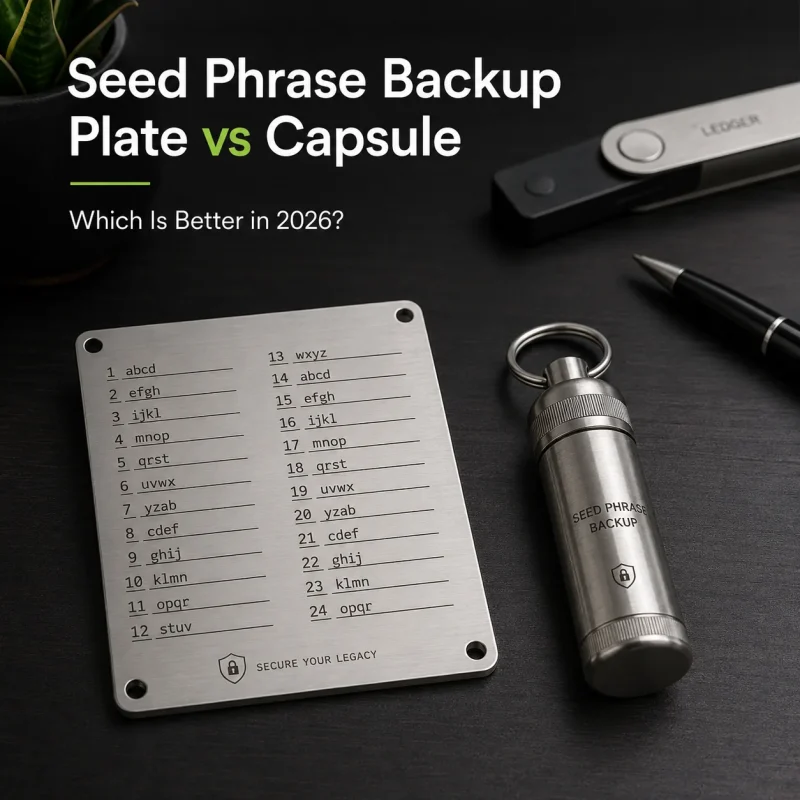
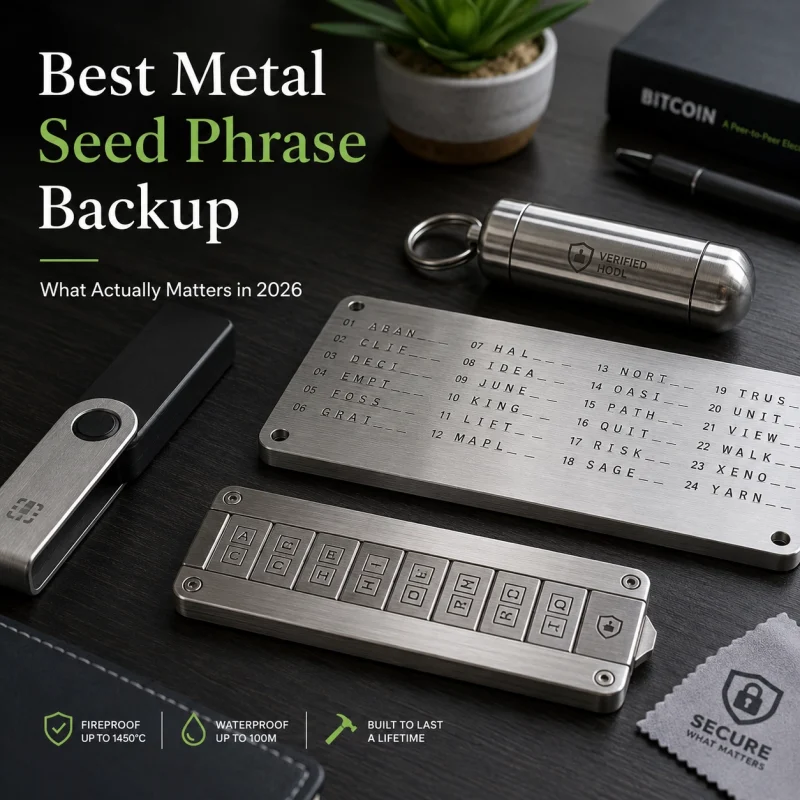
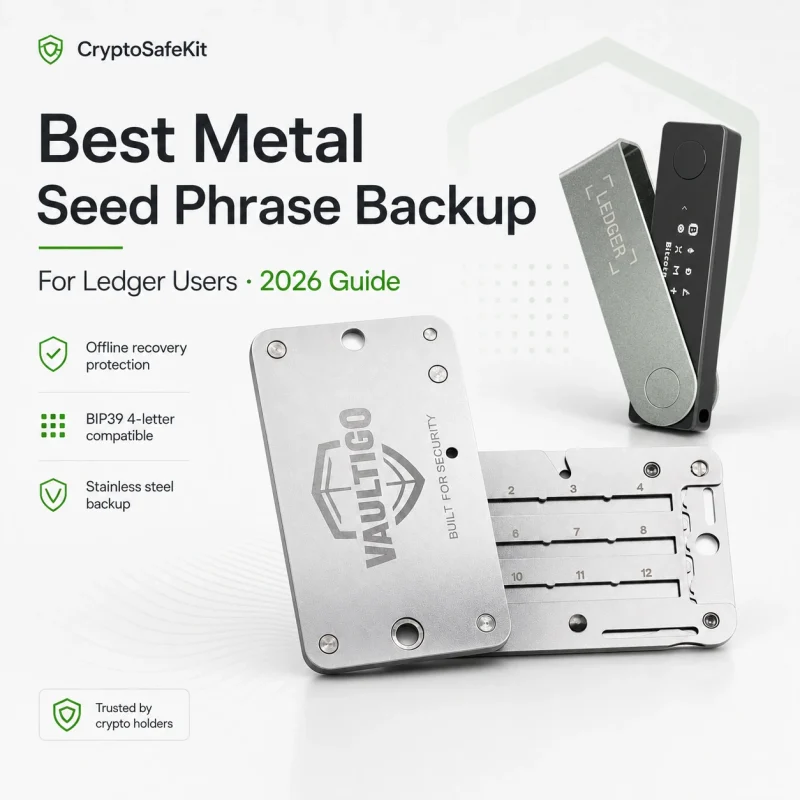
The physical medium can be the Ledger Recovery Sheet, another clearly written archival-quality paper backup, or a properly designed metal seed-storage product.
The right setup depends on your threat model. A person protecting a modest long-term portfolio in an apartment has different risks from someone managing substantial assets, a business treasury or wallets used by several family members. For a broader framework covering devices, backups, transaction signing, disaster resilience and inheritance, see our complete hardware-wallet cold-storage security guide.
A backup that nobody can steal but that you also cannot find after five years is not a good backup. Security requires both confidentiality and recoverability.
| Storage Method | Main Strength | Main Weakness | Best Use |
|---|---|---|---|
| Paper Recovery Sheet | Simple, offline, inexpensive | Fire, water, fading and physical damage | Basic secure backup |
| Metal Seed Backup | High physical durability | Still vulnerable to theft or discovery | Long-term cold storage |
| Second Hardware Wallet | Immediate signing backup | Another physical device to secure | Operational redundancy |
| Ledger Recovery Key | Offline PIN-protected recovery option | Requires compatible Ledger workflow | Additional recovery redundancy |
| Photo / Cloud / Computer File | Convenient | Creates remote attack exposure | Not recommended |
Paper vs Metal: Which Is Better for a Ledger Seed Phrase?
Paper is secure against online attacks
A correctly written paper recovery sheet has one major advantage: it has no network connection, operating system, cloud account or malware exposure.
For many users, paper stored inside a genuinely secure and environmentally protected location is workable. The larger concern is what happens over years rather than weeks.
If you are designing a backup intended to survive long periods without regular use, our long-term 24-word seed storage guide covers deterioration, relocation, disaster risk and future recovery in more detail.
Paper’s main weaknesses are physical:
- Fire
- Flooding and water damage
- Ink fading or smearing
- Tearing and deterioration
- Accidental disposal
- Someone photographing or stealing the sheet
Metal improves disaster resistance
A properly designed stainless-steel, titanium or similarly durable backup can provide substantially better resistance to heat, water, corrosion and long-term physical deterioration.
That does not make metal automatically “more secure” against every threat. A thief who finds a readable metal plate containing all 24 words can still possess the recovery information.
Material strength protects against disasters. Access control protects against people. A strong backup strategy requires both.
How Many Copies of Your 24 Words Should You Keep?
One backup minimizes the number of places an attacker can find your seed, but it creates a single point of failure.
Multiple full backups improve resilience against fire, loss and accidental destruction, but every additional copy creates another location that must remain private and secure.
For many users, two carefully controlled physical recovery paths in separate secure locations provide a reasonable balance.
Fewer places for an attacker to discover, but a larger single-point-of-failure risk.
Protects against loss of one location, but requires disciplined access control at both locations.
Accuracy matters just as much as the number of copies. A backup with one missing, damaged or unreadable word may become difficult to use when the original hardware is unavailable. If this has already happened, read what you can and cannot recover when part of a Ledger seed phrase is lost.
A single fire, burglary or access event can affect both at the same time.
Where Should You Physically Store a Ledger Recovery Phrase?
There is no universal location that is safest for every user. The right place depends on the threats you are trying to reduce.
A strong location should ideally provide:
- Restricted physical access
- Protection from casual discovery
- Fire and water resistance
- Long-term environmental stability
- A realistic way for you to access it during a recovery emergency
- Separation from other components that would allow immediate wallet access
Home safe
A properly installed quality safe can provide useful protection against casual theft, fire and household accidents. A small portable safe that can simply be carried away provides far less protection.
Second secure property or trusted location
A geographically separate location can reduce the risk that one fire, flood or burglary destroys every backup. Access should still be strictly controlled.
Safe-deposit or secure custody location
Some users use bank or professional secure-storage facilities for one recovery copy. This can improve physical protection but introduces different considerations: access rules, opening hours, jurisdiction, documentation and what happens if the owner becomes incapacitated.
Physical access is part of the wallet threat model, particularly when an attacker knows that someone owns crypto. Our guide to crypto wrench attacks and physical-theft risk explains why privacy, location exposure and backup separation matter alongside cryptographic security.
Ask: “What happens if my home burns down?” Then ask the opposite question: “What happens if someone gains access to my backup location?”
Should You Store Your Ledger and 24 Words Together?
Normally, no.
Keeping the Ledger and complete recovery phrase in the same bag, drawer or small safe concentrates two valuable pieces of your wallet security in one location.
Someone who steals only the Ledger still faces the device PIN and its hardware security controls. For more detail on that protection layer, see our Ledger PIN security guide.
Someone who steals the complete recovery phrase faces a different situation: they may be able to reconstruct the wallet without needing the original device at all.
The objective is to prevent a single burglary, lost bag or compromised storage location from exposing everything required to control the wallet.
Why You Should Not Store Ledger 24 Words Digitally
One of the most common seed-storage mistakes is converting an offline secret into a digital file for convenience.
Avoid storing the phrase in:
- Phone photos or screenshots
- Apple Notes, Google Keep or similar note apps
- Email drafts
- Google Drive, iCloud, Dropbox or OneDrive
- Ordinary text, Word or PDF files
- Chat histories
- Password managers
- Cloud photo backups
Even if the file is later deleted, copies may remain in synchronization services, backups, caches, trash folders or another device connected to the same account.
This is one reason the recovery phrase remains a frequent phishing target. Attackers do not necessarily need to compromise the hardware if they can persuade the owner to type the words into a fake security process. Our Ledger phishing defense guide shows how real customer information can be used to make fake Ledger messages appear more convincing.
If your recovery phrase has been stored on an internet-connected device and meaningful assets are still controlled by it, consider generating a completely new seed on trusted hardware and migrating the assets.
Should You Split the Ledger 24 Words Into Two or Three Pieces?
Simply cutting a standard 24-word BIP39 phrase into pieces is not automatically an advanced security system.
For example, storing words 1–12 in one location and 13–24 in another may prevent either location from containing the complete phrase, but it introduces a serious availability problem: losing either half may make normal recovery impossible.
It also creates operational complexity for heirs or for your future self.
Advanced backup systems should use protocols specifically designed for redundancy rather than improvised word splitting.
For most ordinary Ledger users, two well-secured full offline backups or a physical backup combined with another supported recovery method are easier to understand and less likely to fail through operational mistakes.
What Changes If You Use a Ledger Passphrase?
Ledger’s optional passphrase feature adds another secret to your recovery setup. The 24 words plus the exact passphrase derive a separate set of accounts from the base wallet.
That can reduce the consequences of someone obtaining only your 24 words, but it also increases your own recovery responsibility.
Your standard recovery phrase restores these accounts.
The exact passphrase is also required to reproduce these accounts.
If you use a passphrase, store it offline and accurately. Capitalization, spaces and symbols matter.
Before adding this extra recovery dependency, understand exactly how the two secrets interact. Our Ledger passphrase vs seed phrase guide explains the account structure, recovery consequences and common mistakes in detail.
An advanced security feature that you forget can become a self-inflicted loss mechanism.
What About Ledger Recovery Key or a Second Ledger?
Ledger Recovery Key
Ledger Recovery Key is a PIN-protected physical card designed to store protected wallet recovery information inside its Secure Element and communicate with compatible Ledger touchscreen devices through NFC.
It can complement a conventional paper or metal backup and provide another offline recovery route.
Second hardware wallet
A second Ledger restored from the same recovery phrase can also act as an operational backup. If the primary device fails, the second device can already sign for the same wallet.
This does not remove the need to think carefully about the master recovery phrase itself. A hardware backup protects device availability; a durable seed backup protects long-term wallet restoration.
A metal backup protects against physical destruction. A second signer protects against device failure. A separate secure location protects against a local disaster.
Do Not Forget Emergency and Inheritance Access
Extreme secrecy can create another problem: nobody authorized to inherit your assets knows that the wallet exists, where the recovery material is located or how it should be used.
A mature self-custody plan should consider what happens if you become incapacitated or die.
That does not mean writing all 24 words into your will. Estate documents can become visible to lawyers, courts or other parties depending on the jurisdiction.
Instead, consider separating instructions from secrets.
What exists, which wallet is involved and who should be contacted.
Without unnecessarily exposing the secret itself.
The 24 words should not be broadly copied into estate paperwork.
Complex estates or substantial holdings may justify professional legal advice and a more formal multisignature or institutional custody structure.
10 Ledger Seed Phrase Storage Mistakes to Avoid
Taking a phone photo “just for backup.”
Saving the words inside a password manager.
Keeping the recovery phrase in the same bag as the Ledger.
Making several copies and forgetting where they all are.
Using erasable or fading ink on a paper backup.
Never checking that every word was copied correctly.
Scanning a QR code from an unsolicited “Ledger security” letter.
Giving words to fake support during a wallet emergency.
Using a passphrase without a reliable recovery plan.
Creating a backup so complicated that nobody can recover it.
Ledger 24-Word Storage Checklist
- My recovery phrase was generated by my trusted hardware wallet.
- I recorded all 24 words in the correct order.
- I have never photographed or digitally uploaded the phrase.
- The backup is stored offline.
- The material can survive the physical risks relevant to my location.
- The complete recovery phrase is not casually stored next to my Ledger.
- I know exactly how many copies exist.
- Every copy has controlled physical access.
- My redundant copies are not all exposed to the same disaster.
- If I use a passphrase, I have a reliable offline recovery plan for it.
- I will never give my 24 words to Ledger Support or another person.
- I have considered what happens if I am unable to recover the wallet myself.
How Should You Store Ledger 24 Words?
The best seed phrase storage strategy is not the most complicated one. It is the one that remains secure, offline, physically durable and realistically recoverable years from now.
Offline + Secure
A clearly recorded physical backup protected from unauthorized access.
Durable + Redundant
Separate secure recovery paths designed to survive both theft and physical disaster.
For long-term holders, a durable offline backup in a well-controlled location, combined with carefully planned redundancy, is generally more robust than relying on a single sheet of paper.
What should never change is the digital-security rule: do not type your 24-word Secret Recovery Phrase into a website, ordinary computer application, cloud service or support conversation.
Your Ledger protects the keys you use today. Your recovery phrase protects your ability to recover them tomorrow.
Ledger 24-Word Storage FAQ
Where is the safest place to store Ledger 24 words?
Use a secure offline location with strong physical access control and protection from relevant environmental risks. The best location varies according to your home, jurisdiction and threat model.
Should I store my seed phrase in a safe?
A properly installed quality safe can be useful, especially when combined with a durable backup medium. Avoid assuming that every small portable consumer safe provides strong burglary protection.
Can I take a picture of my Ledger 24 words?
No. Keep the recovery phrase offline rather than storing photographs or screenshots on phones or computers.
Can I store my Ledger seed phrase in a password manager?
The safer default is to keep the Secret Recovery Phrase offline rather than placing it inside an internet-connected password manager or cloud account.
Is metal seed storage better than paper?
Metal generally provides stronger resistance to fire, water and long-term physical deterioration. It does not eliminate theft risk, so secure location and access control remain essential.
Should I make two copies of my seed phrase?
Multiple secure copies can reduce single-point-of-failure risk, but every additional full copy creates another exposure point. If you keep more than one, use genuinely separate controlled locations.
Should I keep my Ledger and recovery phrase together?
Usually no. Separation reduces the chance that one theft or local incident compromises both your signing device and master recovery backup.
Can Ledger Support ask for my 24 words?
No. A request for the complete Secret Recovery Phrase should be treated as a scam.
What if my recovery phrase was once stored on my computer?
If the complete phrase has been exposed to an internet-connected device, treat it as a security event. For meaningful holdings, generating a fresh hardware-wallet seed and migrating assets is the safer long-term approach.
Sources & Methodology
This guide is based primarily on Ledger’s current recovery-phrase, phishing, Recovery Key and wallet-security documentation together with standard self-custody threat-modeling principles. Product functionality and supported recovery workflows may change over time.
- Ledger Academy — What Is a Seed Phrase / Secret Recovery Phrase?
- Ledger Academy — Recovery Done the Right Way
- Ledger — Recovery Sheet guidance
- Ledger Academy — Ledger Passphrase
- Ledger Academy — Ledger Recovery Key
- Ledger — Ongoing Phishing Campaigns