

Hardware Wallet Cold Storage Security: A Complete Guide to Protecting Your Crypto Long-Term

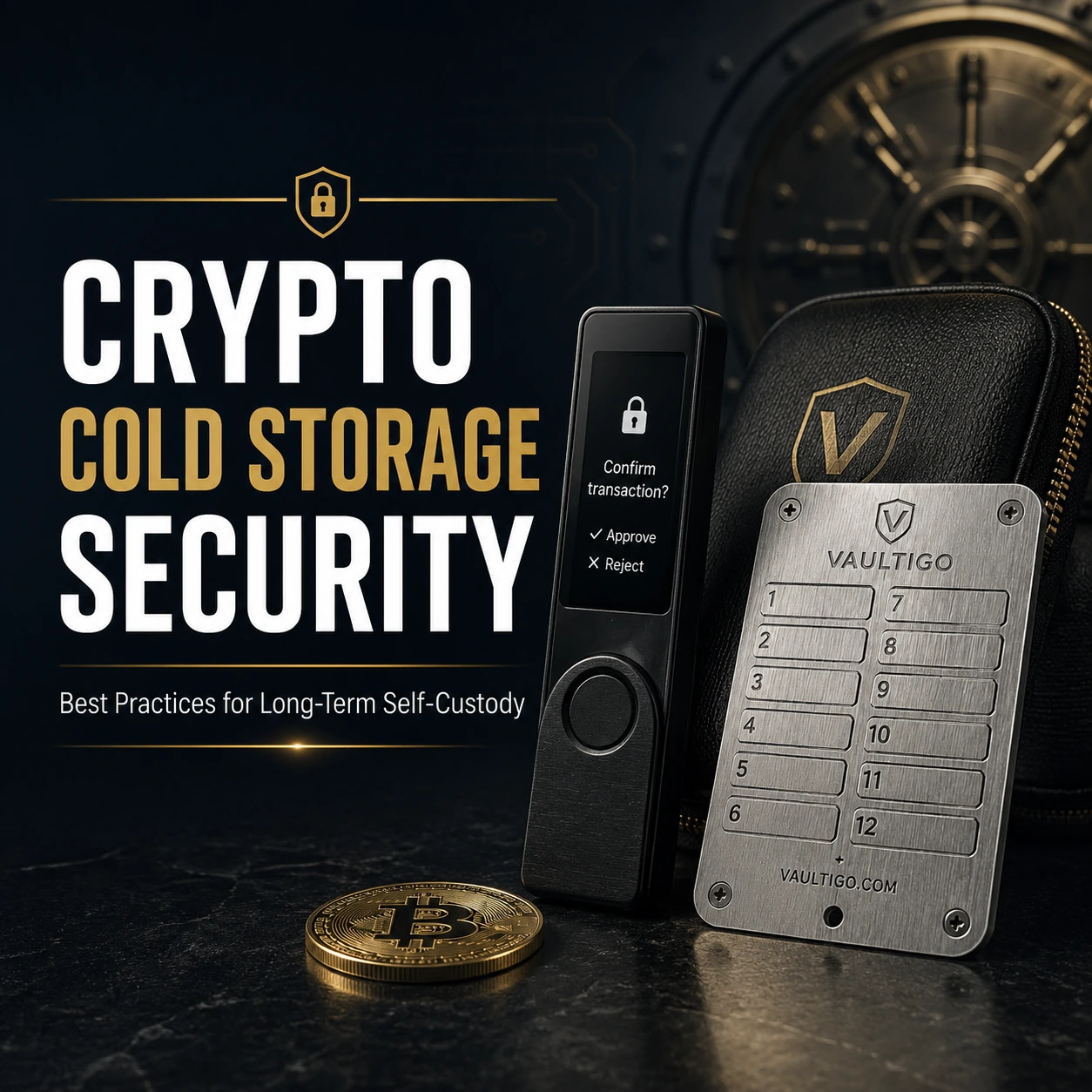
Moving cryptocurrency to a hardware wallet does not mean your security work is finished.
For anyone holding Bitcoin, Ethereum, stablecoins, or other digital assets over several years, the most serious risks do not always come from remote hackers. Signing the wrong transaction, exposing a recovery phrase, purchasing a tampered device, losing a paper backup in a fire, or forgetting a complicated recovery process can all result in permanent loss.
Effective crypto cold storage security best practices therefore require more than a single device. They require a complete security system covering:
Private key generation and wallet initialization;
Hardware wallet supply chain verification;
Transaction and signature verification;
Offline recovery phrase protection;
Fire, moisture, theft, and disaster resilience;
Geographically separated backup storage;
Recovery after device loss or failure;
Long-term maintenance and inheritance planning.
The objective is not to create a system that is theoretically impossible to attack. The objective is to prevent any single mistake, accident, theft, or equipment failure from causing a total loss of funds.
1. What Does Crypto Cold Storage Actually Mean?
Cold storage generally refers to keeping the private keys that control cryptocurrency away from directly connected online environments.
A hardware wallet stores private keys in an isolated environment and uses those keys to sign transactions. Your Bitcoin or tokens are not physically stored inside the device. They remain recorded on the relevant blockchain.
The hardware wallet protects the cryptographic keys that authorize transfers.
This distinction has several important consequences:
A damaged hardware wallet does not automatically mean your assets are lost;
A missing hardware wallet does not automatically mean your assets are lost;
A compatible backup can usually restore access on another supported device;
Anyone who obtains the complete recovery phrase may be able to restore the wallet without possessing the original hardware wallet.
The central objective of long-term cold storage is therefore not simply to protect a physical device. It is to protect five connected elements:
The private keys and recovery phrase;
The transaction-signing process;
The physical backup;
The recovery procedure;
The owner from phishing, manipulation, and operational mistakes.
A secure device with a weak backup process is not a secure cold storage system.
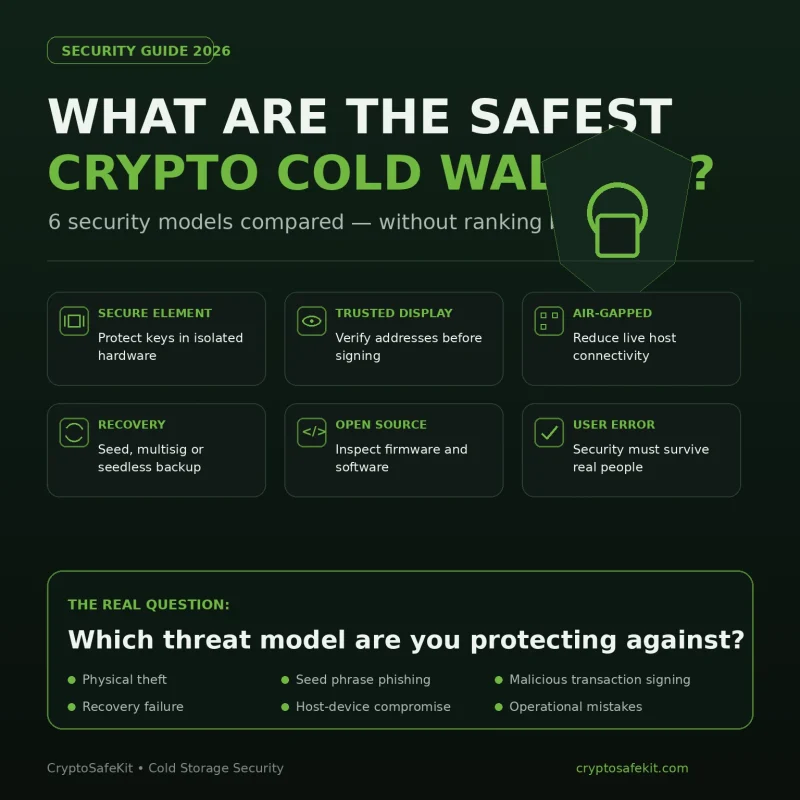
2. Start With a Personal Cold Storage Threat Model
There is no single storage architecture that is appropriate for every cryptocurrency holder.
Someone protecting a relatively modest balance does not necessarily need the same setup as an individual, family office, company, or investor managing a substantial long-term position.
Before selecting devices, backup locations, or advanced security features, define your threat model.
How long will the assets remain untouched?
If you plan to hold cryptocurrency for three, five, ten, or more years, you must account for risks that may not be relevant to short-term storage:
Paper degradation;
Fading ink;
Device battery failure;
Discontinued hardware;
Software compatibility changes;
Moving to another property or country;
Changing family circumstances;
Forgotten procedures;
Death or incapacity.
A system that works today must still be understandable and recoverable years from now.
How often will the wallet be used?
A wallet used regularly for DeFi, NFT transactions, token approvals, or experimental protocols should not normally be treated as a deep cold storage wallet.
A more resilient structure separates assets by purpose:
Long-term cold storage wallet: Holds the majority of long-term assets and rarely connects to applications;
Transaction wallet: Used for occasional transfers, purchases, or portfolio adjustments;
High-risk interaction wallet: Used for unfamiliar decentralized applications, NFT claims, testing, or speculative protocols.
This compartmentalization limits the damage if a high-risk wallet signs a malicious transaction or grants an unsafe token approval.
Which risks are most realistic for you?
Common threats include:
Clipboard malware replacing a copied wallet address;
Phishing websites asking for a recovery phrase;
Counterfeit or pre-initialized hardware wallets;
Malicious smart contract signatures;
Fire, flooding, humidity, or corrosion;
Theft of a hardware wallet and its backup from the same location;
Too many complete backup copies;
Only one backup copy, which later becomes unreadable;
Family members being unable to recover funds after the owner’s death or incapacity.
A good security plan prioritizes risks based on likelihood and potential impact. Adding complexity without a clear purpose can make the system less reliable rather than more secure.
3. Hardware Wallet Supply Chain Security
Cold storage security begins before the device is initialized.
A hardware wallet may be exposed to substitution, tampering, pre-configuration, or fraudulent packaging during manufacturing, distribution, resale, or delivery. These risks are generally described as supply chain attacks.
Buy from official or verifiable channels
Whenever possible, purchase hardware wallets through:
The manufacturer’s official website;
An official brand-operated online store;
A retailer listed by the manufacturer as an authorized reseller;
A reputable seller that can provide clear sourcing and purchase documentation.
Avoid second-hand hardware wallets from unknown sellers, especially when the price is significantly below the normal market rate.
A used device may appear functional while containing a preconfigured wallet, altered instructions, or manipulated recovery materials.
Do not rely only on packaging seals
Plastic wrapping, tamper stickers, and packaging condition can provide useful warning signs, but they should not be treated as definitive proof that a device is genuine or uncompromised.
When the wallet arrives, inspect:
Whether the packaging appears to have been opened or resealed;
Whether the device casing, screen, buttons, or connection ports look unusual;
Whether the recovery phrase cards are completely blank;
Whether any recovery words have already been written or printed;
Whether the device asks you to generate a new wallet during initialization;
Whether the manufacturer’s official software can authenticate the device.
Whenever a manufacturer provides a genuine-device check or authenticity verification process, complete it before transferring significant funds.
Never use a recovery phrase supplied inside the package
A legitimate hardware wallet should generate a new recovery phrase during initialization.
Stop immediately if the package contains:
A prewritten 12-, 20-, or 24-word recovery phrase;
Instructions telling you to restore a wallet using supplied words;
A “preconfigured wallet”;
A QR code claiming to activate or unlock your funds;
A website asking you to enter the recovery phrase for verification.
A recovery phrase supplied by another person must be assumed to be compromised.
Even if the wallet initially appears empty, someone who knows the phrase can monitor the associated addresses and transfer funds after you deposit cryptocurrency.
4. Initialize the Hardware Wallet Correctly
A genuine device can still become unsafe if it is initialized carelessly.
Use a trusted computer or mobile device
Download wallet management software only from the manufacturer’s official website or verified application store listing.
Do not install wallet software through:
Search engine advertisements;
Social media messages;
Unsolicited emails;
Messaging group links;
Pop-up windows;
Unverified download websites.
Before initialization:
Update the operating system;
Run basic malware and security checks;
Disable unnecessary remote access software;
Verify that the wallet application is official;
Avoid public, shared, or workplace computers;
Use a private environment where the device screen cannot be observed.
Let the hardware wallet generate the recovery phrase
Do not generate a long-term wallet recovery phrase using:
An online seed phrase generator;
A browser-based random word tool;
A standard mobile application;
Words shown in an image or screenshot;
A phrase supplied by another person;
An AI tool, chatbot, or online document;
A recovery phrase created on an internet-connected computer.
The recovery phrase for a long-term wallet should be generated by a trusted hardware wallet and recorded directly onto an offline physical medium.
Choose a strong, unpredictable PIN
Avoid obvious PINs such as:
0000;
1234;
A date of birth;
The last digits of a phone number;
A PIN already used for other devices or accounts.
The PIN helps protect the physical hardware wallet if someone obtains the device. It does not replace the recovery phrase.
An attacker who obtains the complete recovery phrase may be able to restore the wallet elsewhere without knowing the original device PIN.
5. The Most Important Digital Risk: Signing the Wrong Transaction
A common misunderstanding is that funds are completely protected as long as the private keys never leave the hardware wallet.
That is not correct.
A hardware wallet can help prevent direct private key extraction, but it cannot prevent the owner from approving a malicious or unintended transaction.
Examples include:
Sending funds to the wrong address;
Approving unlimited token spending;
Signing a malicious NFT transaction;
Connecting to an impersonated decentralized application;
Approving changes to a multisignature wallet;
Authorizing an unfamiliar smart contract;
Blind-signing transaction data that cannot be clearly understood.
Blind signing occurs when the user approves a transaction without being able to review all relevant details in a clear, human-readable format.
Verify every transaction on the hardware wallet screen
Do not rely exclusively on the computer or mobile display.
Before approving a transaction, check as much information as the device supports, including:
The complete or properly verified destination address;
The transfer amount;
The asset or token;
The selected blockchain network;
The transaction fee;
The contract interaction type;
The token approval amount;
Any warning about unknown data or blind signing.
A compromised computer can display one address while sending another address to the hardware wallet. The trusted device screen should therefore be treated as the final source of confirmation.
Send a small test transaction first
When transferring a significant amount to a new exchange account, custodian, wallet, or recipient:
Verify the destination address on the hardware wallet;
Send a small amount that you can afford to lose;
Confirm that the recipient received it on the correct network;
Reverify the address before sending the remaining balance.
A test transaction cannot eliminate every risk, but it can reduce losses caused by incorrect addresses, incompatible networks, or operational mistakes.
6. Building a Secure Offline Recovery Phrase Backup
The recovery phrase is both the most important and the most sensitive component of a long-term cold storage system.
It must satisfy two requirements that can appear to conflict:
It must remain inaccessible to unauthorized people;
It must remain available after equipment failure, natural disaster, relocation, or the passage of time.
Never create a digital copy of the recovery phrase
Do not:
Photograph it;
Take a screenshot;
Save it in a phone note;
Send it to yourself by email;
Upload it to cloud storage;
Save it in a messaging application;
Store it in a normal document;
Print or scan it;
Enter it into an online form;
Record it using a connected camera.
Even an encrypted digital file can increase the attack surface through cloud synchronization, malware, browser extensions, clipboard monitoring, screen recording, remote access tools, and account compromise.
The safest default is simple:
A recovery phrase generated offline should remain offline.
Do not rely on memory alone
Memory can be affected by time, stress, illness, injury, and unexpected life events.
Memorizing a recovery phrase may be used only as an additional measure. It should not replace a reliable physical backup.
Do not invent your own word-splitting or scrambling system
Some users attempt to “encrypt” a standard recovery phrase by:
Changing the word order;
Recording only some of the words;
Storing the first and second halves separately;
Replacing words with personal codes;
Omitting words that they plan to remember;
Adding decoy words.
These methods often increase the risk of recovery failure. They may also make the backup unusable for family members, executors, or the owner after several years.
Users who require distributed backup protection should consider properly designed threshold backup standards or multisignature arrangements instead of manually splitting or rearranging a standard BIP39 phrase.
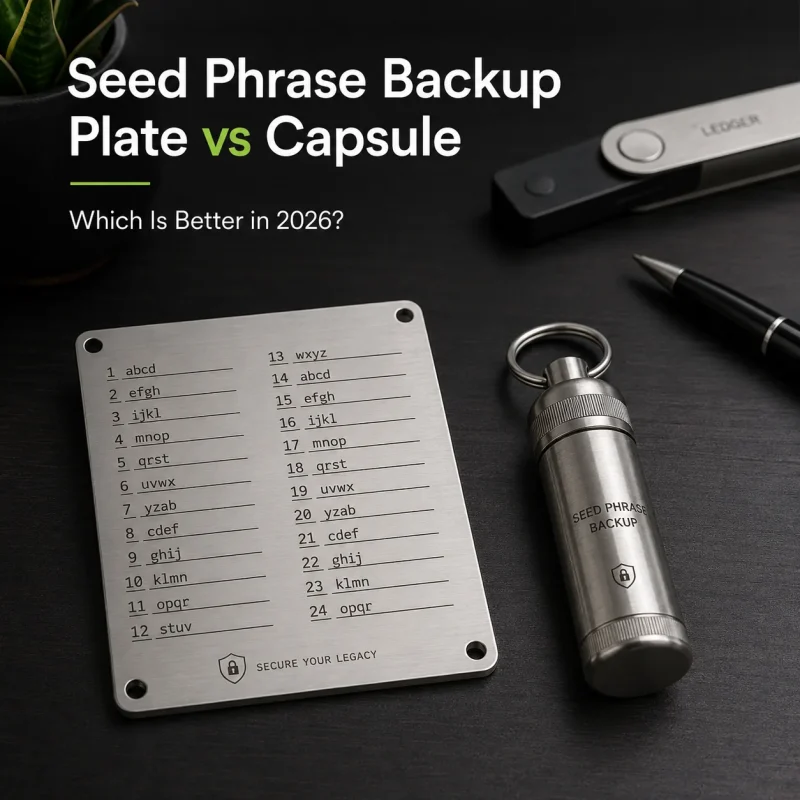
7. Why Metal Recovery Backups Are Better Suited to Long-Term Storage
Paper is convenient for initial recording and short-term verification, but it has clear limitations for backups intended to survive for many years.
Paper can be damaged by:
Humidity;
Mold;
Fading ink;
Tearing;
Insects;
Fire;
Floodwater;
Firefighting water;
Accidental disposal.
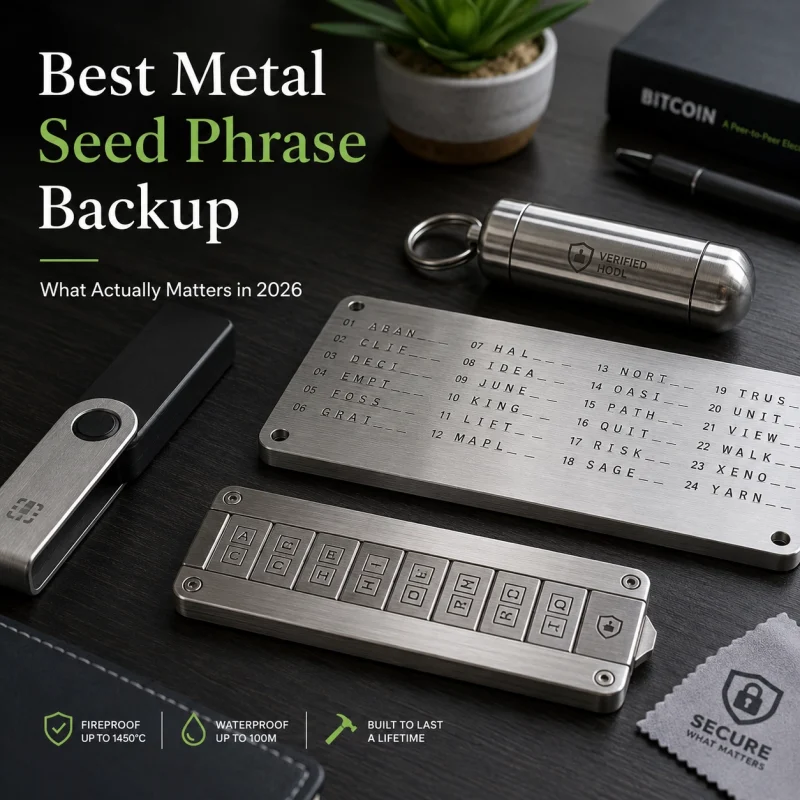
The purpose of a metal recovery plate is not to increase the cryptographic strength of the recovery phrase. Its purpose is to improve the physical durability of the backup.
What should you look for in a metal recovery plate?
Consider the following factors:
Metal type;
Plate thickness;
Overall construction;
Character-recording method;
Long-term legibility;
Reliance on loose or removable components;
Evidence of tampering;
Support for 12-, 20-, or 24-word backups;
Clear setup instructions;
Suitability for sealed or geographically separated storage.
Punching, stamping, or deeply engraving characters is generally better suited to long-term storage than writing with an ordinary marker because the information is physically embedded into the material.
However, no metal backup should be described as indestructible.
Real-world durability depends on:
Material composition;
Thickness;
Structural design;
Marking depth;
Exposure duration;
Fire temperature;
Corrosive conditions;
Mechanical force.
Metal improves resilience, but it does not eliminate the need for secure storage.
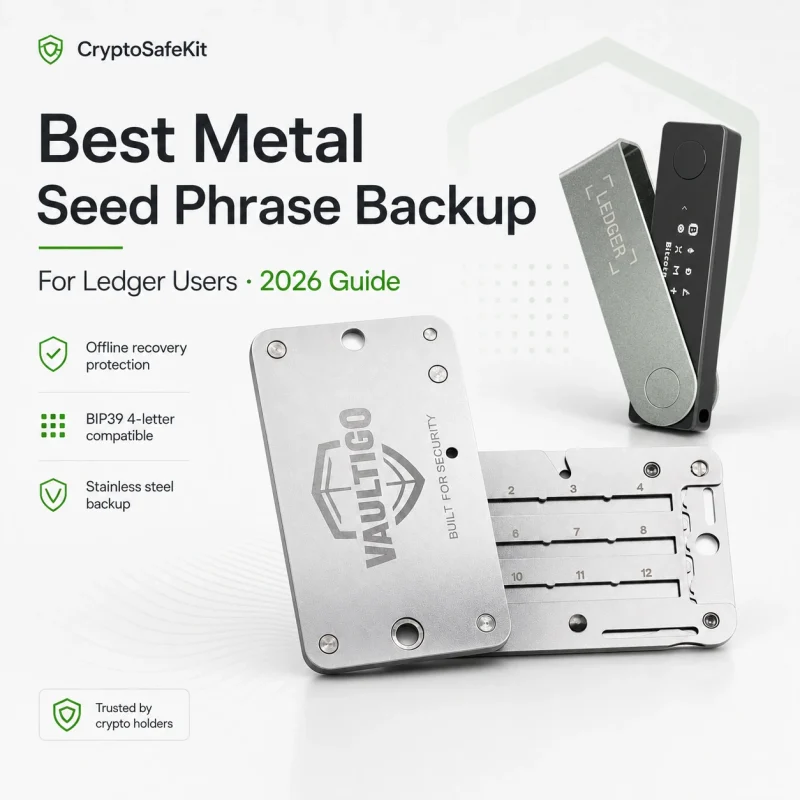
The role of a VAULTIGO metal seed phrase backup
A VAULTIGO metal seed phrase backup can replace or supplement a paper recovery card that may be vulnerable to moisture, fading, tearing, or environmental damage.
A sensible setup process is:
Generate the recovery phrase on the hardware wallet;
Verify the phrase in a private environment without cameras or surveillance;
Record each word or required character sequence on the metal plate;
Check the word order, position numbers, and characters carefully;
Complete an official recovery phrase verification;
Seal and store the metal backup in a secure location.
A metal recovery plate addresses physical durability. It does not replace good storage location selection, theft protection, privacy practices, or recovery testing.


VAULTIGO 4-Letter Metal Seed Phrase Backup System
Original price was: $99.00.$59.99Current price is: $59.99.VAULTIGO 4-Letter Metal Seed Phrase Backup is a reusable stainless steel backup system designed to store your recovery words offline. Built for standard English BIP39 seed phrases, each recovery word can be identified by its first four letters, helping you create a compact, organized, and durable backup without punching, engraving, or hammering.
- Stores the first 4 letters of each recovery word
- Designed for standard English BIP39 word lists
- No punching, engraving, or hammering required
- Reusable metal letter tiles
- Water and corrosion resistant stainless steel design
- Lockable structure for added physical protection
- Ideal for hardware wallets, cold wallets, and long-term crypto self-custody
8. Multiple Copies and Geographically Separated Storage
Too few backups create a single point of failure.
Too many complete backups increase the number of locations from which the wallet can be compromised.
A multi-location backup strategy must balance recoverability against exposure.
Option 1: One complete metal backup
This may be suitable when:
The total asset value is limited;
The home environment is stable;
A high-quality safe or secure storage facility is available;
Simplicity is a priority.
Avoid storing the hardware wallet and the complete recovery phrase in the same container.
If both are stolen together, the attacker may obtain the device and the information needed to restore the wallet elsewhere.
Option 2: Two complete backups in separate locations
Advantages include:
A fire, flood, or theft at one location does not destroy the only backup;
Recovery remains relatively straightforward;
No advanced backup standard is required.
Disadvantages include:
Every complete backup is another potential entry point;
The second location may introduce risks from staff, visitors, cameras, contractors, family members, or local regulations.
The locations should have genuinely independent risk profiles. Two drawers in the same building are not meaningful geographic separation.
Option 3: Threshold backup shares
More advanced users may consider a threshold backup standard such as SLIP39, provided it is supported by their chosen wallet and recovery environment.
A threshold system can create multiple shares and require a defined number of them for recovery.
For example, a three-share configuration with a two-share threshold allows recovery using any two shares. One stolen share may be insufficient for recovery, while the loss of one share may not destroy access.
Important considerations include:
SLIP39 is not the same as manually splitting a 24-word BIP39 phrase;
Wallet and device compatibility must be confirmed;
Recovery instructions must be documented clearly;
The threshold configuration must be tested;
All shares should not eventually return to the same location.
Option 4: Multisignature storage
Multisignature does not divide one recovery phrase into pieces. It uses multiple independent private keys to control the same wallet.
A 2-of-3 multisignature setup, for example, requires signatures from any two of three independent keys.
This can reduce the risk of one compromised key causing a total loss, but it also increases:
Setup complexity;
Recovery complexity;
Device management requirements;
Software compatibility risk;
Backup requirements;
Inheritance difficulty.
Multisignature is generally better suited to high-value holdings, business funds, family offices, or experienced users who understand signer backups, wallet descriptors, and recovery procedures.
9. Should the Hardware Wallet and Recovery Phrase Be Stored Together?
In most cases, no.
A more resilient structure is:
Store the hardware wallet at location A;
Store the complete recovery phrase at location B;
Do not store the PIN with the device;
Do not store an additional passphrase with the standard recovery phrase.
This reduces the likelihood that one burglary or disaster will expose every recovery component.
However, excessive separation can create its own problems. A setup involving too many locations, undocumented rules, or complicated personal codes may become impossible to recover years later.
A well-designed system should achieve the following balance:
An attacker should have difficulty obtaining enough information to take control, while the legitimate owner should still be able to recover the wallet during an emergency.
10. Are Faraday Bags Useful for Crypto Cold Storage?
A Faraday bag uses conductive shielding material to reduce the transmission of certain wireless signals.
It may provide an additional isolation layer for devices with:
Bluetooth;
NFC;
Cellular connectivity;
Other wireless communication capabilities.
A Faraday bag may be useful when storing or transporting a hardware wallet, particularly when the user wants to reduce unintended wireless communication.
However, it is not the foundation of cold storage security.
A Faraday bag does not prevent:
Recovery phrase exposure;
Malicious transaction signing;
Phishing;
Physical theft;
PIN observation;
Supply chain tampering;
Fire damage to a backup;
The user approving an unsafe smart contract.
Shielding performance also depends on:
The materials used;
The frequencies being blocked;
The closure design;
Damage or wear;
Whether the device is completely enclosed;
The quality of the product.
A Faraday bag is best treated as:
An additional protection layer during travel;
A way to reduce unintended wireless connectivity;
A privacy and physical packaging accessory.
It does not replace device authentication, secure signing habits, or a durable offline recovery backup.
11. Physical Theft and Personal Security
For holders of substantial cryptocurrency positions, the most serious threat may not be a remote technical exploit. It may be real-world exposure, coercion, stalking, burglary, or targeted fraud.
Minimize public disclosure
Avoid publicly revealing:
Your exact cryptocurrency holdings;
The number and type of wallets you own;
Where recovery backups are stored;
Details about a home safe;
Links between your identity and high-value wallet addresses;
Information about carrying hardware wallets while traveling.
Even without exposing private keys, publicly displaying significant wealth may increase the risk of social engineering, physical surveillance, home invasion, or coercion.
Do not treat a home safe as a complete solution
A safe can delay unauthorized access and protect against opportunistic theft. However, it may become a target if it is visible, portable, or widely known.
When evaluating a safe, consider:
Whether it is anchored to the building structure;
Its realistic fire resistance;
Who knows where it is;
Who has the key, PIN, or combination;
Whether contractors, tenants, staff, or visitors may see it;
Whether the hardware wallet and recovery phrase are stored together.
A safe is one layer in a system, not the entire system.
Carry only what is necessary when traveling
Avoid carrying every component required to control your long-term holdings.
A safer travel approach is to:
Carry only a limited-use or spending wallet;
Leave the long-term cold wallet unused;
Never travel with the complete recovery phrase unless absolutely necessary;
Avoid wallet recovery in airports, hotels, co-working spaces, or public areas;
Consider tamper-evident packaging or a Faraday bag as an additional layer;
Avoid discussing the purpose of the device in public.
Local laws, border procedures, customs practices, and privacy expectations vary between countries. Travelers should consider the legal and operational environment of each destination.
12. Should You Use an Additional Passphrase?
Some hardware wallets support an additional passphrase on top of the standard recovery phrase. This feature is sometimes informally called a “25th word,” although the passphrase does not need to be a single word.
The passphrase creates a separate wallet with different addresses.
If an attacker obtains the standard recovery phrase but does not know the correct passphrase, the attacker may be unable to access the passphrase-protected wallet.
However, this feature also introduces a serious risk of permanent loss:
Different capitalization creates a different wallet;
Additional spaces create a different wallet;
Different punctuation creates a different wallet;
A forgotten passphrase usually cannot be recovered;
Family members may find the recovery phrase but not know that a passphrase exists;
Poor documentation may make the setup impossible to inherit.
A passphrase should be treated as an advanced security feature.
Use one only if you can maintain a recovery process that is:
Clear;
Testable;
Secure;
Durable;
Understandable to an authorized successor.
Do not rely on memory alone for a passphrase controlling significant long-term assets.
13. Verify the Backup Before You Need It
A recovery phrase that has never been verified should not be considered a dependable backup.
Common backup errors include:
Incorrect word order;
Misspelled words;
Unreadable handwriting;
Misaligned punch marks;
Confusing the backup of one wallet with another;
Forgetting an additional passphrase;
Restoring a wallet that generates different addresses from the expected wallet.
Use the manufacturer’s official backup check
If the hardware wallet supports an official recovery phrase or backup verification feature, use that process instead of typing the phrase into a computer or phone.
A secure verification procedure should keep the sensitive words on the hardware device rather than exposing them to the connected computer.
Do not test a long-term recovery phrase in a software wallet
Entering a deep cold storage recovery phrase into a browser extension, desktop wallet, or mobile wallet destroys the original isolation model.
If a full recovery test is necessary:
Use a trusted spare hardware wallet;
Work in a private environment;
Ensure that no cameras or screen recording systems are active;
Enter the recovery phrase only on the hardware device;
Confirm that the restored wallet produces the expected addresses;
Reset or secure the spare device according to your documented plan.
Recovery testing should increase confidence without unnecessarily increasing exposure.
14. Conduct an Annual Cold Storage Security Audit
Long-term crypto storage is not a one-time setup.
Review the system every six to twelve months without repeatedly exposing the full recovery phrase.
Device review
Check whether:
The device still powers on;
The battery is degraded or swollen;
The charging or connection port is damaged;
The manufacturer still supports the model;
Firmware updates are available through official channels;
The manufacturer has published relevant security notices.
A hardware wallet does not necessarily need to be constantly updated if it remains unused, but the owner should understand the consequences of outdated firmware before the next transaction.
Backup review
Confirm that:
The storage location remains secure;
There is no moisture, corrosion, heat, or physical damage;
Characters on the metal plate remain legible;
Tamper-evident seals show no signs of interference;
You can identify which wallet the backup belongs to without exposing the phrase;
Recovery instructions remain accurate.
Address and asset review
Use a watch-only wallet or reputable blockchain explorer to:
Confirm expected balances;
Identify unknown outgoing transactions;
Review token approvals where relevant;
Confirm that the long-term wallet has not been used for unintended high-risk interactions.
Never enter the recovery phrase simply to check the balance.
Recovery and inheritance review
Assess whether:
The emergency contact or executor remains appropriate;
Legal documents require updating;
Authorized family members know that recovery instructions exist;
Multisignature participants remain available;
Off-site storage locations remain accessible;
Passphrase or threshold backup instructions remain understandable.
The purpose of an annual audit is to confirm that the system still works, not to expose sensitive information more often.
15. What to Do After Device Loss or Recovery Phrase Exposure
Scenario 1: The hardware wallet is lost, but the recovery phrase remains secure
Take the following steps:
Evaluate the strength of the device PIN;
Obtain a new hardware wallet from a trusted source;
Restore the wallet using the existing recovery phrase;
If the lost device might be unlocked, generate an entirely new wallet;
Transfer the funds to new addresses;
Update the physical backup and recovery documentation.
If there is any realistic possibility that an attacker can access the device, migration to a new recovery phrase is safer than relying entirely on the PIN.
Scenario 2: The recovery phrase may have been photographed, copied, or observed
Do not wait for suspicious transactions.
A recovery phrase cannot be changed like an account password.
Take action immediately:
Generate a new recovery phrase on a trusted hardware wallet;
Verify the new receiving addresses;
Transfer the assets to the new wallet;
Revoke relevant token approvals connected to the old wallet;
Stop using the compromised phrase;
Investigate how the exposure occurred;
Rebuild the backup system.
Scenario 3: The metal backup is missing, but the hardware wallet still works
If you cannot prove that the backup was destroyed rather than stolen, treat it as compromised.
Generate a new wallet and transfer the funds instead of waiting for unauthorized activity to appear on-chain.
16. Long-Term Crypto Cold Storage Checklist
Use the following checklist after completing your setup.
Device and supply chain security
The device was purchased from an official or verifiable authorized source;
The packaging and device showed no obvious signs of tampering;
Device authenticity was checked using the official application;
The recovery phrase was generated during initialization;
No prewritten recovery phrase was supplied in the package;
A strong, unique PIN was selected.
Digital security
The recovery phrase has never been entered into a phone or computer;
No photograph, screenshot, scan, or cloud copy exists;
Every transaction is verified on the hardware wallet screen;
Large transfers begin with a small test transaction;
The long-term wallet does not connect to unfamiliar applications;
Long-term assets are separated from daily-use and high-risk wallets.
Physical backup security
The paper recovery card has been replaced or supplemented with a metal backup;
Every recorded word or character position has been checked;
The backup has been verified using an official device-based process;
The hardware wallet and complete recovery phrase are stored separately;
The storage location addresses fire, moisture, theft, and access risks;
There are no unnecessary, unmanaged copies of the complete recovery phrase.
Recovery readiness
You understand the recovery procedure if the device fails;
An additional passphrase is not stored only in memory;
Threshold backups or multisignature arrangements are documented;
An authorized successor knows how to locate the recovery instructions;
The cold storage system is reviewed at least once per year.
Frequently Asked Questions
Can cryptocurrency be lost if a hardware wallet is not used for several years?
Normally, no.
Cryptocurrency is recorded on the blockchain, not stored inside the hardware wallet’s battery or memory in the same way that files are stored on a computer.
If the device stops working, access can generally be restored using a compatible wallet and the correct recovery backup.
Long-term users should still monitor device support, recovery compatibility, and documentation.
Is a metal seed phrase backup safer than paper?
A metal backup is usually more physically durable than paper.
It can reduce the risk of damage from moisture, tearing, fading, and certain fire-related incidents. However, it does not prevent another person from reading or copying the recovery information.
A metal recovery plate must still be stored securely and separated appropriately from the hardware wallet, PIN, and additional passphrase.
Can a recovery phrase be stored in a bank safe deposit box?
A bank safe deposit box may be used as part of an off-site storage strategy.
However, consider:
Access restrictions;
Local laws;
Bank closure or insolvency procedures;
Inheritance requirements;
Identification requirements;
Government or court access;
Emergency availability;
Annual fees.
Do not place the only recovery backup in a location that may become inaccessible for an extended period.
Legal treatment of safe deposit boxes varies considerably between jurisdictions.
How many recovery phrase backups should be kept?
There is no universal number.
One backup is simple but creates a single point of failure. Two complete backups improve disaster resilience but increase the number of locations from which the wallet could be compromised.
Threshold backup systems and multisignature arrangements can reduce certain single-point risks, but they also increase technical and operational complexity.
The correct structure depends on asset value, technical experience, trusted locations, family circumstances, and the personal threat model.
Can a Faraday bag prevent a hardware wallet from being hacked?
A Faraday bag cannot guarantee that a hardware wallet will remain secure.
It may reduce certain wireless signals, but it cannot stop phishing, recovery phrase theft, malicious signatures, incorrect transfers, physical theft, or supply chain tampering.
It should be treated as an optional additional layer rather than the foundation of a cold storage plan.
Should a metal recovery plate be stored with the hardware wallet?
Usually not.
Separating the device from the complete recovery phrase reduces the risk that one burglary, fire, or other incident will compromise both the signing device and the recovery backup.
Conclusion: Long-Term Cold Storage Is a System, Not a Single Product
A hardware wallet is only one component of a reliable cold storage strategy.
A robust long-term self-custody system combines:
A hardware wallet obtained from a trusted source;
A secure initialization process;
Strict transaction verification habits;
A recovery phrase that never enters a connected device;
A durable physical backup;
Carefully selected off-site or geographically separated storage;
A verified recovery process;
A practical maintenance and inheritance plan.
A VAULTIGO metal seed phrase backup can help replace a fragile paper recovery card with a physical backup designed for more durable long-term storage. It should not, however, be treated as a standalone guarantee of security.
The strongest cold storage architecture prevents an attacker from gaining complete control through one compromised element while allowing the legitimate owner to recover after equipment failure, relocation, disaster, or years of inactivity.
Self-custody gives you direct control over your cryptocurrency. It also means there is no bank, exchange, or customer support department that can reset your private keys.
Before increasing the amount stored in a cold wallet, make sure the recovery system can withstand at least one failed device, one physical disaster, and one human mistake.
Disclaimer: This article is provided for general security education only. It does not constitute investment, legal, tax, or personalized cybersecurity advice. Advanced arrangements—including passphrases, SLIP39 threshold backups, multisignature wallets, and geographically distributed storage—should be used only after the recovery process is fully understood and tested.