

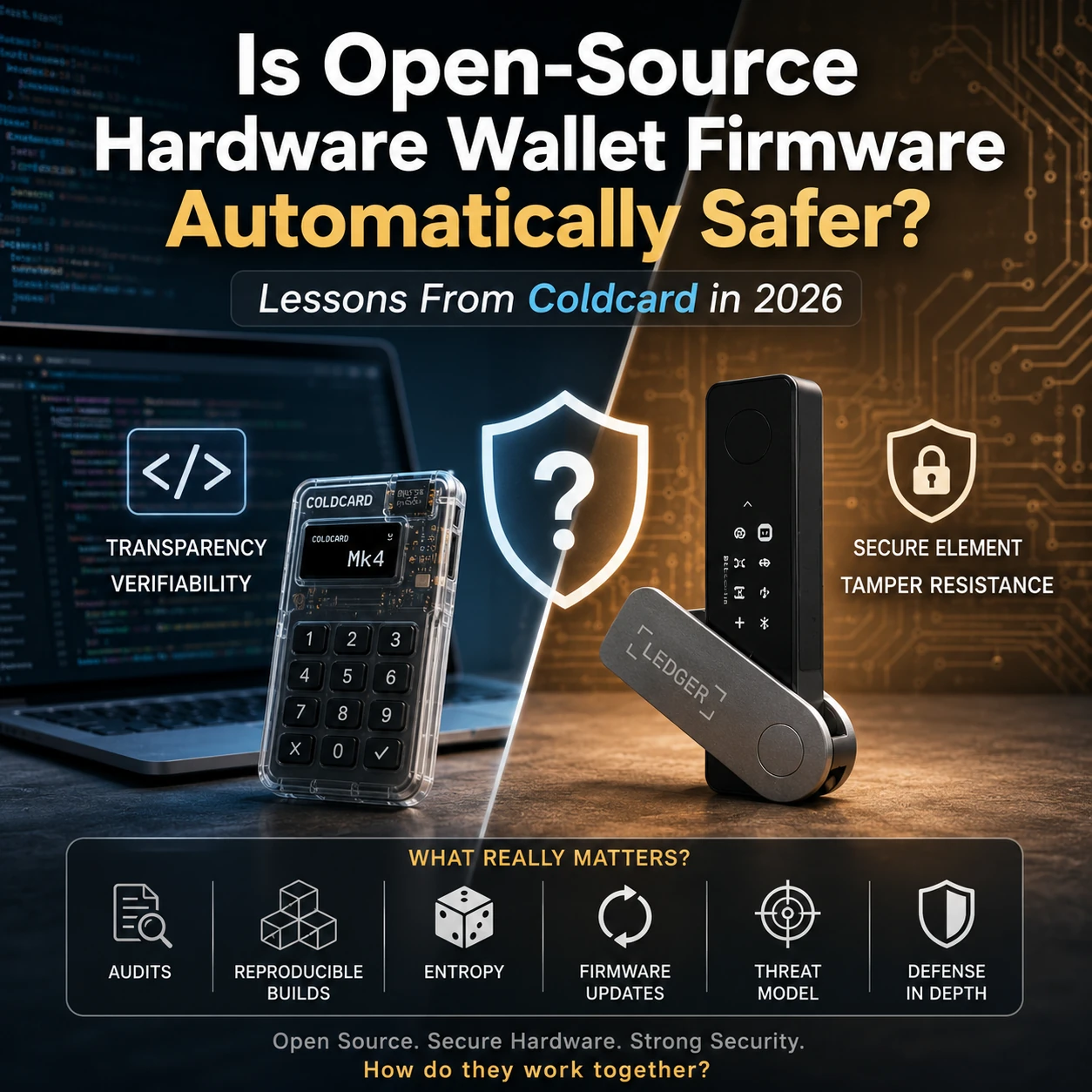
Is Open-Source Hardware Wallet Firmware Automatically Safer? Lessons From Coldcard in 2026

Hardware Wallet Security · August 2026
Open-source firmware can make a hardware wallet easier to inspect, reproduce, and challenge. It does not automatically make the wallet safer.
The 2026 COLDCARD entropy incident turned an old hardware-wallet debate into a much more useful question: not “open or closed?” but which failures can this design detect, resist, and recover from—and what evidence supports those claims?
Why the Open-Source Hardware Wallet Debate Matters in 2026
Hardware-wallet discussions often collapse into a binary argument. One side says open source is essential because users should be able to inspect what protects their keys. The other says physical security, secure chips, certification, and controlled release processes matter more than publishing every line of code.
Both positions contain something important. Neither is sufficient by itself.
The debate became more intense after Coinkite disclosed a seed-generation defect affecting multiple COLDCARD firmware lines in July 2026. Shortly afterward, Ledger CTO Charles Guillemet published an argument that source availability should not be confused with a complete security property. Coinkite, meanwhile, responded by publishing remediation details, fixed releases, independent checks, and a growing public security record. [1][2]
The useful lesson is not that “open source failed,” nor that “closed source won.” The useful lesson is that security properties are specific.
A better question
Instead of asking whether a wallet is “open source,” ask what you can verify, what you still have to trust, what attacks the hardware is designed to resist, how releases are reviewed, and what happens when one layer fails.
What the COLDCARD Incident Actually Teaches
The 2026 COLDCARD issue is unusually instructive because the failure did not come from a dramatic cryptographic breakthrough. It came from integration.
Coinkite’s technical backgrounder says COLDCARD was intended to use a hardware true random number generator for seed generation. During a 2021 software migration, however, a build-and-link integration problem caused the wallet’s random-number call to resolve to MicroPython’s general-purpose Yasmarang PRNG instead of the intended hardware RNG path. The hardware RNG had not “failed and fallen back”; the wrong implementation was linked into the seed-generation path. [1]
Later COLDCARD models mixed additional entropy from secure elements into the software PRNG state, which Coinkite says materially improved the situation but still did not restore the intended security target. The manufacturer released fixed firmware across supported release tracks and told users that updating firmware fixes future seed generation, not seeds already created under affected firmware. [1][3]
This is the distinction that matters for the open-source discussion. The firmware being publicly inspectable did not automatically prevent the bug. But public code, release tags, reproducible-build work, and later independent review also made it possible to examine the remediation in a way that would be harder in a fully opaque system. Coinkite now explicitly warns that publication does not equal a complete audit and that reproducibility does not prove the absence of vulnerabilities. [2]
Open Source Improves Transparency—But Transparency Is Not the Same as Review
Open firmware can reduce some trust assumptions.
Depending on the project, users and researchers may be able to:
- Inspect implementation details instead of relying only on vendor descriptions.
- Review changes between firmware releases.
- Search for insecure cryptographic usage or dangerous fallback behavior.
- Build the firmware independently.
- Compare independent findings publicly.
- Fork or preserve software if a vendor disappears.
Those are meaningful advantages.
But source availability creates an opportunity for review. It does not create a guarantee that expert review actually happened. A large codebase can sit in public view for years while a subtle defect survives because the dangerous behavior exists at a boundary between modules, build configuration, hardware abstraction, or compiler/linker behavior.
“Many eyes” only helps when the right eyes are looking at the right property.
That is why a serious evaluation should ask not only “is the source public?” but also:
- Who reviews release-critical code?
- Are security reports public?
- Is there a funded bug bounty or disclosure process?
- Are build and dependency boundaries covered?
- Are release binaries connected back to reviewed source?
Reproducible Builds Are Powerful—And Narrow
Reproducible builds solve one of the most important verification gaps in open-source firmware:
Does the binary distributed by the vendor correspond to the source code that reviewers can inspect?
Both COLDCARD and Trezor publish workflows intended to let technically capable users rebuild firmware and compare the result with official releases. Trezor documents a deterministic build process and explains how to account for vendor headers and firmware signatures during comparison. COLDCARD documents reproducible builds for its firmware repository and release files. [2][4]
That is valuable evidence.
But a reproducible build proves source-to-binary identity. It does not prove that the source is safe.
Reproducible builds can help prove
- The release binary corresponds to a particular source tree.
- The build process is not silently injecting unexplained code.
- Independent parties can reproduce a known release.
They do not prove
- The source has no vulnerability.
- The entropy path is correct.
- The hardware behaves exactly like its public design.
- The supply chain has not substituted hardware.
- The user will verify transactions correctly.
Coinkite now states this limitation explicitly in its security documentation. That is the right way to think about reproducibility: a strong verification property, not a universal safety certificate. [2]
What Secure Elements Solve—and What They Do Not
A Secure Element is a hardened chip designed to protect secrets against physical and side-channel attacks more effectively than a conventional microcontroller.
Secure Elements can make attacks such as invasive extraction, fault injection, probing, and some side-channel techniques substantially harder. But they do not automatically protect against every firmware bug, bad seed-generation path, malicious transaction approval, phishing attack, or recovery-phrase exposure.
Ledger places heavy emphasis on Secure Elements and keeps some low-level OS code tied to proprietary chip interfaces closed because of vendor intellectual-property restrictions. Ledger says most of its wallet application, crypto libraries, device apps, and SDK components are open, while the remaining low-level Secure Element boundary is reviewed internally and by external laboratories under NDA. [5][6]
Trezor demonstrates that open firmware and Secure Elements are not mutually exclusive. Current Safe-family devices combine open-source firmware with Secure Element protection. Trezor Safe 7 goes further with the TROPIC01 secure element, whose architecture is intended to be more openly inspectable. In 2026, Ledger Donjon disclosed a laser fault-injection weakness in that chip. Trezor and Tropic Square published responses and argued that layered protections prevented the issue from becoming direct access to users’ funds or wallet backups. [7]
This is a useful counterexample to simplistic thinking. Transparency can expose a flaw. Secure hardware can still contain a flaw. Defense in depth determines whether one flaw becomes total compromise.
Audits Matter Because Public Code Does Not Review Itself
Security audits are imperfect, but they create something public source alone does not: assigned responsibility, defined scope, expert time, and an explicit attempt to break assumptions.
Ledger says its Donjon security team reviews every Ledger OS release and that a third-party laboratory is given access to the complete OS source—including closed components—before releases. Ledger also publishes third-party assessment reports and cryptographic signatures that allow users to verify the reports themselves. [6]
COLDCARD’s post-incident record includes targeted independent checks of the fixed RNG path, source review, hotfix mechanics, and at least one reproducible-build verification for a fixed release. Coinkite is careful to state that these checks validate specific scopes rather than proving that every fixed binary has undergone a complete independent audit. [2]
That qualification is important.
“Audited” is not a binary label. Ask:
- Who performed the audit?
- What exact firmware or hardware version was reviewed?
- Was the build system included?
- Were dependencies and submodules included?
- Were side-channel and physical attacks in scope?
- Was entropy generation tested end to end?
- Were findings remediated and retested?
A narrow code review and a full hardware penetration test are both “audits,” but they answer very different questions.
Entropy Is the Unfashionable Security Property That Can Decide Everything
Hardware-wallet marketing tends to focus on screens, chips, air gaps, open source, and connectivity. Entropy gets much less attention.
That is a mistake.
A seed phrase is secure only if the underlying random value is unpredictable enough. BIP39 converts entropy into human-readable mnemonic words; it does not rescue weak entropy after the fact. CryptoSafeKit’s BIP39 explainer covers the relationship between entropy and recovery phrases in more detail.
The COLDCARD incident showed why entropy must be checked as a complete pipeline:
- What physical or software source produces randomness?
- How is it conditioned or mixed?
- Which implementation is actually linked into the release?
- What function does the seed-generation path really call?
- Are health checks or continuous tests present?
- Can the build fail closed if the expected RNG path disappears?
Inspecting a high-quality TRNG implementation is not enough if the wallet never reaches it.
This is one reason “open source versus Secure Element” is too shallow a framework. A design can have public source and still make an integration mistake. A design can have a certified secure chip and still feed it weak or incorrectly generated seed material. The security property lives in the system, not the label.
Firmware Updates Are Security Controls—But They Cannot Rewrite History
Secure update mechanisms matter because hardware wallets are long-lived devices. New vulnerabilities are discovered, protocol behavior changes, and implementation bugs need to be fixed without forcing every user to replace the hardware.
A good firmware-update design should answer several questions:
- Are firmware releases cryptographically signed?
- Can the device reject unauthorized firmware?
- Can users verify the downloaded release?
- Can the community reproduce or inspect the release?
- Are rollback or downgrade risks controlled?
- Does the update preserve the security boundary around existing secrets?
But software updates have limits.
Coinkite’s current guidance is a perfect example: fixed COLDCARD firmware corrects future seed generation, but an already-generated weak seed does not become stronger because the device was updated. Unless a documented exception applies, affected users must generate a fresh seed on fixed firmware and migrate funds. [1][3]
That is a broader lesson for every wallet owner. Firmware can repair future behavior; it cannot always repair historical secrets.
Use a Threat Model, Not a Slogan
Hardware-wallet security becomes much clearer when you separate threat classes.
| Threat | Controls that matter most | Controls that are not enough alone |
|---|---|---|
| Remote malware | Key isolation, trusted display, transaction verification | Open source by itself |
| Physical extraction | Secure Element, tamper resistance, PIN policy, physical design | Reproducible build by itself |
| Malicious firmware | Signed updates, attestation, source review, independent audits | Secure Element certification by itself |
| Weak seed generation | Entropy design, end-to-end RNG testing, build checks, independent review | Air gap or screen size |
| Supply-chain substitution | Device authenticity checks, secure boot, attestation, purchase discipline | Public firmware alone |
| Phishing / seed theft | Offline backup discipline, user education, recovery isolation | Secure Element or open source |
| Bad transaction approval | Clear on-device display, human verification, transaction decoding | Strong RNG |
This is also why the “most secure hardware wallet” question rarely has a universal answer. The strongest choice for a Bitcoin-only user who wants verifiable air-gapped workflows may differ from the strongest choice for a multi-chain user who prioritizes physical attack resistance, large-screen transaction review, or broad application compatibility.
CryptoSafeKit’s Ledger vs Trezor vs Tangem comparison applies this same threat-model approach to mainstream multi-chain wallets.
Ledger, Trezor, and COLDCARD: Three Different Security Philosophies
These products should not be reduced to “closed,” “open,” or “air-gapped.” Their security architectures combine controls differently.
COLDCARD
Bitcoin-only, publicly inspectable/verifiable firmware, reproducible-build support, air-gapped signing options, and dual Secure Elements on current models. Its 2026 entropy incident is a strong reminder that publicly visible source can still contain integration failures—and that public remediation can also improve scrutiny after discovery. [2]
Ledger
Secure-Element-centric architecture with large portions of the ecosystem open source, while some low-level OS components remain closed because of Secure Element vendor interfaces. Ledger emphasizes internal Donjon review, external audits, device attestation, and physical attack resistance. [5][6]
None of these approaches removes trust entirely.
A user may trust a chip vendor, a bootloader, a compiler toolchain, a manufacturing process, an audit firm, a firmware-signing key, a published source tree, or some combination of them. The goal of good security architecture is not to pretend trust disappears. It is to make trust assumptions explicit, minimize unnecessary ones, and ensure that one failed assumption does not automatically expose the wallet.
Seven Questions to Ask Before Calling Any Hardware Wallet “Safer”
What can I independently verify?
Source code, release hashes, signatures, firmware builds, device attestation, transaction details, or only vendor claims?
How is entropy generated and tested?
Look beyond “hardware RNG.” Ask whether the entire seed-generation path and build configuration are reviewed end to end.
What does the Secure Element actually protect?
Is it storing the seed, enforcing PIN limits, authenticating firmware, contributing entropy, or performing several of these functions?
How are firmware releases verified?
Signed firmware, secure boot, reproducible builds, published hashes, and independent release review each solve different problems.
Who is paid to attack the design?
Look for named audit firms, internal red teams, coordinated disclosure, bug bounties, and public remediation records.
What happens when one layer fails?
A good design should degrade safely. A chip flaw, firmware bug, compromised host, or stolen device should not automatically become full key loss.
Does the wallet match my threat model?
Bitcoin-only cold storage, active DeFi, travel, multisig, inheritance, and high-value physical security create very different priorities.
If you are still building the broader storage plan around the device, see CryptoSafeKit’s hardware wallet cold-storage security guide. Device architecture matters, but long-term self-custody also depends on recovery backups, transaction verification, physical access, and operational discipline.
Final Verdict: Open Source Is Evidence, Not a Guarantee
Open-source hardware-wallet firmware is valuable because it can make implementation choices visible, support reproducible builds, lower some trust assumptions, and invite independent scrutiny.
It is not automatically safer.
A wallet with public source can still contain an undiscovered integration bug. A wallet with closed components can still receive serious independent review and strong physical protection. A Secure Element can reduce physical-extraction risk while leaving phishing untouched. A reproducible build can prove that a binary matches its source while proving nothing about whether that source contains a dangerous flaw.
The 2026 COLDCARD incident should therefore push the industry away from labels and toward evidence.
Ask what is open. Ask what is closed. Ask what is reproducible. Ask what is audited. Ask how randomness reaches the seed. Ask how firmware is authenticated. Ask what happens if the chip, host computer, build system, or user makes a mistake.
The strongest security model is not the one with the best slogan. It is the one whose assumptions are visible, whose critical paths are tested, whose failures are contained, and whose trade-offs fit the person actually using it.
Primary Sources and Further Reading
- Coinkite: Technical Deep Dive into the Entropy Issue
- COLDCARD: Security and Verification
- COLDCARD: Current Security Status
- Trezor Firmware: Reproducible Builds
- Ledger: Approach to Open-Source Software
- Ledger: Third-Party Security Assessment Reports
- Trezor: Response to the TROPIC01 Chip Disclosure
- Ledger: Open Source Is Not A Security Property