





How to Create a Secure Ledger Seed Phrase Succession Plan

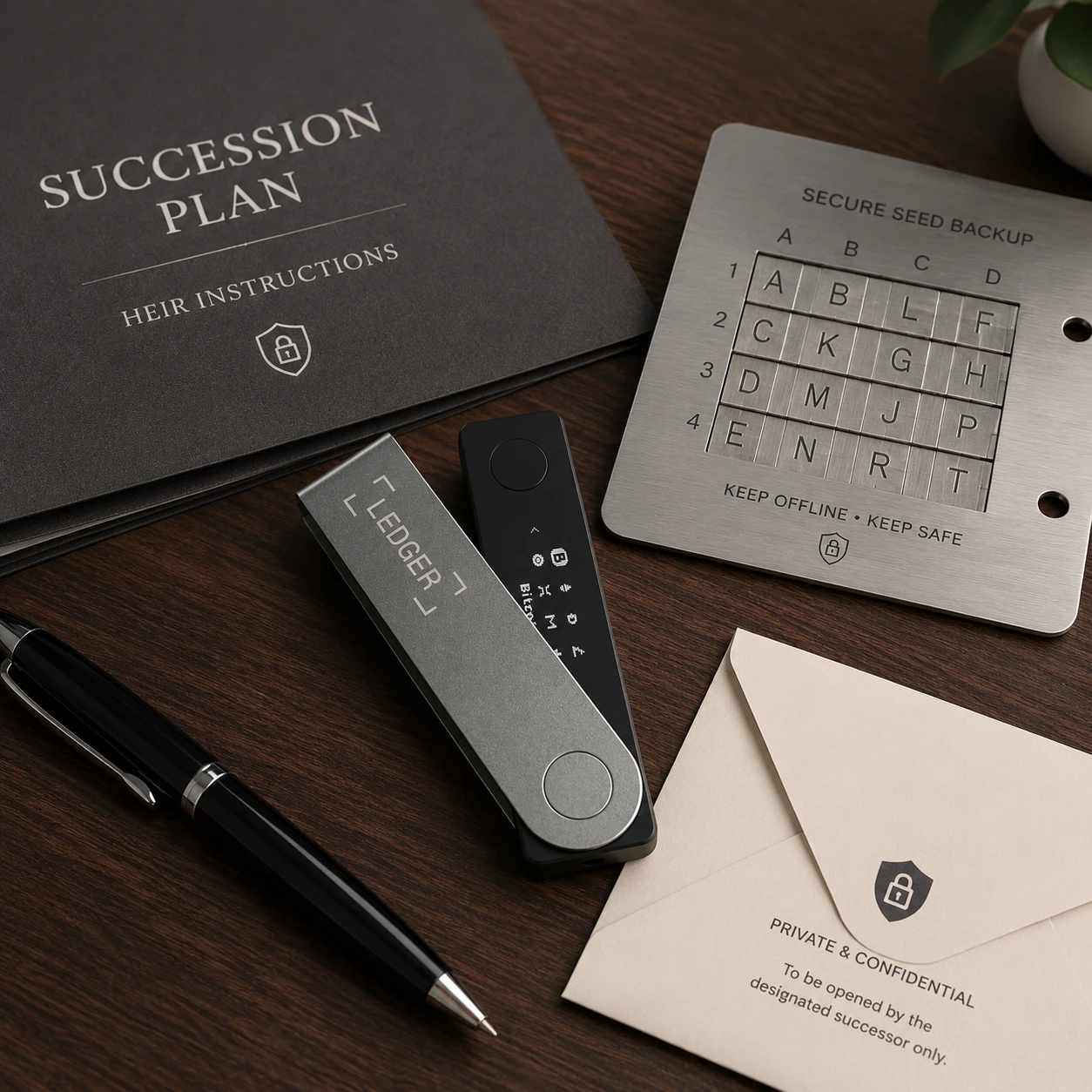
Create a secure Ledger seed phrase succession plan that lets trusted heirs recover your wallet without exposing the recovery phrase, passphrase, or device PIN too early.
A Ledger can protect your private keys for years. It cannot tell your family where those keys are, explain your passphrase, or build a recovery process for them after you are gone.
A secure succession plan must solve two opposing problems: the intended successor must eventually be able to recover the wallet, while no single document or storage location should expose everything needed to take control today.
The strongest Ledger succession plan separates discovery, recovery, and authorization.
- Discovery: heirs can learn that the wallet exists without receiving the seed.
- Recovery: the verified recovery phrase remains offline and physically protected.
- Authorization: any passphrase or additional recovery component is managed separately.
Self-custody changes inheritance in a fundamental way. A conventional self-custody wallet has no administrator who can simply reset ownership after the owner becomes unavailable. Recovery depends on valid recovery material and enough information to reconstruct the intended wallet safely.
CryptoSafeKit’s broader guide to crypto inheritance and hardware-wallet recovery planning covers the wider inheritance problem. This article narrows the focus to a practical Ledger succession system: how to make the wallet recoverable without turning the succession document itself into a master key.
The Core Rule: Separate Instructions From Secrets
The biggest design mistake is creating one convenient document containing the hardware-wallet model, PIN, 24-word Secret Recovery Phrase, optional passphrase, exact storage locations, account list, and recovery instructions.
That may be convenient for a legitimate heir. It is equally convenient for a burglar, malicious insider, or anyone who obtains a copy.
Never place a complete seed phrase, private key, device PIN, passphrase, and recovery instructions in the same digital or physical record. The succession system should reveal the recovery path without making one discovered document sufficient to recover the wallet.
A practical Ledger succession plan separates four components:
- Non-secret succession map: explains that the wallet exists and where the authorized recovery process begins.
- Recovery phrase: remains completely offline and protected as a high-value secret.
- Optional passphrase: receives its own recovery strategy when used.
- Operational instructions: explain how an heir can restore and verify the wallet without relying on strangers.
For the technical background, see How Ledger Hardware Wallets Work.
Why Leaving the Ledger Device Is Not Enough
A plan that says “my family knows where the Ledger is” is not a complete recovery plan. The device can be lost, damaged, reset, stolen, become unsupported, or simply be unusable when recovery is needed.
Useful for normal signing and convenient access, but replaceable.
Controls local device access. It is not a wallet backup.
Can recreate the underlying wallet on compatible hardware.
The stronger question is not “Who gets my Ledger?” It is “Can the intended successor recover the correct wallet if the original Ledger no longer works?”
Step 1: Build a Non-Secret Crypto Succession Map
Start with a discovery document that contains no recovery phrase, private key, PIN, or passphrase. Its purpose is to prevent the opposite failure: an heir never learns that the self-custody wallet exists.
A useful succession map can record:
- That self-custodied digital assets exist.
- The hardware-wallet ecosystem involved.
- Whether one or more Ledger devices are relevant.
- The major blockchain networks or account categories that should eventually be located.
- Whether an additional BIP39 passphrase exists.
- Where the authorized recovery instructions can be obtained.
- Which trusted person or professional is expected to coordinate recovery.
For example: “This Ledger wallet uses an additional passphrase. The 24-word recovery phrase alone opens a different wallet. Follow the separate passphrase instructions before concluding that the expected accounts are missing.”
Step 2: Verify the Recovery Phrase Before You Build Around It
A succession plan built around an incorrectly recorded seed creates false confidence. Ledger provides a Recovery Check application that verifies a Secret Recovery Phrase directly on the device.
Before relying on a long-term backup, confirm that:
- Every word is correct.
- The order is correct.
- The backup belongs to the intended wallet.
- The physical record remains readable.
- The succession map points to the correct recovery system.
Never use a website, browser extension, cloud tool, support form, or unknown application to check whether a recovery phrase is valid. Use the manufacturer’s documented hardware-based verification or recovery process.
If you need the underlying recovery standard explained first, read Understanding BIP39 and Your Mnemonic Phrase.
Step 3: Choose a Recovery Medium That Can Survive the Time Horizon
Succession planning is usually measured in years or decades. Paper is simple and offline, but long-term storage introduces physical risks such as fading, moisture, tearing, accidental disposal, and general deterioration.
Metal backup does not make the recovery phrase cryptographically stronger. It changes the durability of the physical record.
CryptoSafeKit’s Seed Phrase Storage Best Practices compares paper, metal, multiple backups, threshold schemes, and multisig in greater depth.
A reusable stainless-steel recovery backup designed for standard English BIP39 seed phrases. It records the first four identifying letters of each recovery word with reusable metal letter tiles, avoiding permanent punching, engraving, or hammering.
The product is a physical backup medium, not a hardware wallet. It does not generate private keys or connect to blockchain networks, and it should still be protected from theft, photography, and unauthorized access.
View VAULTIGO 4-Letter BackupStep 4: Keep the Ledger and Recovery Phrase in Different Security Zones
Avoid creating a single “crypto box” containing the Ledger, PIN, seed phrase, passphrase, and instructions.
The objective is not to make recovery difficult. It is to ensure that compromise of one location does not automatically expose the complete wallet. See CryptoSafeKit’s Cold Storage Security Guide for a wider long-term storage framework.
Step 5: Treat a Ledger Passphrase as a Separate Succession Problem
A BIP39 passphrase creates a different wallet from the same recovery phrase. That makes passphrase-protected accounts particularly easy for heirs to misunderstand.
Correct recovery phrase + missing or incorrect passphrase = a different wallet. The standard wallet may restore successfully and still appear empty.
Ledger’s Recovery Check verifies the Secret Recovery Phrase, but it does not verify an optional passphrase. The passphrase therefore needs a separate, exact recovery strategy.
Read CryptoSafeKit’s Hardware Wallet Passphrase Guide before adding this complexity to an inheritance plan.
Step 6: Do Not Make the PIN the Master Recovery Method
The Ledger PIN protects local access to the physical device. It is not a substitute for the recovery phrase. A successor should not be told to keep guessing PINs if they are unsure, because repeated incorrect attempts can reset the device.
The succession plan should remain viable if the original Ledger is destroyed or reset. Recovery architecture, not the physical device alone, should be the durable foundation.
Step 7: Write a Successor Runbook
Do not force a family member to learn hardware-wallet security during an emergency. Give them a concise sequence that explains what to do and what not to do.
Step 8: Train the Successor Without Revealing the Real Seed
Create a separate practice wallet containing little or no value. Let the successor learn how to identify a legitimate recovery workflow, restore a training phrase, add an account, verify an address, and understand the difference between a PIN and a recovery phrase.
The production seed remains sealed and private while operational knowledge is practiced independently.
Step 9: Review the Plan When the Wallet Changes
Review the plan after replacing the Ledger, creating a new recovery phrase, adding or changing a passphrase, moving a physical backup, changing the intended successor, adding multisig, or changing the physical backup medium.
You do not need to expose the seed during every review. Confirm that the documented recovery path still points to the correct materials and that authorized people can still follow it.
Should You Use Ledger Recovery Key in a Succession Plan?
Ledger Recovery Key is a PIN-protected NFC card that can back up a Secret Recovery Phrase and restore access on compatible Ledger secure touchscreen devices. Ledger currently documents compatibility with Ledger Stax, Ledger Flex, and Ledger Nano Gen5.
This can provide another hardware-assisted recovery path, but it also adds another physical object, another PIN, and another procedure that a successor must understand.
A Practical Three-Layer Ledger Succession Model
When a Single Seed Phrase May No Longer Be Enough
For high-consequence holdings, multisignature can reduce dependence on a single signing key. The trade-off is recovery complexity: heirs may need several signing keys, recovery backups, wallet policy or descriptor information, compatible coordinator software, and enough functional signers to satisfy the threshold.
CryptoSafeKit’s Ledger and Trezor Multisig Hardware Wallet Guide explains these additional requirements.
Multisig is not automatically superior for every household. A well-documented single-signature setup may be safer than a multisig arrangement nobody can reconstruct.
Common Ledger Succession Mistakes
- Leaving only the Ledger device and PIN.
- Storing the device, PIN, seed phrase, passphrase, and instructions together.
- Protecting the seed perfectly but telling nobody the wallet exists.
- Putting the complete recovery phrase in cloud storage or a routinely copied digital document.
- Relying entirely on memory for a passphrase.
- Failing to tell the successor that passphrase-protected accounts exist.
- Assuming Recovery Check can verify a passphrase.
- Giving the production seed to an heir for practice.
- Using homemade seed-splitting systems that nobody has tested.
- Adding multisig without preserving the required wallet configuration.
- Never reviewing the plan after changing wallets or storage locations.
Ledger Seed Phrase Succession Security Checklist
- ✓ The Secret Recovery Phrase has been verified through an appropriate hardware-based process.
- ✓ The production seed has never been photographed or stored in ordinary cloud storage.
- ✓ The physical backup remains readable and correctly labeled without exposing the words.
- ✓ The Ledger device and complete recovery backup are stored separately.
- ✓ The successor can discover that a self-custody wallet exists.
- ✓ The discovery document contains no recovery phrase, private key, PIN, or passphrase.
- ✓ Any passphrase has a separate, exact recovery strategy.
- ✓ The plan remains viable if the original Ledger device is destroyed or reset.
- ✓ The successor knows never to provide recovery words to customer support or a website.
- ✓ A practice recovery has been demonstrated using a non-production wallet.
- ✓ Backup locations remain accessible to the intended recovery process.
- ✓ The plan is reviewed after material wallet or family changes.
Frequently Asked Questions
Can my family recover my crypto without the original Ledger?
Is the Ledger PIN enough for inheritance?
Should I give my 24-word recovery phrase to my heirs now?
What happens if my Ledger wallet uses a passphrase?
Can Ledger Recovery Check verify my passphrase?
Is a metal seed backup better for succession?
Should high-value holders use multisig for inheritance?
Final Thoughts
The strongest Ledger succession plan is not the one with the most secrets or the most elaborate technology. It is the one that keeps the wallet recoverable for the right person without making one document or storage location sufficient for the wrong person.
Keep discovery information separate from the Secret Recovery Phrase. Give any passphrase its own reliable recovery method. Make the plan work without the original Ledger device. Verify the seed before trusting it, and train the successor with a practice wallet rather than real recovery material.
A hardware wallet protects signing today. A succession plan protects the possibility that the right person can still recover the wallet tomorrow.