

Crypto Inheritance & Hardware Wallet Recovery Planning: A Secure Heir Strategy


Self-custodied crypto does not automatically move to another person when its owner dies.
The blockchain continues recording the same addresses and balances. The hardware wallet does not contact a family member, and the manufacturer cannot simply reset ownership after receiving a death certificate.
Access still depends on the private keys.
For a conventional single-signature hardware wallet, a successor will generally need either a working device and its PIN, or the wallet’s recovery backup so the accounts can be restored on compatible hardware. A wallet backup may provide complete access to the associated wallet, which is why it must remain both recoverable and confidential.
This creates a difficult inheritance problem.
A plan must reveal enough information for a trusted person to recover the assets, but not so much that one document, one relative, one burglary, or one compromised storage location can take control immediately.
Effective crypto inheritance hardware wallet planning is therefore not about handing someone a list of recovery words.
It is about creating a controlled recovery path.
Critical security rule: Do not place the complete recovery phrase, passphrase, device PIN, asset inventory, and step-by-step access instructions in one document. One stolen or photographed file could expose the entire wallet.
What Happens If a Hardware Wallet Owner Dies?
The physical hardware wallet is only one part of the system.
Crypto assets remain on their blockchains. The device protects the keys used to authorize transactions, while the wallet backup can generally recreate those keys on compatible hardware. Ledger and Trezor both describe the recovery phrase or wallet backup as the information required to restore wallet access if the original device is unavailable.
After the owner’s death, one of four situations usually exists.
The device and PIN are available
A trusted successor may be able to unlock the device and transfer assets.
This can provide short-term access, but it is not a complete long-term recovery plan. The device may fail, its battery may degrade, or the wallet application may later require recovery.
The recovery phrase is available
A compatible hardware wallet can usually restore the relevant accounts.
The successor must still know:
Which wallet standard is involved
Whether a passphrase exists
Which blockchain accounts to add
Which wallet interface is required
How to verify the expected addresses
A passphrase-protected wallet exists
The seed phrase alone may restore only the standard wallet.
Without the exact passphrase, the intended wallet may remain inaccessible. An incorrect passphrase can derive another valid but empty wallet rather than producing a clear error.
Neither the device nor valid recovery information is available
The assets may remain permanently inaccessible.
No manufacturer or blockchain administrator can recreate unknown private keys for a non-custodial wallet.
The Most Common Crypto Inheritance Failures
Inheritance plans often fail because the owner protected secrecy while ignoring recoverability.
Common failure scenarios include:
Family members do not know that the wallet exists.
The only paper backup is destroyed, faded, wet, or discarded.
A metal backup exists, but nobody knows what wallet it belongs to.
The device is found, but its PIN and recovery process are unknown.
The seed phrase is available, but an undocumented passphrase protects the real wallet.
The heir has recovery words but does not know which networks or accounts to restore.
A multisig key survives, but the wallet descriptor or signer arrangement is missing.
All secrets are stored together and stolen in one incident.
The heir is frightened by the process and sends the phrase to a fake support agent.
The plan was never tested and contains a transcription error.
The strongest encryption does not solve an undocumented recovery process.
Build the Plan in Four Separate Layers
A practical inheritance system separates discovery, recovery, instructions, and authority.
Layer 1: Discovery Information
The trusted successor needs to know that digital assets exist.
A discovery document can include:
Hardware-wallet brand or general device type
Approximate account purpose
Blockchains likely to be involved
Location of recovery instructions
Name of a technically capable trusted contact
Date the plan was last reviewed
It should not include the complete seed phrase.
It also does not need to list every balance. Public balances change, and a detailed asset inventory can create an unnecessary security target.
Layer 2: Recovery Secrets
Recovery secrets may include:
Standard recovery phrase
Multi-share backup shares
Passphrase
Multisig signer backups
Hardware recovery card
Device PIN
These elements should not all be stored together.
A person who finds the instruction document should not automatically gain the ability to move the assets.
Layer 3: Operational Instructions
Instructions explain how the pieces fit together.
They may state:
Whether the wallet is single-signature or multisig
Whether a passphrase exists
Which wallet application should be used
Which accounts or address types must be restored
How to identify the correct receiving addresses
Which components must never be entered into a website
How to perform a small test transaction
The document can reference storage locations without reproducing the secrets.
Layer 4: Human Authority
At least one trusted person must understand that the plan exists and what role they have.
That does not necessarily mean giving the person immediate access to the full wallet.
A successor may receive:
Discovery instructions now
One physical component later
Access to another component only after a defined event
Technical assistance from a separately chosen person
The objective is controlled recoverability rather than instant access.
Never Put the Full Seed Phrase in One Heir Document
A common mistake is creating one envelope or document containing:
The complete recovery phrase
The passphrase
The device PIN
The wallet brand
A list of balances
Instructions for transferring everything
This is easy for an heir.
It is equally easy for a thief.
The document may be:
Photographed
Copied during property administration
Viewed by an unauthorized relative
Uploaded by someone trying to preserve it
Included in a cloud-scanned document archive
Lost during a house move
Discovered years before it is needed
Editorial recommendation: Separate the information required to understand the plan from the secrets required to execute it.
An heir should be able to discover the recovery path without one discovery document becoming the wallet itself.
Option 1: Paper Recovery Backup
Paper is the simplest inheritance medium.
It is offline, inexpensive, easy to read, and does not require specialized equipment.
Advantages
Straightforward to create
Easy for a successor to understand
Compatible with standard word-based recovery
No battery or electronic component
Easy to place in sealed physical storage
Limitations
Vulnerable to moisture, fire, tearing, fading, and accidental disposal
Easy to photograph
Difficult to detect unauthorized copying
Handwriting may become ambiguous
A single paper copy creates one physical point of failure
Ledger’s current recovery guidance identifies paper as a basic backup method but notes its exposure to environmental damage and human error. Ledger and Trezor also emphasize that recovery information must remain private because it can provide full wallet access.
Paper may be acceptable for a low-complexity wallet when stored in a controlled environment and supported by another independent backup.
It is weaker as the only multi-decade recovery method.
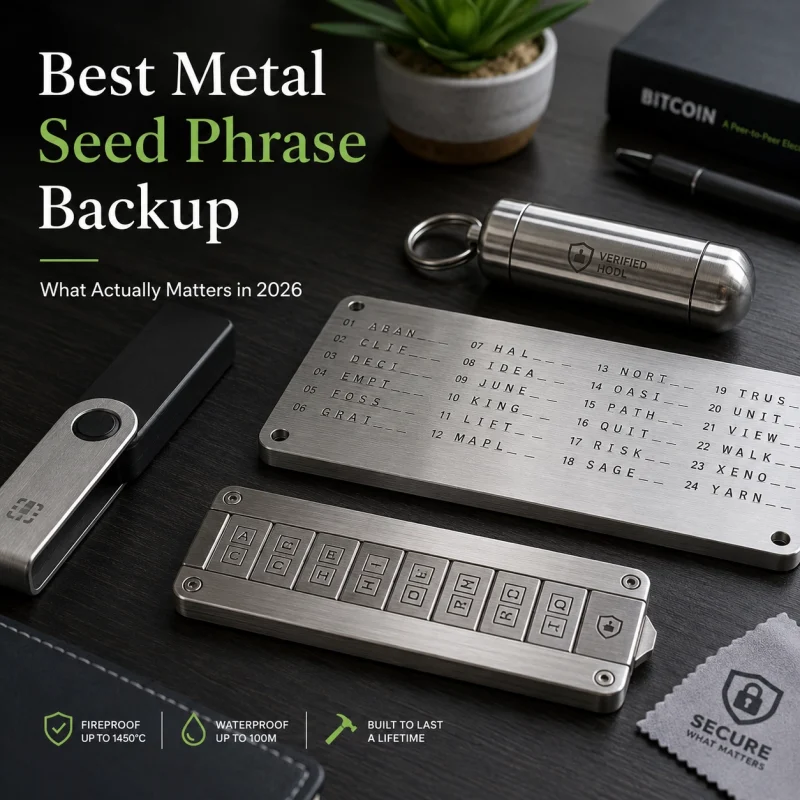
Option 2: Metal Backup in a Separate Location
A metal seed backup replaces fragile paper with a more durable physical recording medium.
Its purpose is not to make the phrase impossible to steal. Its purpose is to improve resistance to physical deterioration and environmental damage.
Advantages
More resistant to tearing and fading
Better suited to long-term physical storage
Remains completely offline
Can be stored independently of the hardware wallet
Does not depend on batteries, software, or cloud accounts
Limitations
Anyone who can read the complete backup may be able to recover the wallet
It can still be stolen, photographed, misplaced, or confiscated
Product durability varies by material and construction
Incorrectly recorded words remain incorrect
A metal plate without instructions may be meaningless to an heir
Ledger and Trezor describe metal as a more durable physical alternative to ordinary paper, while also treating storage design and backup accessibility as separate responsibilities.
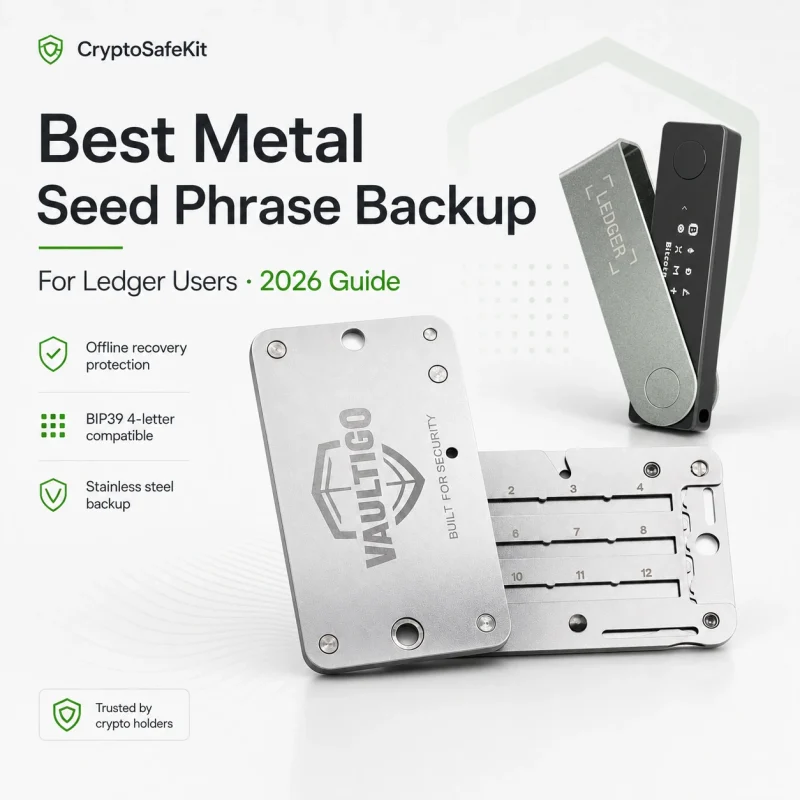
A VAULTIGO metal seed plate can serve as the durable recovery component of an inheritance plan. It should be stored separately from the hardware wallet and supported by clear, non-secret recovery instructions. CryptoSafeKit’s metal backup products are designed as offline physical records rather than online recovery services.
Review the available VAULTIGO metal seed backup options before selecting a format that matches the wallet’s backup standard.
Option 3: Multiple Complete Backups
Two complete backups in separate locations can protect against one building fire, one lost safe, or one inaccessible property.
This is a practical model for many single-signature users.
Advantages
Simple recovery process
No threshold calculation
Either copy can restore access
Easy to explain to a trusted successor
Compatible with most conventional hardware wallets
Limitations
Every copy is a complete access point
More copies increase the chance of theft or unauthorized viewing
A trusted person holding one copy may gain full control
Copies may become inconsistent if the wallet plan changes
For many individuals, two verified offline copies in genuinely separate security zones provide a reasonable balance between redundancy and exposure. Creating additional full copies should address a defined risk rather than a vague desire for “more backup.” CryptoSafeKit’s existing backup analysis reaches the same general conclusion.
Option 4: Multi-Share or Threshold Backup
A standardized multi-share backup divides recovery data into several shares.
A defined threshold—such as three out of five shares—is required to restore the wallet. One share alone does not normally provide full access.
Trezor’s current Multi-share Backup uses SLIP39 and allows recovery when the required threshold of valid shares is available. Shares can be distributed across locations or trusted people.
Advantages
No single share provides full recovery
Some shares can be lost without losing the wallet
Suitable for geographic distribution
Can separate family, professional, and physical storage roles
Reduces reliance on one complete seed copy
Limitations
More complicated to document
The heir must understand the threshold
Losing too many shares makes recovery impossible
Share labels and storage locations must remain accurate
Compatibility must be checked before relying on the format
It should not be confused with manually splitting a normal seed phrase
Do not create homemade fragments such as “words 1–12” and “words 13–24” and assume that this provides the same security as a standardized threshold scheme.
Manual splitting can produce a fragile process that successors cannot reconstruct.
Option 5: Multisig Inheritance
A multisignature wallet requires more than one signing key to authorize a transaction.
A 2-of-3 wallet, for example, can spend when any two of three valid keys approve the transaction.
This can support an inheritance structure where:
The owner controls one key.
A trusted family member controls another.
A third key remains in secure independent storage.
Bitcoin multisig uses a defined set of public keys and a signature threshold. Recovery also depends on preserving the wallet configuration or descriptor that identifies how those keys form the wallet. Bitcoin Core’s current documentation returns a descriptor when creating multisig arrangements and warns that relevant wallet changes require backup.
Advantages
One stolen or lost key does not necessarily compromise the wallet
One heir does not need to hold every secret
Authority can be distributed among people and locations
One key can be replaced or rotated before a failure becomes critical
Suitable for higher-consequence Bitcoin storage
Limitations
Every signing key still requires its own backup
The wallet policy or descriptor must also survive
Successors may not understand the coordinator software
Device and software compatibility can change
Poorly documented multisig can be harder to recover than single-signature storage
Transaction execution requires more operational coordination
Trezor’s current multisig guidance presents multi-key security as a way to reduce dependence on one device or backup, but it also requires a correctly maintained setup.
CryptoSafeKit’s multisig hardware-wallet guide explains the additional signer and coordinator requirements.
A Practical Single-Signature Inheritance Model
A conventional hardware-wallet user does not necessarily need multisig.
A manageable plan might contain:
Primary signer
Hardware wallet stored securely
PIN kept separately or recoverable through instructions
Device used periodically to confirm it still works
Recovery backup
Verified metal seed backup
Stored outside the same physical risk zone
Never photographed or uploaded
Passphrase component
Stored separately when one exists
Exact capitalization, spacing, and punctuation preserved
Not left only in the owner’s memory
Discovery document
States that the wallet exists
Names the hardware-wallet ecosystem
Explains where recovery instructions are held
Contains no complete seed phrase
Recovery manual
Explains the account structure
Identifies relevant blockchains
Warns against entering words into websites or software wallets
Requires a small test before transferring the main balance
Hypothetical Example
A long-term holder keeps a VAULTIGO metal backup in an off-site secure location.
At home, a sealed document explains:
Which hardware-wallet brand was used
That an optional passphrase exists
Where the passphrase instructions can be accessed
Which accounts should appear after recovery
How to verify a known public address
The home document does not contain the seed phrase.
The off-site metal backup does not contain the passphrase or a detailed asset inventory.
Neither location independently provides complete access.
This arrangement improves separation but remains simple enough for a prepared successor to follow.
How to Handle a Passphrase
A passphrase creates an additional recovery dependency.
If the owner uses one, the inheritance plan must state that it exists. Without that information, an heir may correctly restore the seed and find only an empty or unrelated standard wallet.
The passphrase should be:
Recorded exactly
Stored separately from the seed
Protected from casual access
Included in the recovery test
Documented for authorized successors
Do not rely exclusively on memory.
A passphrase that dies with the owner defeats the inheritance plan.
Test the Plan Before Depending on It
An untested plan is only a theory.
A controlled recovery test should confirm:
The backup is accurate.
The correct wallet can be restored.
Any passphrase opens the intended accounts.
Known public addresses match.
Multisig descriptors and signers are complete.
Instructions can be followed by someone other than the owner.
No recovery phrase needs to enter an ordinary computer or website.
Use an official hardware-wallet backup-check procedure or a compatible spare hardware device where appropriate. Ledger recommends verifying its recovery phrase before relying on it, and Trezor supports device-based recovery workflows for standard and Multi-share Backups.
Do not perform the first recovery test during an emergency.
Review the Plan Regularly
Long-term recovery arrangements become stale.
Review the plan after:
Moving home
Changing countries
Replacing a hardware wallet
Creating a new passphrase wallet
Moving assets to another blockchain
Changing a multisig signer
Marriage, separation, or death in the family
Changing secure-storage providers
Discovering that a backup may have been viewed
Major wallet-software or recovery-standard changes
A yearly review is reasonable for many long-term holders.
The review does not require exposing every word. It should confirm that the locations, instructions, trusted people, and recovery methods still work.
A Crypto Inheritance Checklist
Before considering the plan complete, confirm:
A trusted person knows that self-custodied assets exist.
Discovery instructions contain no complete recovery secret.
At least one verified recovery backup exists.
A second independent backup exists where the risk justifies it.
The device and recovery phrase are not routinely stored together.
Any passphrase is documented separately.
The wallet type and account structure are explained.
Multisig descriptors or wallet policies are backed up.
Recovery instructions prohibit websites, cloud services, and unsolicited support.
A small recovery or access test has been completed.
The plan identifies who can provide technical assistance.
The plan has a recorded review date.
Final Thoughts
There is no perfect crypto inheritance system.
Maximum secrecy can leave a family unable to recover anything.
Maximum accessibility can allow one person, document, or storage location to compromise the entire wallet.
The objective is to balance:
Privacy
Theft resistance
Physical durability
Recovery simplicity
Geographic redundancy
Successor competence
Long-term maintainability
For many holders, the strongest practical starting point is:
A genuine hardware wallet
A verified offline recovery phrase
A durable metal backup stored separately
A discovery document with no complete secrets
Separate handling of any passphrase
Clear recovery instructions
A prepared trusted successor
A tested and periodically reviewed process
More complex holdings may justify Multi-share Backup or multisig.
Complexity should be added only when it solves a specific threat and the future recovery process remains understandable.
A hardware wallet protects access while the owner is alive.
A well-designed recovery plan protects access when the owner is no longer available to explain it.
5. Security Disclaimer
This article is provided for general educational and self-custody security purposes only. It does not constitute legal, tax, estate-planning, financial, investment, insurance, or personalized cybersecurity advice.
Inheritance rights, property administration, disclosure obligations, and legal-document requirements vary by jurisdiction. Obtain appropriate professional advice for those matters without disclosing recovery phrases, private keys, device PINs, or passphrases.
Hardware wallets, paper backups, metal plates, Multi-share Backup, and multisig arrangements all have limitations. None eliminates theft, physical loss, procedural error, coercion, incompatible software, undocumented passphrases, or human misunderstanding.
CryptoSafeKit and VAULTIGO will never request your recovery phrase, private key, hardware-wallet PIN, wallet password, or passphrase through a website, email, cloud service, support form, messaging application, or remote-access session.


VAULTIGO 4-Letter Metal Seed Phrase Backup System
Original price was: $99.00.$59.99Current price is: $59.99.VAULTIGO 4-Letter Metal Seed Phrase Backup is a reusable stainless steel backup system designed to store your recovery words offline. Built for standard English BIP39 seed phrases, each recovery word can be identified by its first four letters, helping you create a compact, organized, and durable backup without punching, engraving, or hammering.
- Stores the first 4 letters of each recovery word
- Designed for standard English BIP39 word lists
- No punching, engraving, or hammering required
- Reusable metal letter tiles
- Water and corrosion resistant stainless steel design
- Lockable structure for added physical protection
- Ideal for hardware wallets, cold wallets, and long-term crypto self-custody
6. Frequently Asked Questions
What happens to crypto if a hardware-wallet owner dies?
The assets remain assigned to their blockchain addresses. A trusted successor needs a valid method of controlling those addresses, normally through a working device and PIN or through the wallet’s recovery information.
Should I give my heir the complete seed phrase now?
Giving one person the complete phrase provides immediate recovery capability but also creates an immediate security risk.
A safer plan often separates discovery instructions, recovery secrets, passphrases, and technical guidance.
Is a metal seed backup suitable for inheritance?
Metal can provide a more durable offline record than ordinary paper. It does not prevent theft or unauthorized reading and must be stored with appropriate physical access controls.
Should the hardware wallet and seed phrase be stored together?
Usually not.
One theft, fire, or disposal event could remove both the working device and its recovery path.
How does an heir know whether a passphrase exists?
The inheritance instructions should clearly state that the wallet uses a passphrase without necessarily storing that passphrase beside the seed.
Is multisig always better for inheritance?
No.
Multisig can reduce dependence on one key, but it introduces signer, descriptor, software, and coordination requirements. Poorly documented multisig may be more difficult to inherit than a well-designed single-signature wallet.
Can I split a normal 24-word phrase between relatives?
Manually splitting a conventional recovery phrase is not the same as standardized secret sharing.
Use a supported threshold system such as Multi-share Backup when multiple shares are required.
Should recovery instructions include wallet balances?
Exact balances are usually unnecessary and quickly become outdated.
It is often sufficient to identify the wallet type, likely blockchains, known public addresses, and recovery process.
How often should the plan be reviewed?
Review it after major wallet, family, residence, or storage changes. An annual operational check is a practical starting point for many long-term holders.