

Trezor vs Tangem Hardware Wallet: Security, Usability & Long-Term Storage Comparison

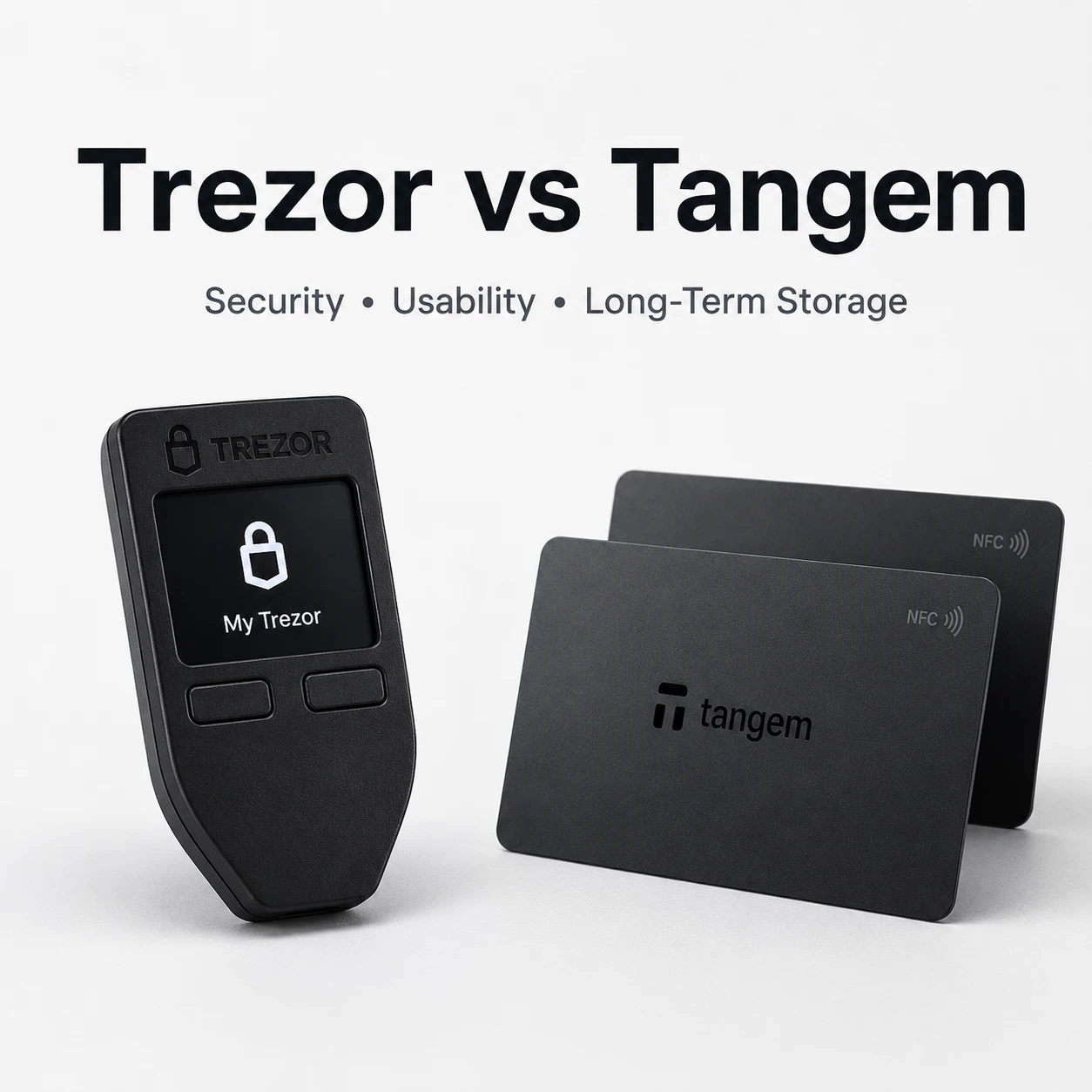
Trezor and Tangem both keep private keys away from a conventional exchange account, but they approach self-custody from opposite directions.
Trezor follows the familiar hardware-wallet model: a dedicated device with a screen, physical or touchscreen controls, open-source firmware and a written wallet backup that can restore access on compatible hardware.
Tangem removes many of those familiar elements. It uses an NFC card or ring with no battery, cable or built-in screen. In the standard seedless setup, recovery depends on multiple physical Tangem devices rather than a written recovery phrase.
Neither design is automatically safer for every owner.
Trezor gives users greater recovery portability, independent transaction verification and more advanced privacy controls. Tangem reduces setup friction and removes the need to record recovery words, but creates greater dependence on the physical cards and the phone used to operate the wallet.
This Trezor vs Tangem hardware wallet comparison examines the trade-offs that matter most: security architecture, recovery, usability, privacy, travel and long-term storage.
Security warning: Neither Trezor nor Tangem support will ever need your recovery phrase, private key, PIN, access code or optional passphrase to diagnose an ordinary connection or transaction problem.
Quick Verdict
Choose Trezor if you want:
A built-in screen for independent transaction verification
Publicly reviewable firmware
A conventional wallet backup that can restore access on compatible devices
Optional passphrase protection
Multi-share recovery
Desktop-based wallet management
Bitcoin-focused privacy tools such as Tor and coin control
Choose Tangem if you want:
The simplest mobile-first setup
No battery, charging cable or USB connection
A credit-card-sized wallet for travel
A standard setup without written recovery words
NFC signing from a compatible smartphone
Several equivalent physical backup devices
The central trade-off
Trezor asks you to protect recovery information.
Tangem’s seedless model asks you to protect multiple physical devices.
The better system is the one whose failure modes you can manage reliably for many years.
Trezor vs Tangem at a Glance
| Feature | Trezor | Tangem |
|---|---|---|
| Device format | Screen-based USB or wireless device, depending on model | NFC card or ring |
| Transaction review | On the hardware-wallet screen | On the smartphone screen |
| Device firmware | Open source and updateable | Fixed and non-updateable |
| Companion software | Trezor Suite and compatible third-party wallets | Tangem mobile application |
| Standard recovery | Human-readable wallet backup | Two or three equivalent physical devices |
| Optional seed phrase | Yes | Yes on supported current devices |
| Multi-share recovery | Supported on compatible Trezor models | Not the standard Tangem backup model |
| Passphrase wallet | Supported | Different access and recovery model |
| Battery | Model-dependent | No battery |
| Primary connection | USB; additional options vary by model | NFC |
| Best fit | Recovery portability, privacy and independent verification | Mobile simplicity and seedless physical redundancy |
Tangem Is Seedless, but It Is Not an MPC Wallet
Tangem is sometimes described online as an MPC wallet. That description is inaccurate for its standard consumer backup process.
MPC, or multi-party computation, typically divides signing responsibility among separate key shares. The participants jointly produce a signature without one complete private key being stored on every participant.
Tangem’s official backup documentation describes a different process.
The first Tangem chip generates one private key. During initial setup, a secure Diffie–Hellman communication channel is established between the devices, and that private key is securely copied to the selected backup cards or ring. Every device in the resulting wallet set provides equal access to the same wallet.
That is physical key replication, not threshold MPC signing.
This distinction matters because losing one card is usually manageable, but losing every seedless Tangem device means losing every copy of the key.
1. Security Architecture
Trezor’s approach
Trezor publishes its firmware and related software in public repositories, allowing developers and security researchers to inspect the implementation. Current Trezor Safe devices also include dedicated Secure Elements intended to strengthen PIN enforcement and resistance to physical attacks.
With a Trezor Safe 3 or Safe 5, the user reviews the destination, amount and available transaction information on the hardware-wallet screen before confirming an action.
The practical security model combines:
Open-source firmware
A dedicated hardware display
Physical device confirmation
PIN protection
An offline wallet backup
Optional passphrase protection
Secure Element protection in current Safe models
No part of this structure makes phishing impossible. A Trezor can still sign a harmful transaction when the owner deliberately approves it.
Tangem’s approach
Tangem stores its private key inside an EAL6+ certified Secure Element. The card or ring has no battery, screen or independent internet connection. It activates through the NFC field of a compatible smartphone.
Tangem’s card firmware is fixed after manufacture. The companion mobile application is open source, but the firmware inside the card is not presented as a fully open-source, user-updateable system in the way Trezor firmware is. Tangem instead emphasizes a narrow, immutable firmware surface and third-party auditing.
Kudelski Security reported that issues found during its 2018 smart-card code review were mitigated by Tangem. Riscure later assessed the wallet firmware, while Cure53 conducted a white-box review of Tangem’s mobile SDK cryptography in 2026. These audits provide useful external evidence, but they do not establish that any wallet is permanently free from every future vulnerability.
2. Open-Source Firmware vs Immutable Firmware
The firmware difference is not simply “transparent versus secure.”
It reflects two different engineering strategies.
Benefits of Trezor’s open-source, updateable model
Public firmware makes it possible to:
Inspect how the wallet works
Review changes
Compile or compare builds
Identify implementation weaknesses
Deliver security patches and new functionality
Trezor firmware is actively maintained, and the company recommends keeping devices updated through official Trezor Suite workflows.
The trade-off is that firmware updates become part of the owner’s operational security. Users must install updates through legitimate software and verify unexpected prompts carefully.
Benefits of Tangem’s immutable model
Tangem’s card firmware cannot be altered after production.
This removes the ordinary firmware-update process from the user experience and prevents a malicious update from being installed on an existing card through routine use.
The limitation is equally important: deployed cards cannot receive firmware patches or new card-level capabilities. If a future issue required a firmware change, the practical solution could involve replacing the physical device rather than updating it.
Editorial assessment: Trezor favors transparency and maintainability. Tangem favors a minimal, fixed-function device. Neither model removes the need to trust manufacturing, cryptographic implementation and the connected application.
3. Independent Screen vs Smartphone Display
This is one of the largest security differences between the two products.
Trezor provides a trusted device display
A Trezor screen can independently show transaction information received from the computer or phone.
This matters because malware may alter:
A copied receiving address
A destination displayed by a browser
A transaction amount
A smart-contract request
When the hardware-wallet screen displays the correct destination and amount, the owner has a separate verification point outside the general-purpose computer.
A small screen does not guarantee safe signing. It only helps when the wallet can display meaningful information and the owner checks it carefully.
Tangem relies on the phone for transaction details
Tangem cards do not have a screen. The smartphone displays the transaction, and the physical card is tapped to authorize the signature.
The private key remains protected by the card, but the phone remains the primary place where the user interprets the requested action.
Tangem argues that its application security, card authentication and physical NFC tap provide an appropriate authorization model. That is the manufacturer’s design position.
Editorial assessment: For high-value or complex transactions, a separate hardware display provides a stronger independent verification boundary. Tangem remains simple and usable, but users must be particularly disciplined about application authenticity, destination verification and phishing.
4. Recovery: Written Backup vs Physical Backup Cards
The strongest difference is not the chip. It is recovery.
Trezor recovery
Trezor supports human-readable wallet backups. Depending on the device and selected workflow, the backup may use 12, 20 or 24 words. Compatible models can also use Multi-share Backup, where a chosen threshold of several shares is required to recover the wallet.
This provides several benefits:
The hardware wallet can be replaced.
Recovery does not depend on retaining the original device.
The backup can be stored on paper or metal.
Multi-share Backup can distribute recovery across locations.
The owner can document an inheritance process.
It also creates the traditional recovery-phrase risk: anyone who obtains enough valid backup information may be able to restore the wallet.
A Trezor backup must never be photographed, uploaded or typed into an ordinary website or software wallet.
Tangem seedless recovery
In Tangem’s standard seedless setup, the wallet is backed up to two or three equivalent devices.
There is no primary card after setup. Any card or ring in the same set can access the wallet.
This removes a common failure point: a written phrase that can be photographed, phished or entered into a fake application.
It replaces it with a different requirement:
At least one functioning device from the original wallet set must remain available.
Tangem also supports an optional seed-phrase setup on current compatible products. Choosing that mode reintroduces recovery portability, but also reintroduces the familiar risks of written seed storage.
5. Tangem Seedless Wallet Risks
Seedless does not mean risk-free or backup-free.
Losing every device
When no seed phrase exists, losing all cards and rings from the wallet set results in permanent loss of access.
There is no account-recovery department that can reproduce the key.
Keeping all cards together
A three-card set provides little geographic redundancy if all three cards remain in one wallet, bag or home safe.
One theft, fire or disposal event may remove the entire recovery system.
Backup devices cannot simply be added later
Tangem states that private-key backup is completed during the initial backup process and that another device cannot later be added to the existing wallet set. Users should therefore decide at setup whether they want two or three devices.
Phone dependence
Tangem requires a compatible NFC smartphone and the Tangem application for routine account management and signing. The card itself does not provide a screen or standalone transaction interface.
A damaged phone does not destroy the wallet, because another compatible phone can run the application. However, the user remains dependent on access to a supported mobile platform.
6. Trezor Recovery Risks
Trezor’s portability comes with its own failure modes.
Recovery-phrase theft
A complete standard backup—or enough valid Multi-share shares—may allow another person to recover the wallet.
The hardware device and PIN may no longer matter after the backup is exposed.
Incorrect transcription
A missing word, incorrect order or damaged backup can make emergency recovery difficult or impossible.
Verify the backup using the manufacturer-supported process before relying on it.
Passphrase loss
Trezor supports optional passphrase wallets. Each exact passphrase can create a different wallet, and Trezor cannot reset or recover a forgotten passphrase.
A typo may open a valid but empty wallet rather than producing an obvious error.
Passphrases should be used only when the owner can maintain a separate, durable and understandable recovery plan.
7. Which Is Easier for Beginners?
Tangem is easier to initialize.
A compatible phone, official application and two or three cards are enough for the standard workflow. There is no USB connection, battery, device firmware update or written recovery phrase in the default seedless setup.
For users intimidated by recovery words and hardware-wallet menus, that simplicity is meaningful.
Trezor setup requires more deliberate steps. A Safe 3 setup includes installing official firmware, authenticating the device, creating the wallet backup and setting a PIN.
Those additional steps create more initial responsibility, but they also teach the owner how the wallet can be recovered independently of the original hardware.
Beginner recommendation
Choose Tangem when the biggest risk is that the owner will photograph, mistype or lose a seed phrase—but only when the backup cards can be distributed responsibly.
Choose Trezor when the owner wants a conventional, portable recovery method and is prepared to protect it offline.
8. Privacy and Bitcoin Use
Trezor provides a more developed privacy-focused workflow for Bitcoin users.
Trezor Suite documents support for:
Tor connectivity
Coin control
Custom nodes or servers
New-address use
Discreet portfolio viewing
Tor can reduce direct network-level tracking, while coin control lets users decide which Bitcoin UTXOs are spent together.
Tangem’s design focuses more heavily on mobile multi-chain convenience. Its application is open source, but the official product positioning does not center on a desktop Bitcoin privacy suite comparable to Trezor’s Tor and coin-control workflow.
Recommendation for privacy-focused Bitcoin users: Trezor is generally the stronger fit, particularly when combined with careful node selection, address management and a properly protected wallet backup.
9. Travel and Everyday Portability
Tangem has the practical advantage for travel.
A card fits into an ordinary wallet, requires no charging and is powered through the phone’s NFC field. It has no port or cable requirement.
Trezor devices are also compact, and Trezor states that current Safe devices are suitable for air travel and X-ray screening. However, most Trezor workflows require the physical device plus an appropriate cable or supported wireless connection, depending on the model.
Hypothetical Example
A traveler carries one Tangem card and stores the other two cards in separate secure locations.
This provides convenient mobile access while preserving recovery outside the travel bag.
Carrying all three cards together would be simpler, but one lost wallet could remove the entire seedless backup set.
For Trezor, the traveler may carry the device while keeping the wallet backup and any passphrase record in separate locations.
Never travel with the hardware wallet, full recovery backup and passphrase stored together.
10. Asset Support and Applications
Both product families support many blockchain networks and tokens, but raw asset counts are not directly comparable.
Manufacturers may count:
Native blockchain assets
Individual token contracts
Assets supported only through third-party wallets
Assets visible in the native application
Networks supported for signing but not portfolio display
Tangem currently advertises support for more than 14,000 tokens across over 90 blockchains. Trezor states that most supported assets work across its current devices, with some exceptions and third-party integrations.
Before buying either device, verify:
The exact asset
The blockchain network
The required wallet interface
Whether transaction details can be reviewed meaningfully
Whether the application supports the intended dApp or account type
Do not select a wallet based only on the largest marketing number.
11. Long-Term Storage and Inheritance
Trezor is generally easier to integrate into a conventional long-term recovery plan.
A documented seed or Multi-share Backup can be stored in durable physical form and recovered without retaining the original Trezor device. This may be easier to explain to an executor or technically capable beneficiary.
Tangem’s seedless model may be simpler during the owner’s lifetime, but inheritance planning must explain:
Where at least one valid card is stored
How the access code is handled
Which application is required
How the beneficiary distinguishes the correct card set
What happens if the device becomes unavailable
Using Tangem’s optional seed-phrase mode can improve recovery portability but removes the main advantage of avoiding a written seed.
Large long-term holdings
Asset value alone does not determine the correct wallet.
The more useful questions are:
How serious would permanent loss be?
Can the owner protect written recovery information?
Can several physical locations be maintained?
Is independent transaction verification important?
Does another person need to recover the wallet later?
For high-consequence long-term storage, Trezor’s screen, recovery portability, Multi-share option and privacy controls create a more configurable system.
Tangem can still be appropriate when a three-device seedless set is carefully distributed and the owner prioritizes operational simplicity.
12. Price and Value
As of July 28, 2026, Trezor lists the Safe 3 at approximately US$59 on its official comparison page. Tangem lists its two-card set at approximately US$54.90 and its three-card set at approximately US$69.90. Regional tax, shipping, currency and promotions vary.
The entry prices are therefore close.
The more meaningful value comparison is what each package provides:
Trezor Safe 3: Device screen, open-source firmware, Secure Element, standard or Multi-share Backup and Trezor Suite.
Tangem two-card set: Two equivalent seedless physical access devices.
Tangem three-card set: Greater physical redundancy for a relatively small additional cost.
For seedless use, the three-card Tangem set is usually the more resilient configuration, provided the cards are not stored together.
Which Wallet Should You Choose?
Choose Trezor for larger long-term holdings when:
You want independent on-device verification.
You can protect an offline backup.
You want Multi-share recovery.
You need a documented inheritance process.
Bitcoin privacy features matter.
You prefer publicly reviewable firmware.
Explore the Trezor Safe 3 hardware wallet available through CryptoSafeKit.
Choose Tangem when:
You want the fastest mobile-first experience.
You do not want to maintain a written recovery phrase.
You travel frequently.
You can securely separate two or three physical cards.
You accept phone-based transaction review.
You prefer NFC over cables and device menus.
Review the Tangem NFC hardware wallet for its current card-based setup.
Choose Trezor for privacy-focused Bitcoin use
Trezor’s Tor, coin-control and custom-node options provide a more mature privacy workflow.
Choose Tangem for small or active multi-chain portfolios
Tangem’s card format and mobile application reduce friction for routine access. Keep high-risk dApp activity separate from long-term storage accounts.
Choose neither until the recovery plan is clear
A wallet should not be selected only because its setup looks easier.
Write down the actual failure scenario:
What happens if the device is stolen?
What happens if every card is lost?
Who can recover after incapacity?
Where will backups be stored?
Which screen will be trusted during signing?
The answer usually makes the appropriate architecture clearer.
Final Verdict
Trezor and Tangem are not variations of the same wallet.
Trezor offers a traditional, highly configurable self-custody model:
Open-source firmware
Independent hardware display
Updateable software
Written or Multi-share Backup
Passphrase support
Advanced Bitcoin privacy tools
Tangem offers a deliberately simplified physical-key model:
NFC card or ring
No battery or cable
No hardware screen
Fixed firmware
Seedless multi-device backup
Optional seed-phrase mode
Mobile-first operation
Trezor places more responsibility on recovery-phrase security, but provides greater recovery portability and transaction-verification independence.
Tangem removes the phrase in its default setup, but requires the owner to preserve at least one functioning device from the original set.
For a beginner who repeatedly risks exposing recovery words, Tangem may be the safer practical choice.
For a privacy-conscious user, a long-term holder or anyone who values independent transaction verification and recoverability across compatible devices, Trezor is usually the more flexible option.
Neither wallet is safe when the owner approves the wrong transaction or fails to maintain a valid recovery plan.
The device protects the key.
The recovery design protects future access.
5. Security Disclaimer
This article is provided for general educational and product-comparison purposes only. It does not constitute financial, investment, trading, tax, legal, estate-planning or personalized cybersecurity advice.
Hardware wallets reduce specific private-key exposure risks but cannot eliminate phishing, malicious transactions, physical theft, backup loss, supply-chain risk, device failure or user error.
Product features, prices, supported assets, mobile compatibility and recovery methods can change. Confirm current details through official Trezor and Tangem documentation before purchasing or moving assets.
Never enter a Trezor wallet backup, Tangem seed phrase, private key, PIN, access code or passphrase into an unknown website, cloud service, direct message, support form or remote-access session.
6. Frequently Asked Questions
Is Tangem an MPC wallet?
No, not in its standard seedless consumer backup model.
Tangem generates one private key and securely copies it to the selected backup devices. All cards in the wallet set provide equivalent access. This differs from MPC systems in which separate key shares jointly produce signatures.
Is Tangem safer because it has no seed phrase?
It removes the risk of exposing a written phrase in its default seedless setup.
It introduces a different risk: losing every card or ring from the original wallet set means losing access. Seedless changes the recovery model; it does not eliminate recovery risk.
Is Trezor always a 24-word wallet?
No.
Current Trezor workflows may use 12, 20 or 24 words, depending on the device and backup standard. Compatible devices also support Multi-share Backup.
Which is easier for beginners?
Tangem generally has the simpler setup because it uses an NFC phone workflow and can avoid a written recovery phrase.
Trezor requires more setup steps but provides a screen-based verification and portable backup model.
Which is better for travel?
Tangem is more convenient to carry because it is card-sized, battery-free and cable-free.
Do not travel with every Tangem backup card together. A Trezor is also portable, but its backup should remain separate from the device.
Which is better for Bitcoin privacy?
Trezor provides documented Tor, coin-control and custom-node options, making it the stronger fit for users who actively manage Bitcoin privacy.
What happens if a Tangem card is lost?
Another card or ring from the same wallet set can access the wallet.
When every seedless device is lost, no replacement can reconstruct the private key.
Can Tangem cards be added later?
Tangem states that backup devices must be added during the original backup process. A new card cannot later be added to the existing wallet set.
Which is better for inheritance?
Trezor’s written or Multi-share Backup is generally easier to document independently of the original device.
Tangem inheritance is possible, but the beneficiary must receive at least one valid device and clear instructions for using the correct wallet set and access code.