

Trezor & SafePal Data Breaches 2026: Why Your Shipping Address Is Now Part of Crypto Security

Your hardware wallet can keep private keys offline and still leave you exposed somewhere completely different: the order system that knows your name, phone number and home address.
That is the uncomfortable lesson from a series of hardware-wallet security incidents in August 2026. Trezor disclosed a breach at shipping provider ShipMonk affecting nearly 14,000 customers. Days later, SafePal disclosed unauthorized access to order information belonging to approximately 39,798 customers.
The wallets themselves were not cracked. Seed phrases and private keys were not reported stolen in either incident. But attackers may have obtained something that can still be extremely valuable: a list of real people who purchased cryptocurrency self-custody hardware, together with contact and delivery information.
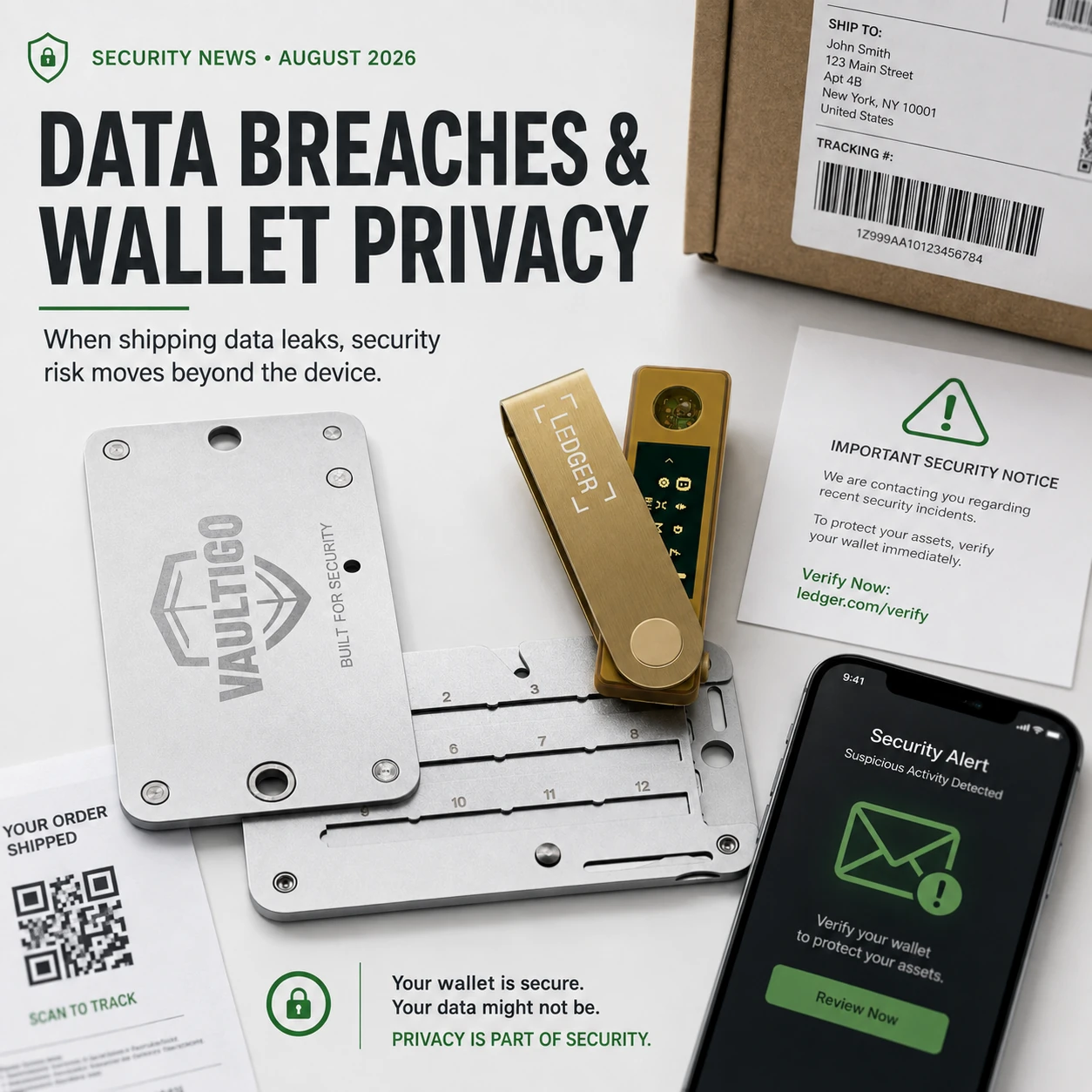
At the same time, national cybersecurity authorities are warning about physical letters containing malicious QR codes that impersonate hardware-wallet providers and attempt to trick recipients into entering their recovery phrases.
The security lesson is bigger than Trezor or SafePal: in 2026, protecting a hardware wallet means protecting the device, the seed phrase, your digital identity and your physical privacy as separate layers.
Customer names, emails, phone numbers and shipping addresses were exposed through a fulfillment-provider breach.
An order-tracking authorization flaw exposed customer identity, shipping and purchase information.
Authorities warned of fake hardware-wallet security letters using QR codes to steal seed phrases.
Ledger again highlighted customer-data risk after Shopify notified it of a data-theft incident affecting Ledger customers.
More Than 53,000 Hardware-Wallet Customers Were Affected
The two incidents were technically different, but they exposed a similar weakness: hardware-wallet companies still depend on ordinary e-commerce, fulfillment and logistics infrastructure.
Trezor: ShipMonk fulfillment-provider breach
Trezor said ShipMonk, one of its shipping providers, notified the company of unauthorized access to systems containing customer order data.
According to Trezor, 11,742 customers had their name, email address, phone number and shipping address exposed. Another 1,947 customers had more limited information exposed, including name, city and email.
Trezor said the incident affected certain customers in the United States, United Kingdom, Sweden, Colombia, Brazil, Italy and Portugal.
SafePal: order-tracking authorization flaw
SafePal disclosed a separate incident affecting approximately 39,798 customers.
The company said a verification or authorization defect associated with an order-tracking plug-in allowed unauthorized access to customer order information.
Exposed information could include names, email addresses, phone numbers, shipping addresses and purchase details.
| Incident | Customers | Potentially Exposed | Wallet Secrets? |
|---|---|---|---|
| Trezor / ShipMonk | 11,742 full + 1,947 partial | Name, email, phone, shipping address / city | No reported exposure |
| SafePal | Approx. 39,798 | Name, email, phone, address, purchase details | No reported exposure |
These were customer-data incidents, not evidence that attackers extracted private keys directly from Trezor or SafePal hardware wallets.
Were Seed Phrases or Private Keys Compromised?
Based on the companies’ current disclosures, no.
Trezor said its systems, products, hardware wallets, private keys and wallet backups were not affected by the ShipMonk incident.
SafePal similarly said its incident did not expose seed phrases, private keys, wallet passwords, payment-card details, bank-account information or government identification.
The attacker still needs a private key, recovery phrase, valid transaction signature or another path to actual wallet control.
This distinction matters because panic can create the exact compromise that the original breach did not.
A fake support message may tell an affected user: “Your wallet was compromised in the breach. Enter your seed phrase to secure your funds.”
If the user follows that instruction, the attacker turns a privacy breach into a wallet compromise.
If Wallet Keys Were Safe, Why Is the Data Still Dangerous?
Generic phishing has to guess.
A targeted attacker with leaked order data may already know:
- Your real name
- Your email address
- Your mobile number
- Your delivery address
- That you purchased a hardware wallet
- Possibly which product you purchased
- Approximately when the order was placed
That changes the quality of the attack.
Easy to dismiss because the message knows almost nothing about you.
Much more convincing because some of the personal details are real.
The personal information may be authentic while the security instructions are completely fraudulent.
CryptoSafeKit previously covered the same pattern after a Ledger-related third-party order-data incident in our Ledger data-leak phishing defense guide .
Phishing Has Moved From Email Into Your Mailbox
One of the most important security developments this month did not happen through email.
On August 18, Switzerland’s National Cyber Security Centre warned that crypto users were receiving physical letters impersonating wallet providers.
The letters claimed that an urgent wallet update was required because of a supposed transition to “quantum resistance.”
A QR code inside the letter directed victims to a phishing website that requested their seed phrase.
Never scan an unsolicited wallet-security QR code and enter your 12- or 24-word recovery phrase.
Postal phishing can feel unusually credible because physical mail is more expensive and harder to automate than email. If the attacker already has a real customer address from a leaked order database, the letter can appear even more legitimate.
This is exactly why personal-data exposure must now be treated as part of hardware-wallet security rather than a completely separate privacy problem.
Does an Exposed Home Address Put Crypto Holders at Physical Risk?
Potentially, but the risk needs to be described carefully.
A leaked delivery address does not reveal:
- Whether the customer still owns the hardware wallet
- Whether the address is their permanent home
- How much cryptocurrency they hold
- Where the hardware wallet is currently stored
- Where the recovery phrase is stored
But it can connect a real identity and location with a known purchase of self-custody hardware.
That is useful intelligence for targeted social engineering and, in more extreme cases, could contribute to physical targeting.
The correct response is to reduce unnecessary information exposure and strengthen physical-security habits, not immediately move all funds because of an unverified message.
We cover this threat model in more detail in What Is a Wrench Attack? Crypto Physical Security Guide .
Do These Incidents Mean Hardware Wallets Are No Longer Safe?
No.
They demonstrate something more important: self-custody moves risk rather than eliminating it.
A well-designed hardware wallet can make remote private-key extraction substantially harder. But it cannot automatically secure every system around the owner.
Protect the private key.
Protect the seed phrase or backup.
Protect the phone and computer.
Protect email, phone and account recovery.
Protect physical privacy.
Minimize unnecessary order data.
August’s events actually show three very different ways cold storage can fail.
The recent COLDCARD incident involved weak seed generation at the device/firmware layer. Trezor and SafePal incidents involved customer-data systems around the hardware. Postal phishing then attempts to convert leaked identity data into seed-phrase theft.
CryptoSafeKit’s COLDCARD seed vulnerability analysis explains why strong cold storage must be treated as a multi-layer security system rather than a single device.
The Modern Hardware-Wallet Threat Model Is Bigger Than the Hardware
Seed generation
Was the recovery seed created with strong and unpredictable randomness?
Key isolation
Can malware on a normal computer extract the private key?
Transaction verification
Can the owner verify the real destination and transaction intent before signing?
Recovery security
Can fire, theft, phishing or human error expose or destroy the backup?
Customer privacy
Who knows that the owner purchased crypto-security hardware?
Physical exposure
Can a purchase record be connected to a home, workplace or public identity?
Privacy is no longer an optional extra around self-custody. Reducing unnecessary links between your real-world identity, home location and wallet setup is part of the security architecture.
What Should Trezor or SafePal Customers Do Now?
If you received a legitimate notification saying your order information was affected, the first step is to understand what the breach did not mean.
There is no reason to type your recovery phrase anywhere simply because customer information leaked.
Do not reset your hardware wallet.
A customer-data leak does not require a seed reset by itself.
Ignore recovery links in unsolicited messages.
Open official websites independently.
Never enter your seed phrase online.
No courier or e-commerce provider needs it.
Expect personalized phishing.
Your name, address or product may be quoted accurately.
Review email security.
Use a unique password and strong MFA.
Harden your mobile account.
Ask your carrier about protections against unauthorized SIM changes.
Remove unnecessary public crypto information.
Avoid linking exact holdings to your identity.
Review physical backup locations.
Do not casually keep the hardware wallet and complete seed together.
Treat physical mail as untrusted.
Do not scan security QR codes without independent verification.
Should You Move Your Crypto After a Customer-Data Breach?
Usually not solely because names, addresses or order information were exposed.
Moving funds creates transaction risk of its own. A frightened user can accidentally send to the wrong address, use the wrong network, download fake wallet software or follow instructions from a scammer.
Increase phishing awareness and protect identity, email and physical privacy.
Generate a completely new seed on trusted hardware and move assets safely.
If you actually entered your seed phrase into a suspicious website, fake app or support form, the situation changes completely.
Treat the seed as compromised.
Our seed phrase attack-vector guide explains how to recognize and respond to seed exposure.
The Next Hardware-Wallet Security Feature May Be Data Minimization
Hardware-wallet manufacturers have spent years competing on Secure Elements, displays, firmware, open-source architecture, anti-tamper design and recovery technology.
The events of 2026 suggest another feature deserves equal attention: how little customer identity data exists after the product is delivered.
Trezor says it already uses a 90-day retention policy for purchase data and is working toward anonymous delivery options in parts of Europe.
SafePal says it is also moving toward shorter order-data retention after its incident.
Ledger has similarly said it wants to delete customer names, addresses and phone numbers as quickly as possible rather than retaining them indefinitely.
Anonymous or privacy-preserving delivery, shorter retention periods, separated logistics databases and stronger third-party controls may become as important to buyers as the security chip inside the wallet.
Hardware-Wallet Privacy Checklist for 2026
- I never enter my recovery phrase into a website or QR-code landing page.
- I understand that real order details do not prove a caller or email is legitimate.
- I verify security alerts through the manufacturer’s official site independently.
- I use unique passwords and strong MFA for the email account connected to hardware-wallet purchases.
- I do not publicly advertise exact crypto holdings.
- I do not store the complete seed phrase beside the hardware wallet by default.
- I remove or securely dispose of shipping labels and packaging that advertise wallet ownership.
- I treat unsolicited physical letters about “wallet upgrades” as potentially malicious.
- I do not move funds solely because an unsolicited message says a data breach compromised my wallet.
- If my seed phrase is actually exposed, I migrate to a completely new recovery phrase.
Your Hardware Wallet Can Be Secure While Your Identity Is Not
The Trezor and SafePal incidents did not demonstrate that hardware wallets are useless.
They demonstrated that self-custody has an attack surface much larger than the device.
Your Secure Element can protect a private key. It cannot stop a logistics database from leaking your address.
Your hardware screen can help you verify a transaction. It cannot stop a fake letter from arriving at your home.
Your seed phrase can recover your wallet after hardware failure. It can also become the attacker’s ultimate target if social engineering convinces you to disclose it.
Protect the device
Keep the private key away from an online computer.
Protect the entire system
Device + recovery + identity + location + transaction behavior.
Cold storage is not just where your private key lives. It is the entire system that prevents an attacker from finding, deceiving or coercing the person who controls it.
Hardware Wallet Data Breach FAQ
Were Trezor private keys hacked in the August 2026 breach?
Trezor says no. The incident occurred at shipping provider ShipMonk and involved customer order information. Trezor says its hardware wallets, private keys and wallet backups were not affected.
Were SafePal seed phrases leaked?
SafePal says the incident did not expose seed phrases, private keys, wallet passwords or other wallet credentials. The exposed data involved customer order information.
How many customers were affected?
Trezor reported 11,742 customers with full exposure and 1,947 with partial exposure. SafePal reported approximately 39,798 affected customers.
Should I move my crypto if my shipping address leaked?
Address exposure alone does not mean the wallet keys are compromised. Focus first on phishing resistance, account security and physical privacy. If your recovery phrase itself has been exposed, migration to a new seed is a different and more urgent situation.
Can a fake hardware-wallet letter arrive by physical mail?
Yes. Cybersecurity authorities have warned about physical letters containing QR codes that redirect recipients to seed-phrase phishing sites.
Will a hardware-wallet company ever ask for my seed phrase?
A legitimate manufacturer, courier, retailer or support agent does not need your complete recovery phrase to verify an order, process a delivery or investigate a customer-data breach.
Are hardware wallets still worth using after these incidents?
Hardware wallets remain useful for isolating private keys from everyday internet-connected devices. The incidents show that users should add identity privacy, recovery security and physical-security planning to their self-custody model.
Sources & Methodology
This article was prepared on August 24, 2026 using current disclosures from hardware-wallet manufacturers, cybersecurity authorities and recent reporting. Incident investigations can change as new information becomes available.
- Trezor — Recent Customer Data Exposed in Shipping Provider Incident
- SafePal — Unauthorized Access to a Subset of Customer Order Information
- Swiss NCSC — Crypto Wallet Phishing by Post
- Ledger — Update on Customer Data Protection