

How Many Seed Phrase Backups Should You Keep? A Practical Security Guide

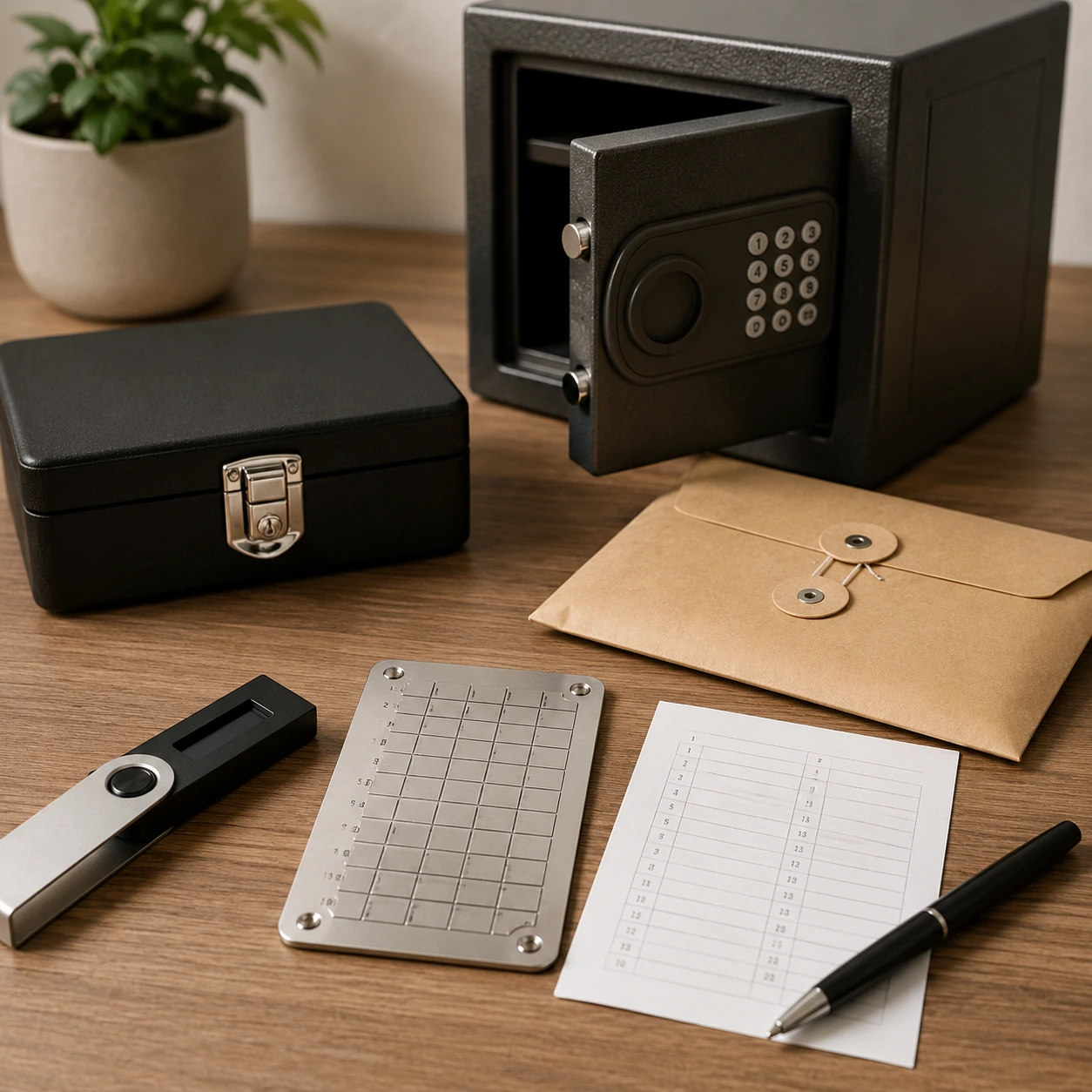
A seed phrase protects you from one of the most serious risks in self-custody: losing access to your wallet.
If your hardware wallet is damaged, lost, stolen, or no longer supported, the recovery phrase can recreate the wallet on a compatible device. That same capability also makes the phrase extremely sensitive. Anyone who obtains a complete copy may be able to restore the wallet and control its assets.
This creates an uncomfortable trade-off.
Keep only one backup, and a fire, flood, burglary, accidental disposal, or simple loss could leave you without a recovery path.
Create too many complete copies, and every additional location becomes another place where the phrase could be discovered, photographed, stolen, or mishandled.
So, how many seed phrase backups should you keep?
The Practical Answer
For many individual hardware-wallet users, a sensible baseline is:
Keep two complete physical backups, stored offline in two genuinely separate and secure locations.
A third complete copy may be appropriate when there is a clear reason, such as geographic separation, difficult travel access, business continuity, or an inheritance plan.
Keeping four, five, or more complete copies is rarely the best way to improve security. At that point, a threshold backup or multisignature structure may offer better resilience without placing a fully usable recovery phrase in every location.
This is not a universal rule. The correct number depends on your threat model, living situation, physical security, technical experience, and the consequences of losing access. Hardware-wallet manufacturers likewise recommend choosing storage arrangements according to the environmental, physical, and remote threats that apply to you.
Why One Backup Is Often Not Enough
One correctly recorded seed phrase is technically enough to restore a standard wallet.
Operationally, however, one copy creates a single point of failure.
That backup could be:
Destroyed in a fire or flood
Damaged by moisture or corrosion
Accidentally discarded
Lost during a move
Made unreadable over time
Trapped in an inaccessible property
Stolen together with the hardware wallet
A hardware wallet protects the private keys while the device is being used. The recovery phrase protects access when the device is no longer available. If both the device and the only backup are lost, there may be no practical recovery path.
Keeping one backup may be an acceptable conscious choice for a low-value experimental wallet whose loss would be tolerable. It is a weak arrangement for long-term savings or assets that would be difficult to replace.
Why Two Backups Work Well for Many People
Two complete copies provide redundancy without creating an excessive number of exposure points.
A useful two-backup structure might be:
Backup A: A protected location at or near the primary residence
Backup B: A separate secure location outside the same physical risk zone
The second location should not be another drawer in the same room.
Two copies stored in the same house can both be lost through one fire, burglary, flood, or unauthorized search. The objective is not simply to own two pieces of paper or metal. The objective is to prevent one event from destroying or exposing both.
A well-designed second location should be independent enough that:
One building fire cannot destroy both backups
One burglar cannot easily obtain both
One household member or contractor cannot discover both
One property-access problem cannot make both unavailable
At the same time, both locations must remain accessible under realistic recovery conditions.
A backup that is geographically distant but legally, practically, or physically inaccessible may provide less resilience than expected.
When a Third Backup Makes Sense
A third complete seed phrase backup can be reasonable when it solves a specific problem.
Examples include:
You regularly live in more than one country or region.
Both existing locations are exposed to the same natural disaster.
One backup may be temporarily inaccessible during travel.
A business requires a documented continuity plan.
An inheritance plan needs a controlled emergency location.
One location depends on an institution that could delay access.
The wallet protects assets whose loss would have severe consequences.
The third copy should not be created simply because “more backups must be safer.”
Every complete copy is independently capable of restoring the wallet. The third copy improves availability, but it also creates a third place that must remain confidential for as long as the wallet exists.
Recommended Backup Counts by Use Case
| Use case | Practical starting point | Main concern |
|---|---|---|
| Temporary or low-value test wallet | 1–2 copies | Avoid unnecessary complexity |
| Typical long-term self-custody | 2 copies | Balance loss protection and confidentiality |
| Geographic, travel, or inheritance risk | 2–3 copies | Maintain access across separate locations |
| Business or shared treasury | Do not rely only on duplicate copies | Consider multisig and formal access controls |
| High-consequence personal custody | Threat-model dependent | Consider threshold backups or multisig |
These are planning guidelines, not guarantees. The quality and independence of the storage locations matter more than reaching a particular number.
More Copies Also Mean More Attack Surface
The security benefit of additional copies does not increase indefinitely.
Suppose you keep six complete copies:
One at home
One at work
One with a relative
One in a vehicle
One in a bank box
One inside travel luggage
You have improved the chance that at least one copy survives.
You have also created six opportunities for someone to find a phrase that can independently restore the entire wallet.
The danger is not limited to deliberate theft. A backup may be photographed by a cleaner, viewed by a family member, exposed during a property repair, included in an insurance inventory, or discarded by someone who does not understand what it is.
The goal is therefore not maximum duplication.
The goal is sufficient recovery redundancy with the smallest manageable number of complete secrets.
A Complete Copy Is Different from a Backup Share
Two copies of the same 12- or 24-word phrase are duplicates.
Either copy can restore the wallet by itself.
A threshold backup works differently. It creates several shares and requires a predefined number of them to recover the wallet.
For example, a 3-of-5 arrangement has:
Five total shares
A recovery threshold of three
No requirement to keep all five available
A person holding only one share cannot normally restore the wallet. The wallet remains recoverable when any three valid shares are combined.
Trezor’s Multi-share Backup, based on SLIP39, supports a configurable recovery threshold and between one and sixteen shares on compatible devices. Trezor describes a 3-of-5 setup as tolerating the loss or compromise of up to two shares while retaining recovery through the remaining threshold.
This can be safer than distributing many complete BIP39 copies, but it introduces more operational complexity.
Before using a threshold system, confirm:
Your hardware and software support the format.
You understand the recovery threshold.
The shares are labeled without revealing unnecessary information.
Your future recovery environment can read the backup format.
Beneficiaries or authorized users understand the procedure.
You have tested the backup using an official verification process.
A multi-share backup is not the same as making several photocopies of one seed phrase.
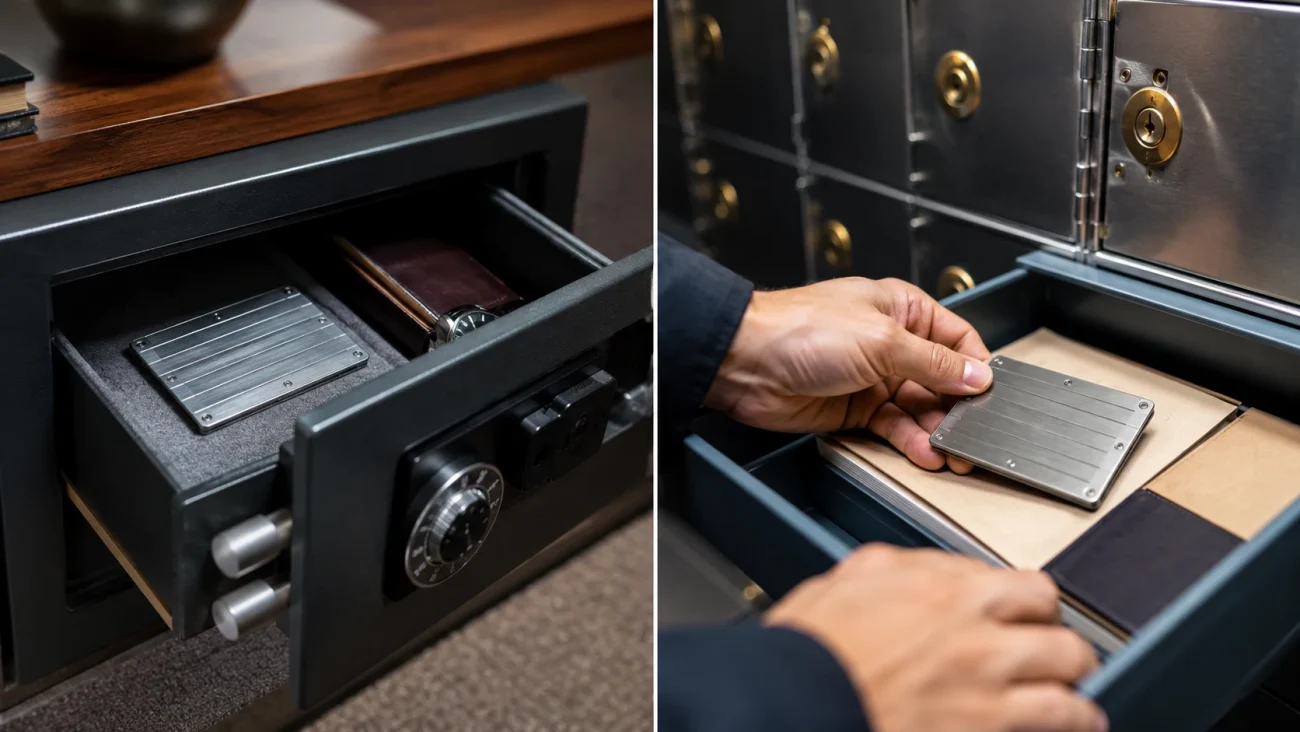
Do Not Manually Split a Standard Seed Phrase
A common homemade arrangement is to place the first half of a phrase in one location and the second half elsewhere.
Another is to create overlapping fragments, such as:
Words 1–16 in Location A
Words 9–24 in Location B
Selected words in Location C
This may look like a threshold system, but it is not a standardized secret-sharing scheme.
Manual splitting can create several problems:
Recovery instructions may be misunderstood.
Word order can be lost.
One fragment may accidentally reveal more than intended.
Family members may discard an incomplete-looking list.
A missing fragment may make recovery impossible.
The arrangement may be difficult to reconstruct years later.
Use a wallet-supported threshold standard when you need distributed shares. Do not invent a custom cryptographic system unless you have the expertise to evaluate and maintain it.
Store Every Seed Phrase Backup Offline
A seed phrase should not be photographed, emailed, uploaded, messaged, scanned, or copied into a conventional cloud document.
Avoid storing it in:
A phone photo gallery
Cloud storage
Email drafts
Messaging applications
Notes applications
Unencrypted text files
Screenshots
Online password managers
Customer-support forms
Browser extensions
General-purpose software wallets
Ledger advises users not to enter a seed phrase into a computer or smartphone and not to keep it in cloud-based services. Trezor likewise warns that digital copies can be accessed or duplicated without the owner noticing.
A hardware wallet’s security model depends partly on generating and handling the recovery secret offline. Typing that secret into an ordinary internet-connected device can undermine that protection.
Paper or Metal: Which Is Better?
A carefully stored paper backup can work.
Paper is inexpensive, easy to write, and easy to verify. Its weaknesses are environmental:
Fire
Water
Humidity
Ink fading
Tearing
Mold
Accidental disposal
A metal seed backup may offer greater resistance to some forms of heat, moisture, physical wear, and long-term degradation. Trezor’s storage guidance identifies stainless steel and titanium as examples of durable materials for physical wallet backups, while Ledger also recommends physical rather than cloud-based storage and discusses metal as an option for disaster resistance.
Metal does not solve every problem.
It does not prevent:
Theft
Photography
Unauthorized reading
Coercion
Incorrect word order
Incomplete stamping
Mislabeling
Loss of the storage location
Product resistance also varies by construction and testing. Do not assume every metal backup has the same fire, corrosion, pressure, or impact performance.
Should Both Backups Be Metal?
Not necessarily.
A reasonable arrangement might use:
One verified paper backup in a protected location
One verified metal backup in a separate location
Another user may prefer two durable metal backups because both locations face environmental risk.
The material should match the location.
For example, paper kept in a controlled indoor vault faces different risks from a backup stored in a humid or fire-prone environment.
The more important questions are:
Is the phrase complete and correctly ordered?
Can only authorized people access it?
Can it survive the likely environmental threats?
Is it separate from the other backup?
Can it still be recovered years from now?
Keep the Hardware Wallet and Backup Separate
Do not routinely store the hardware wallet directly beside its recovery phrase.
A thief who obtains the device may still need the PIN.
A thief who obtains the recovery phrase may not need the device or PIN at all. The phrase can recreate the private keys on another compatible wallet.
Keeping both together allows one theft to capture:
The signing device
The complete recovery secret
Information that identifies the wallet owner
Separation does not make the phrase harmless, but it reduces the chance that one incident compromises every component.
What About a Passphrase?
Some wallets support an optional passphrase in addition to the recovery words.
A passphrase can create a separate wallet that requires both:
The seed phrase
The exact passphrase
If used correctly, storing the passphrase separately can prevent a stolen seed phrase from immediately revealing the protected wallet.
It also creates another permanent recovery dependency.
A forgotten, misspelled, or unavailable passphrase may make the intended wallet inaccessible. Unlike an account password, there may be no reset function.
Do not store the passphrase beside every seed phrase copy if doing so removes the additional protection.
At the same time, your recovery and inheritance plan must explain how an authorized person can eventually obtain both components. A secret that survives theft but cannot be reconstructed by its owner is not a successful backup.
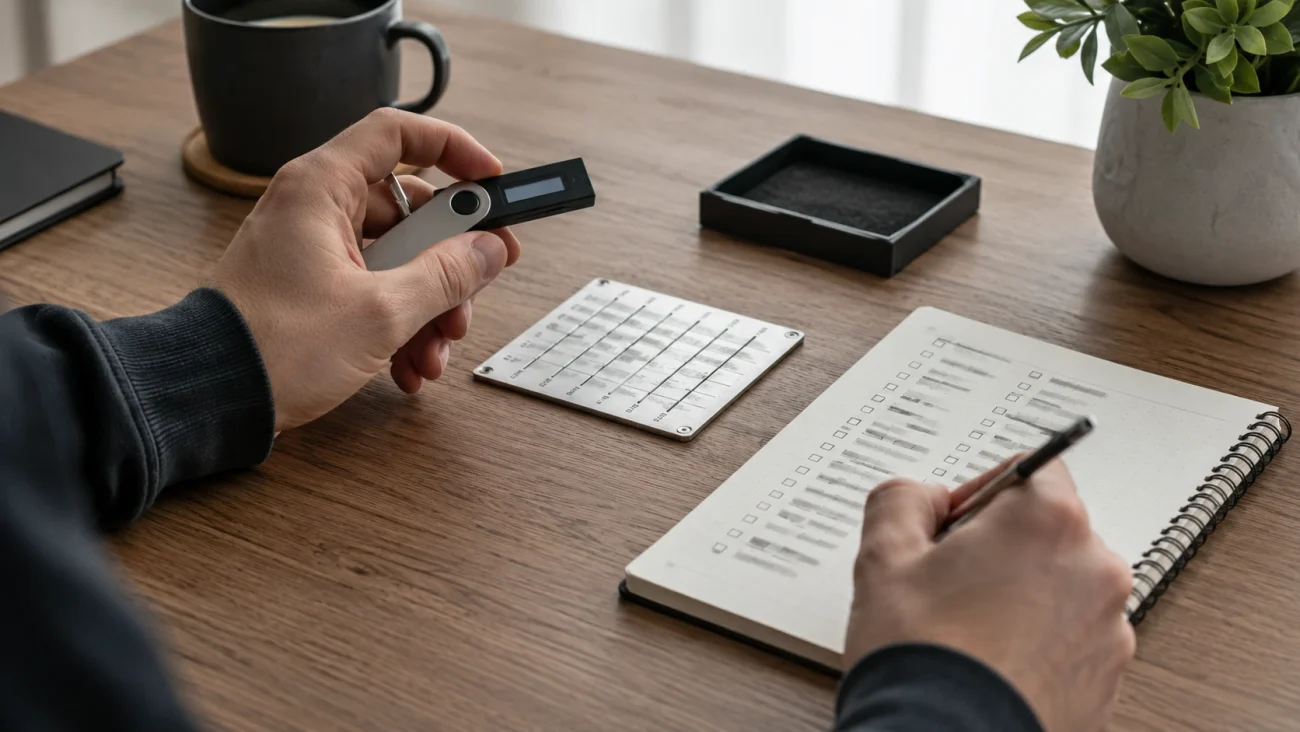
Verify Every Backup Before Relying on It
A backup is only useful if it is accurate.
Common transcription mistakes include:
Misspelled words
Reversed words
Missing words
Repeated words
Incorrect numbering
Confusing similar handwriting
Recording a backup from the wrong wallet
Omitting the passphrase dependency
BIP39 converts generated entropy into an ordered mnemonic sequence. The word order is therefore part of the backup, not an optional formatting detail.
Use the hardware-wallet manufacturer’s official backup-check function where available.
Ledger, for example, provides a Recovery Check application that verifies whether the recorded phrase matches the phrase protecting the connected device. This check is performed through the device workflow rather than by entering the words into an unknown website.
Do not verify a backup by:
Typing it into a search engine
Entering it into a web form
Sending it to support
Importing it into an ordinary software wallet
Reading it aloud during a call
Uploading a photograph for “validation”
Avoid wiping your only working hardware wallet merely to test a backup. Use the device’s official check procedure or a carefully controlled recovery test with a compatible spare device.
Review the Backup Plan Periodically
A seed phrase may remain valid for many years, but its storage environment can change.
Review the arrangement periodically and after major life events such as:
Moving home
Changing countries
Marriage or divorce
Death of a trusted person
Changing banks or vault providers
Property renovation
Flood, fire, or burglary
Changes to inheritance plans
Discovery of unauthorized access
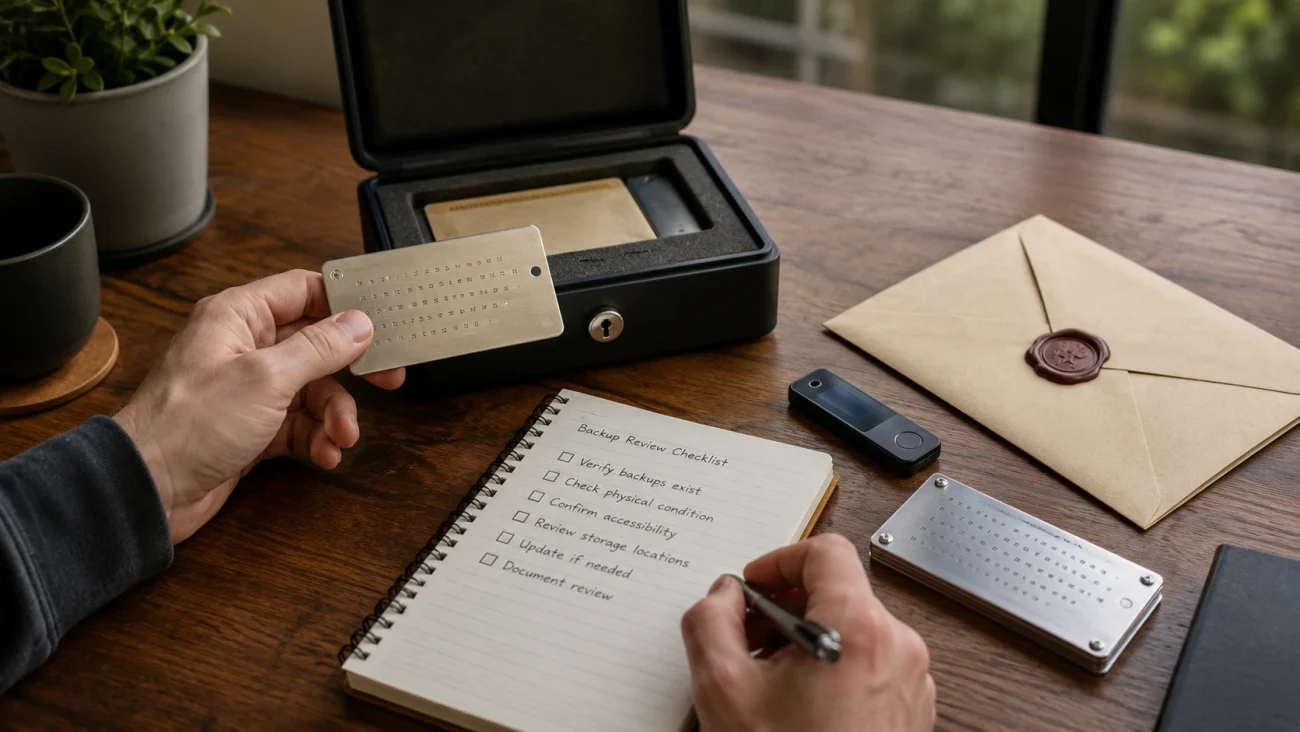
A review does not require exposing every word.
Check that:
Each storage location remains available.
Physical backups remain legible.
Containers and seals remain intact.
Authorized people know what procedure to follow.
Unauthorized people have not gained access.
Passphrase instructions remain valid.
The wallet has not been replaced without updating the backups.
Do not bring every complete copy into one room for routine inspection. That temporarily defeats the geographic separation you created.
What to Do If a Backup May Have Been Exposed
If someone may have seen, photographed, copied, or removed a complete seed phrase, treat the wallet as potentially compromised.
Moving the physical backup to a new hiding place does not make the words secret again.
The safer response is generally to:
Create a new wallet with a new recovery phrase on a trusted device.
Record and verify the new backup.
Send a small test transaction to the new wallet.
Verify the receiving address on the hardware device.
Move the remaining assets.
Retire the compromised wallet only after confirming the transfer.
Anyone with the original complete phrase may be able to restore the original wallet without possessing your hardware device.
Do not announce the suspected compromise publicly or accept unsolicited help from “recovery specialists.”
Common Seed Phrase Backup Mistakes
Keeping Every Copy in the Same Building
Multiple copies do not provide disaster resilience when one event can destroy all of them.
Taking a Photo for Convenience
The image may be copied into cloud backups, application caches, deleted-file storage, or another synchronized device.
Giving a Complete Copy to Several People
Every person becomes another full access point and another potential source of accidental disclosure.
Storing the Seed Phrase with the Hardware Wallet
One theft may compromise both the device and its recovery path.
Creating Too Many Complete Copies
More duplication can eventually increase theft risk faster than it improves recoverability.
Failing to Verify the Backup
A beautifully stored metal plate is useless if a word is missing or recorded in the wrong order.
Storing the Passphrase with Every Seed Copy
This can remove the additional protection the passphrase was intended to provide.
Using a Custom Split Scheme
An improvised arrangement may be impossible for you or your beneficiaries to reconstruct later.
Frequently Asked Questions
Is One Seed Phrase Backup Enough?
One complete backup can restore a wallet, but it creates a single point of failure.
For long-term self-custody, two separately stored physical copies are generally more resilient.
Are Two Seed Phrase Backups Enough?
For many individual users, yes.
Two verified offline copies in separate secure locations provide a practical balance between recoverability and exposure. More copies should be created only to address a defined risk.
Should I Keep Three Seed Phrase Backups?
A third copy can make sense for geographic diversity, inheritance, travel, or business continuity.
It should have a specific purpose and an independent security model. Do not create a third copy merely because additional copies feel safer.
Can I Store a Seed Phrase in a Safe-Deposit Box?
It may be one component of a backup plan, but consider access hours, identification requirements, inheritance procedures, institutional policies, and who may legally access the box.
Do not make an institutional location your only recovery path without understanding those restrictions.
Can I Store My Seed Phrase in a Password Manager?
A conventional password manager is still a digital, internet-connected environment.
For a hardware-wallet recovery phrase, physical offline storage preserves the intended separation from general-purpose computing devices. Ledger and Trezor both advise against ordinary digital storage of wallet backups.
Should I Keep the Seed Phrase and Passphrase Together?
Usually not, because obtaining both would provide access to the passphrase-protected wallet.
However, separating them requires a carefully documented recovery and inheritance plan.
Is a Multi-Share Backup Better Than Two Full Copies?
It solves a different problem.
Two full copies provide simple redundancy, but either copy can independently restore the wallet. A threshold backup requires several shares and can tolerate the loss or compromise of fewer than the recovery threshold. It is more complex and should be used only with compatible, well-understood systems.
Does Multisig Eliminate the Need for Seed Phrase Backups?
No.
A multisignature wallet uses several independent signing keys. Each key still needs an appropriate backup and recovery plan. Multisig reduces dependence on any one key but adds wallet-policy and configuration backups that must also be preserved.
Can I Destroy the Paper Copy After Making a Metal Backup?
Only after verifying that the metal record is complete, correctly ordered, readable, and recoverable.
Do not destroy the only known-good backup immediately after transferring the words to a new medium.
Final Thoughts
There is no benefit in collecting seed phrase copies without a clear storage strategy.
For many self-custody users, the strongest simple arrangement is:
Two complete physical backups
Two separate secure locations
No digital photographs or cloud copies
No routine storage beside the hardware wallet
A verified word order
A documented recovery process
Separate handling of any optional passphrase
A third copy should solve a real availability problem.
When your plan requires many locations or several trusted people, stop duplicating the entire phrase and consider whether a standardized threshold backup or multisignature wallet better matches the risk.
The number matters.
The design matters more.
A seed phrase backup should survive the loss of your hardware wallet without becoming the easiest way for someone else to take control of it.


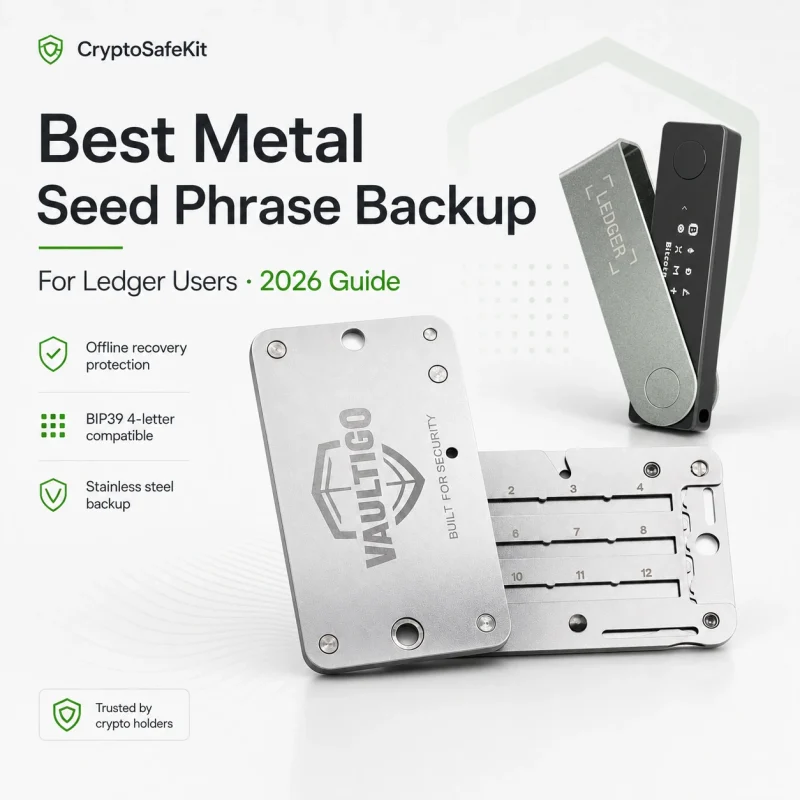
VAULTIGO 4-Letter Metal Seed Phrase Backup System
Original price was: $99.00.$59.99Current price is: $59.99.VAULTIGO 4-Letter Metal Seed Phrase Backup is a reusable stainless steel backup system designed to store your recovery words offline. Built for standard English BIP39 seed phrases, each recovery word can be identified by its first four letters, helping you create a compact, organized, and durable backup without punching, engraving, or hammering.
- Stores the first 4 letters of each recovery word
- Designed for standard English BIP39 word lists
- No punching, engraving, or hammering required
- Reusable metal letter tiles
- Water and corrosion resistant stainless steel design
- Lockable structure for added physical protection
- Ideal for hardware wallets, cold wallets, and long-term crypto self-custody
Security Disclaimer
This article is provided for general educational purposes only. It does not constitute financial, investment, legal, tax, insurance, estate-planning, or personalized security advice.
Self-custody arrangements should reflect your own threat model, jurisdiction, technical experience, household situation, and recovery requirements.
Never enter a seed phrase, private key, hardware-wallet PIN, or passphrase into a website, cloud service, support form, messaging application, or unknown software.