

What Are the Safest Crypto Cold Wallets in 2026? 6 Security Models Compared

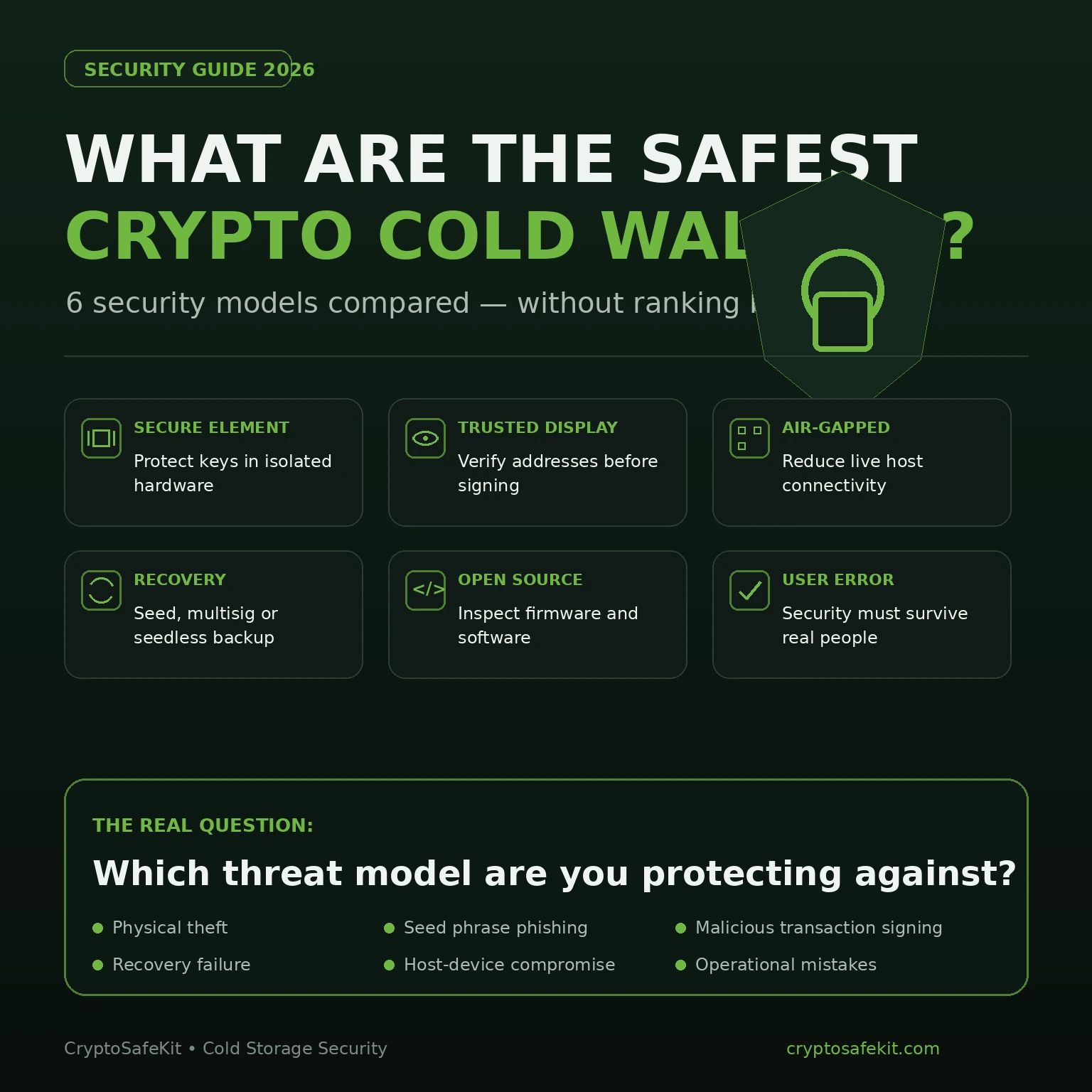
What is the safest crypto cold wallet in 2026? There is no single honest answer, because the strongest hardware wallet against physical extraction may not be the strongest against seed-phrase phishing, malicious transaction signing or recovery failure.
The leading cold wallets now take very different approaches. Ledger uses certified Secure Elements and trusted hardware displays. Trezor emphasizes open-source security and layered recovery. Tangem can eliminate the traditional recovery phrase entirely. COLDCARD focuses aggressively on Bitcoin-only air-gapped signing. Keystone prioritizes QR-based isolation and multiple security chips.
That means choosing the safest wallet requires identifying the threat you actually want to defend against.
In this guide, we compare six of the strongest current hardware-wallet architectures: Ledger Nano Gen5, Trezor Safe 7, Tangem Wallet, COLDCARD Q, Trezor Safe 5 and Keystone 3 Pro.
Rather than giving every device a meaningless numerical security score, we evaluate secure hardware, transaction verification, software transparency, connectivity, recovery design, seed-phrase exposure, physical security and user-error resistance.
Ledger Nano Gen5
Strong multi-chain choice with an EAL6+ Secure Element, trusted E Ink touchscreen, Clear Signing, Transaction Check and flexible USB-C, Bluetooth and NFC connectivity.
Trezor Safe 7
Three-chip security architecture, auditable TROPIC01 Secure Element, EAL6+ secondary Secure Element, open-source software and Advanced Multi-share Backup.
Tangem
EAL6+ card-based hardware with an optional seedless multi-card backup model that removes conventional recovery-word exposure.
COLDCARD Q
Dual Secure Elements, PSBT workflows, QR scanner, MicroSD, anti-phishing login words and extremely configurable physical-security controls.
Trezor Safe 5
EAL6+ Secure Element, open-source firmware, color touchscreen and no Bluetooth radio to manage.
Keystone 3 Pro
QR-oriented air-gapped workflow, large touchscreen, three security chips and support for multiple wallet profiles.
What Does “Safest Crypto Cold Wallet” Actually Mean?
Cold storage means keeping the private keys required to control cryptocurrency isolated from ordinary internet-connected systems.
But offline key storage is only one part of hardware-wallet security.
A serious comparison should ask at least seven questions:
Can malware extract the private key?
What happens if someone steals the device?
Can you independently verify what you are signing?
What happens if the wallet is destroyed?
Does a separate master secret exist outside the device?
Can firmware and application code be independently inspected?
How easy is it to make a catastrophic mistake?
Security depends on the entire system: hardware, firmware, display, backup architecture, transaction workflow and the person operating it.
Safest Crypto Cold Wallets Compared
| Wallet | Core Security | Trusted Screen | Air-Gapped Option | Recovery Model | Best For |
|---|---|---|---|---|---|
| Ledger Nano Gen5 | EAL6+ Secure Element | Yes | No strict air gap | Seed + Recovery Key | Most multi-chain users |
| Trezor Safe 7 | Dual SE + MCU | Yes | No | 12/20/24 words + Multi-share | Open-source defense-in-depth |
| Tangem | EAL6+ Secure Element | No | NFC-only card interaction | Seedless cards or optional seed | Seed-phrase risk reduction |
| COLDCARD Q | Dual multi-vendor SE | Yes | Yes | BIP39 / advanced Bitcoin backups | Advanced Bitcoin security |
| Trezor Safe 5 | EAL6+ Secure Element | Yes | No | 12/20/24 words + Multi-share | Open-source wired security |
| Keystone 3 Pro | Three security chips | Yes | QR workflow | Seed / Shamir options | Air-gapped multi-chain use |
Notice that no row wins every column. That is why security rankings that simply declare one device “the safest wallet in the world” should be treated cautiously.
1. Ledger Nano Gen5
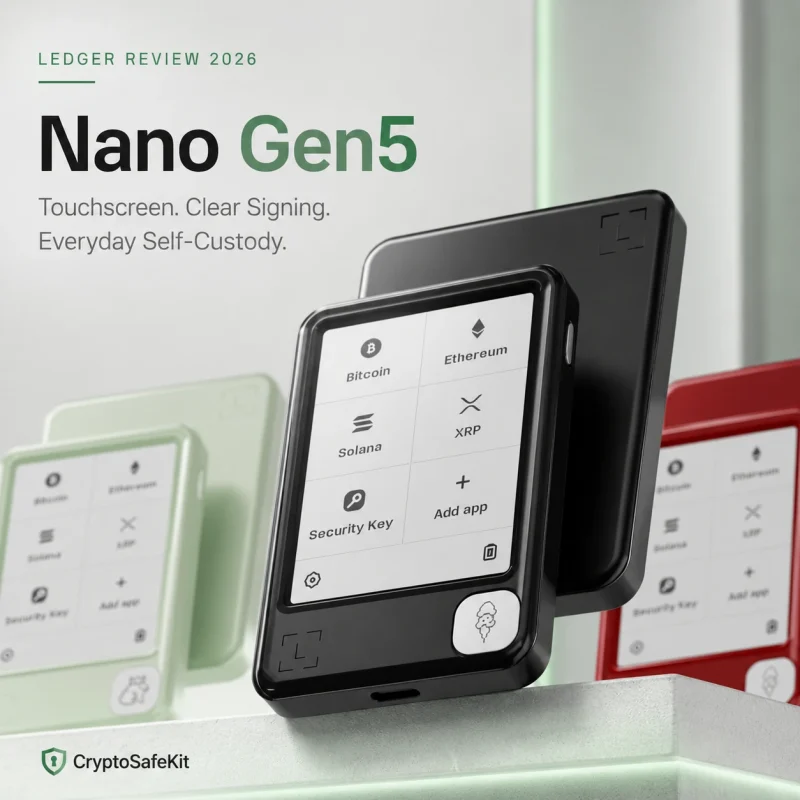
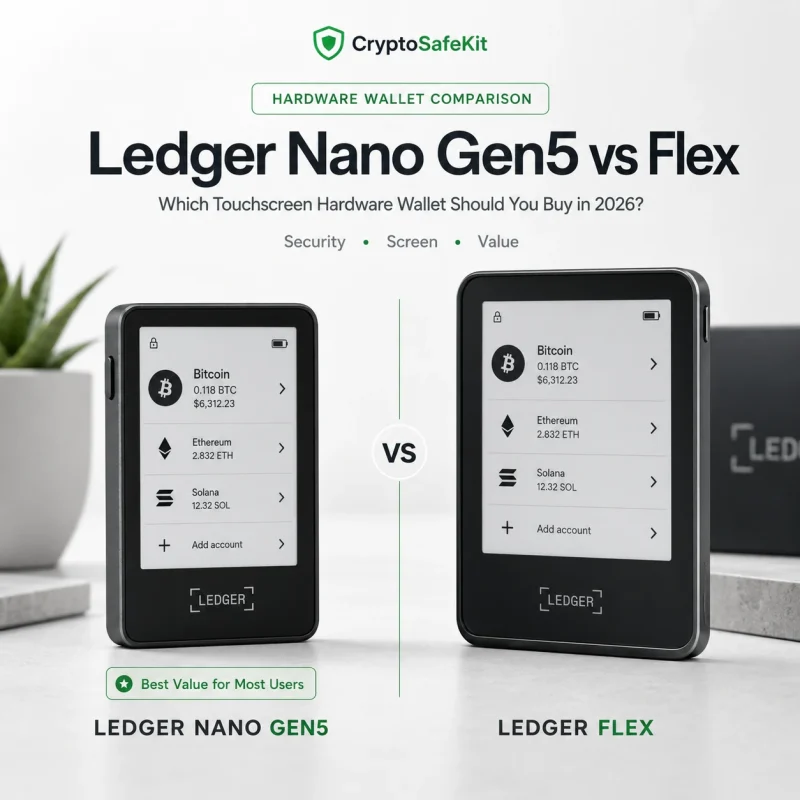
Nano Gen5 is one of the strongest choices for users who want high-assurance hardware security without giving up modern multi-chain usability.
It uses an ST33K1M5 Secure Element certified to CC EAL6+ and runs Ledger OS.
More importantly, the Secure Element works with a dedicated E Ink touchscreen, allowing supported transaction information to be reviewed independently from the phone or computer that prepared the transaction.
Why that matters
Imagine clipboard malware replaces a receiving address on your computer.
If you verify only the computer display, you may approve the attacker’s address. A separate trusted hardware screen gives you another point of verification.
- EAL6+ Secure Element
- Secure 2.8-inch E Ink touchscreen
- Clear Signing for supported transactions
- Transaction Check for supported threat detection
- PIN-protected hardware access
- USB-C, Bluetooth and NFC
- Ledger Recovery Key included
- Broad multi-chain and third-party wallet ecosystem
Main trade-off
Ledger’s firmware and Ledger OS are not fully open-source in the same way Trezor’s software stack is.
Nano Gen5 also supports several connectivity methods. More interfaces do not automatically make a device insecure, but users seeking the smallest possible communications surface may prefer a wired-only or explicitly air-gapped architecture.
A strong option for users who prioritize trusted transaction verification, mobile connectivity and current-generation secure hardware.
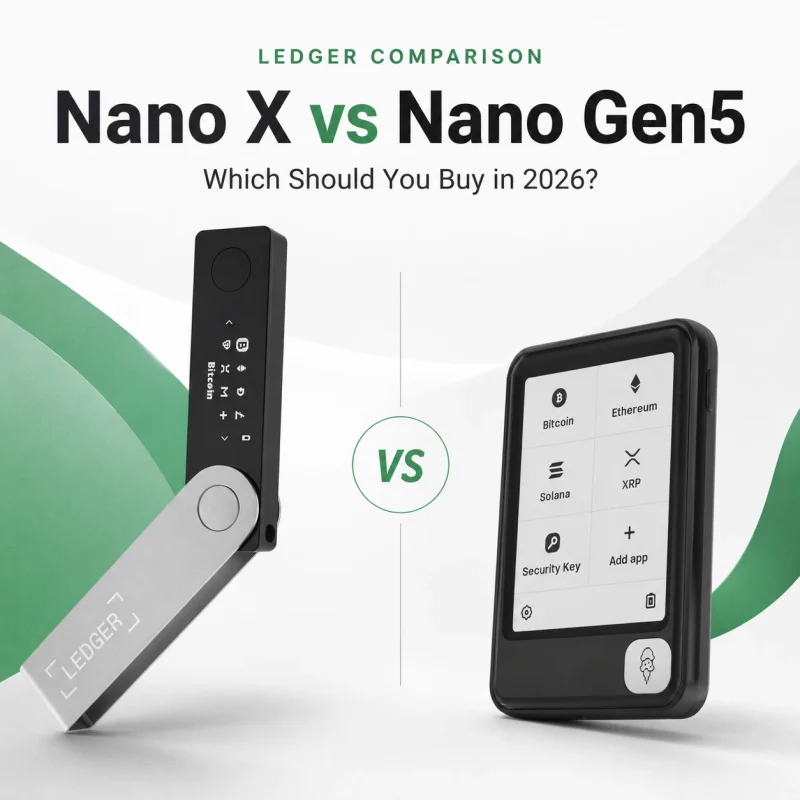
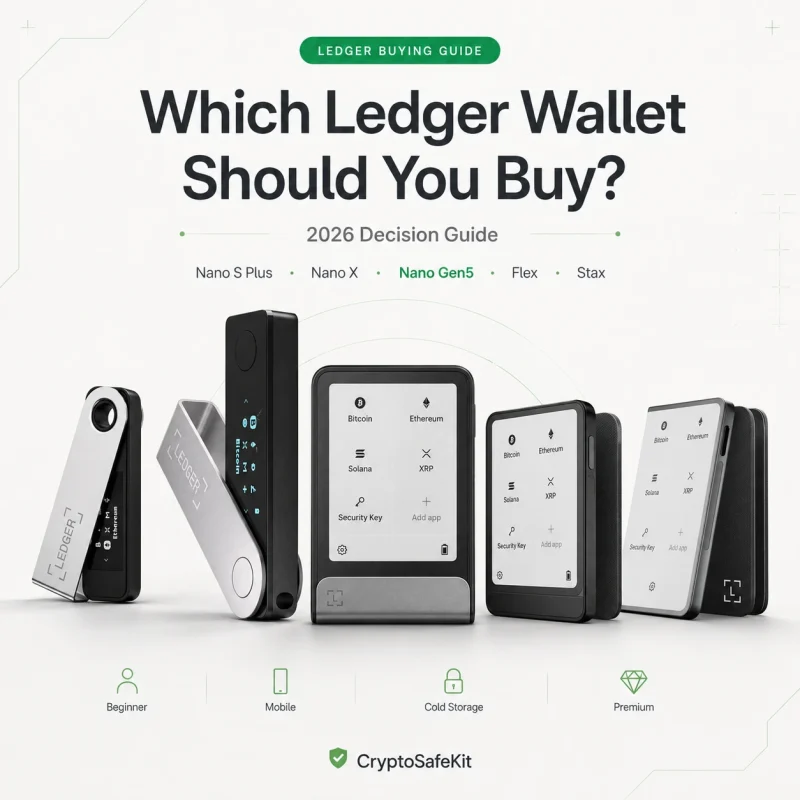
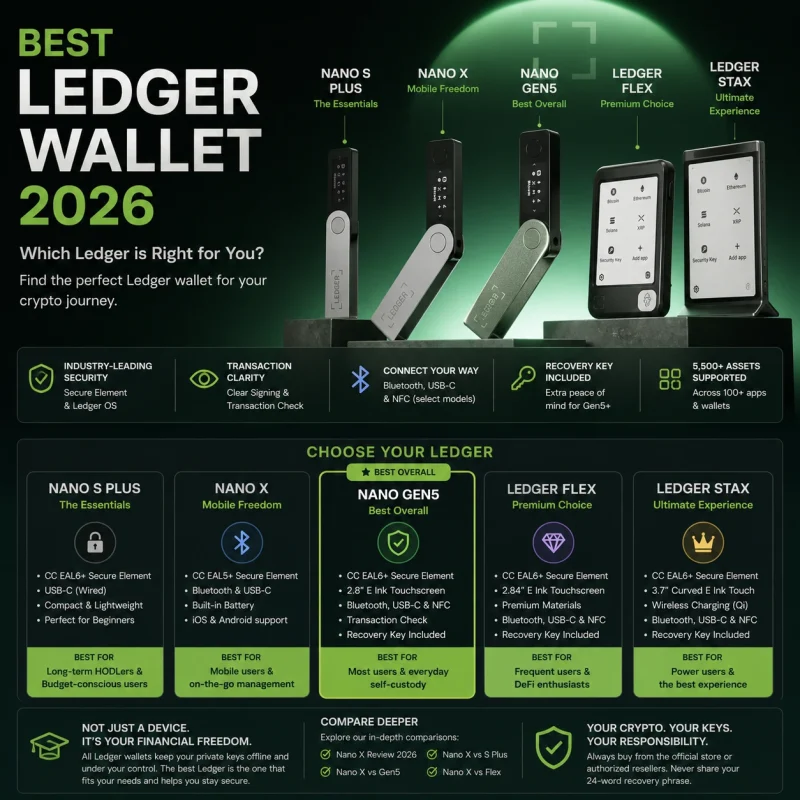
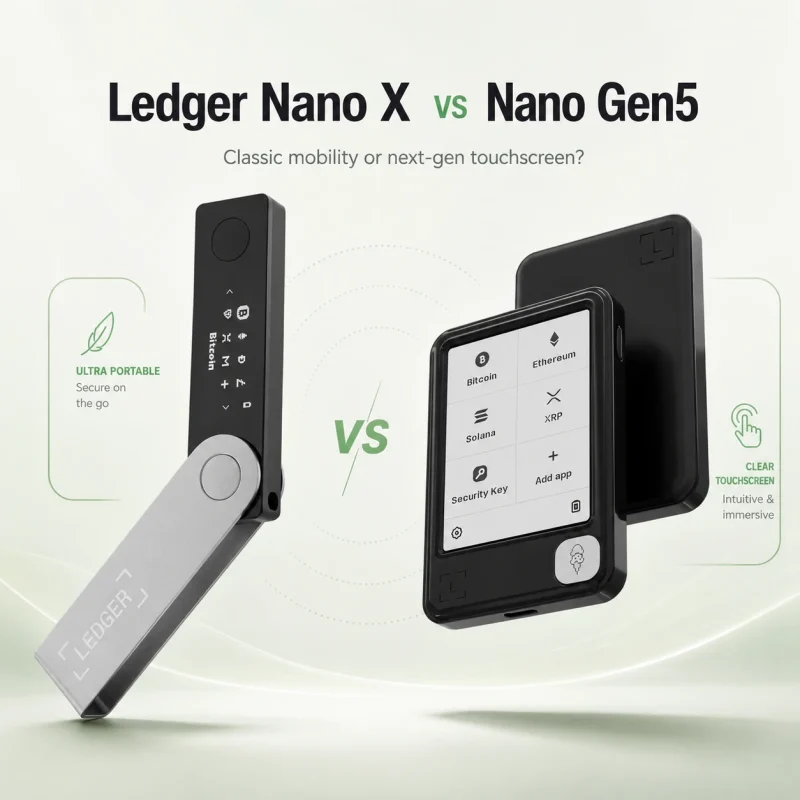
If you are choosing between Ledger models, see our Ledger Nano X Review 2026 for context on how the older Nano architecture differs.
2. Trezor Safe 7
Trezor Safe 7 takes perhaps the most interesting hardware-security approach on this list.
Instead of relying on one security chip, it combines three independent hardware layers:
- TROPIC01 auditable Secure Element
- Infineon OPTIGA Trust M EAL6+ Secure Element
- STM32U5 hardened microcontroller
The architecture is designed so that breaking one component is not enough to recover everything necessary to compromise the wallet.
Trezor also keeps its software stack open-source, which allows researchers and users to inspect and reproduce significant parts of the security system.
Safe 7 supports a 2.5-inch color touchscreen, PIN and passphrase protection, Advanced Multi-share Backup, Tor privacy features, Bluetooth and USB-C.
An important 2026 security disclosure
In early 2026, Ledger Donjon researchers discovered a laser fault-injection vulnerability in the TROPIC01 chip when testing that component separately.
Trezor disclosed the issue publicly and stated that the attack affected one component, not the complete three-layer Safe 7 security architecture.
What matters is whether the vulnerability compromises the complete system, how reproducible the attack is, and how openly the manufacturer responds.
Safe 7’s so-called “quantum-ready” architecture also needs to be described accurately. It uses post-quantum cryptography for areas such as firmware authentication and boot integrity; it does not magically make existing Bitcoin or Ethereum cryptography quantum-proof.
3. Tangem Wallet
Tangem attacks a completely different problem: what if the recovery phrase itself is the biggest security weakness?
The Tangem card contains an EAL6+ certified Secure Element. Private keys are generated inside the chip and signing occurs inside that isolated hardware.
Users can choose a seedless setup in which backup capability is copied securely to two or three Tangem cards instead of writing down a traditional recovery phrase.
That can eliminate several extremely common attack paths:
- Seed phrase photographs
- Cloud backup exposure
- Fake recovery websites
- Paper recovery sheets being stolen
- Mnemonic words being copied incorrectly
Tangem also uses factory-installed immutable card firmware. Its card architecture and companion software have undergone independent security reviews, including audits involving Kudelski Security, Riscure and Cure53.
The major trade-off: no independent wallet screen
Tangem cards do not contain their own display.
Transaction information is presented through the smartphone application. The card signs securely inside its Secure Element, but the user does not have a completely separate hardware screen on which to independently compare the destination and amount.
Whether that trade-off is safer depends on which threat you consider more likely.
4. COLDCARD Q
COLDCARD Q is aimed at a very different audience.
It is Bitcoin-only and is built around users who want extensive control over exactly how signing information reaches the private-key device.
The Q uses two Secure Elements from different vendors alongside the main processor. Its security workflow includes:
- Dual multi-vendor Secure Elements
- QR-code transaction transfer
- Dual MicroSD slots
- PSBT-based signing
- Anti-phishing PIN words
- Configurable Trick PINs
- Physical tamper visibility
- Optional permanent USB and NFC data disabling
It can be operated without maintaining a live data connection to a computer, making it highly attractive for advanced Bitcoin users building deliberately isolated signing workflows.
Important: check the 2026 seed-generation advisory
COLDCARD’s current documentation warns that a seed-generation defect affected certain firmware releases beginning with version 4.0.1.
Fixed firmware is available, but there is an important distinction: if a seed was originally created using affected firmware, updating the device alone does not make that existing seed safe.
Users with potentially affected seeds should follow the manufacturer’s migration process.
When a seed-generation issue occurs, migration to newly generated wallet keys can be necessary.
COLDCARD remains one of the most feature-rich security devices for Bitcoin, but it is not the product we would choose for a beginner who simply wants to hold multiple cryptocurrencies.
5. Trezor Safe 5
Trezor Safe 5 is arguably the cleaner choice for users who like Trezor’s open-source philosophy but do not need Safe 7’s Bluetooth, battery and more complex hardware architecture.
It uses the OPTIGA Trust M Secure Element certified to CC EAL6+ and combines it with Trezor’s open-source firmware.
Security features include:
- EAL6+ Secure Element
- Color touchscreen
- On-device PIN and passphrase entry
- USB-C wired connection
- 12-, 20- and 24-word backup support
- Advanced Multi-share Backup
- Tor integration and coin control through Trezor Suite
For users who keep a wallet primarily at home and do not require wireless signing, having fewer connectivity methods can be a perfectly rational security choice.
6. Keystone 3 Pro
Keystone 3 Pro is designed for users who like COLDCARD’s isolation philosophy but need a broader multi-chain wallet.
Its architecture emphasizes QR-code communication rather than a conventional continuous data connection.
Current features include:
- Three independent security chips
- 4-inch touchscreen
- Air-gapped QR-code transaction workflow
- Open-source software
- Fingerprint authentication
- Passphrase support
- Shamir backup support
- Support for several separate wallet profiles
Its trade-off is complexity. QR workflows, multiple wallets, Shamir recovery and advanced settings are useful only when the owner understands how they work.
Seed Phrase vs Seedless: Which Is Actually Safer?
This may be the most important disagreement between modern cold-wallet architectures.
Traditional recovery phrase
Ledger, Trezor, COLDCARD and Keystone can use mnemonic recovery backups.
The advantage is portability: if the original hardware fails, compatible recovery information can recreate the wallet elsewhere.
The disadvantage is that the recovery phrase becomes a second physical representation of wallet control.
A destroyed hardware wallet does not automatically destroy access to the assets.
Anyone who obtains it may be able to recreate the wallet elsewhere.
Seedless multi-device recovery
Tangem’s seedless option instead makes additional cards the recovery redundancy.
This means there is no recovery sheet for someone to photograph or enter into a phishing website.
But if every valid backup card is permanently destroyed and no other recovery method exists, the owner cannot simply reconstruct the wallet from a mnemonic stored elsewhere.
Traditional wallets ask you to protect secret information. Seedless multi-card systems ask you to protect redundant signing hardware.
If you use a conventional recovery phrase, see our guide to real seed phrase attack vectors before deciding how to store it.
Is an Air-Gapped Wallet Automatically Safer?
No.
Air-gapping can reduce direct communication between the signing device and the online computer. That is valuable, particularly for highly conservative Bitcoin setups.
But transactions still have to cross the gap somehow.
They may move through:
- QR codes
- MicroSD cards
- NFC
- Other controlled transport mechanisms
A malicious transaction transferred through a QR code is still malicious.
Isolation changes how data reaches the signer. It does not guarantee that the data itself matches what the user intended.
Why the Hardware Screen Is One of the Most Important Security Features
One of the most realistic attacks against a hardware-wallet user does not involve extracting a private key.
Malware simply changes the transaction before the user signs it.
That is why Ledger, Trezor, COLDCARD and Keystone all place significant emphasis on reviewing transaction information on the physical device.
Ledger’s current touchscreen devices go further with Clear Signing and Transaction Check for supported interactions.
Trezor provides its own on-device verification model, while COLDCARD emphasizes explicit PSBT review.
Tangem’s screenless design is the outlier: cryptographic signing remains hardware-isolated, but transaction interpretation happens on the smartphone.
Which Cold Wallet Is Safest for You?
Multi-chain + DeFi users
Best fit when trusted transaction verification and broad ecosystem compatibility matter more than strict air-gapping.
Transparency-focused users
Strong fit if open-source software, multi-chip security and sophisticated backup options are top priorities.
Users worried about seed phrases
A strong choice if your biggest concern is losing, exposing or being phished for traditional recovery words.
Advanced Bitcoin holders
Designed for users who understand PSBTs, air gaps, passphrases and deliberate Bitcoin-only signing workflows.
Wired long-term storage
Strong option for users who value open source, a trusted touchscreen and relatively simple USB-only connectivity.
Air-gapped multi-chain users
Better fit for users who want QR-based isolation without restricting themselves to Bitcoin.
How We Would Choose a Cold Wallet in 2026
For most people, we would prioritize features in this order:
It is the device whose security model you understand well enough to use correctly for years without creating a weaker backup or transaction process around it.
Cold Wallet Security Checklist
- Purchase from the manufacturer or a genuinely trusted authorized source.
- Inspect tamper-evident packaging and run device-authenticity checks where supported.
- Initialize the wallet yourself.
- Never use a recovery phrase supplied on a pre-printed card inside the package.
- Install current verified firmware before creating a long-term wallet.
- Check manufacturer security advisories before generating a seed.
- Never photograph or upload a recovery phrase.
- Verify receiving addresses on the hardware device where supported.
- Use a small test transaction when moving significant assets to a new wallet.
- Understand exactly how your recovery system works before funding the wallet.
- Do not store the only recovery backup beside the hardware wallet.
- Review your backup periodically without unnecessarily exposing it.
What Are the Safest Crypto Cold Wallets in 2026?
There is no universal winner, but there are clear leaders for different security models.
Ledger Nano Gen5
Strong Secure Element, trusted touchscreen and modern transaction verification make it one of the most balanced options for multi-chain users.
Trezor Safe 7
Multi-chip protection, open-source software and sophisticated recovery make it especially interesting for users who prioritize verifiability.
Tangem
The card-backup model removes traditional recovery-word exposure, although the lack of an independent screen creates a different trade-off.
COLDCARD Q
Highly configurable air-gapped signing and dual Secure Elements make it a powerful option for experienced Bitcoin users.
Trezor Safe 5 is particularly compelling for users who want a simpler open-source wired wallet, while Keystone 3 Pro offers a useful middle ground for multi-chain users who prefer QR-based signing.
The safest cold wallet is the one that protects the private key, helps you verify what you sign, and gives you a recovery strategy that does not become the weakest link.
For significant long-term holdings, the hardware device should also be only one layer of a broader security plan covering recovery backups, physical access, privacy and transaction verification.
Our complete cold-storage security guide explains how those layers work together.
Safest Crypto Cold Wallet FAQ
What is the safest crypto cold wallet?
There is no single safest device for every threat model. Ledger Nano Gen5 offers a strong balance of Secure Element protection and trusted transaction verification; Trezor Safe 7 emphasizes open-source multi-layer security; Tangem reduces seed-phrase exposure; and COLDCARD Q specializes in advanced Bitcoin-only isolation.
Are hardware wallets safer than exchanges?
Hardware wallets remove much of the exchange counterparty risk by giving the user control of the signing keys. They also transfer responsibility for recovery, backups and transaction security to the owner.
Is Ledger safer than Trezor?
They emphasize different security strengths. Ledger focuses heavily on certified Secure Elements and trusted-display transaction verification, while Trezor places stronger emphasis on open-source transparency and flexible recovery architecture.
Is Tangem safer because it has no seed phrase?
Tangem’s seedless setup can substantially reduce mnemonic theft and phishing risk. However, Tangem is screenless, so users rely on the smartphone interface to interpret transaction information.
Are air-gapped wallets the safest?
Air-gapping reduces direct communication with an online computer, but transaction files still cross the gap and must be verified on the hardware device. An air gap is one security control, not a complete security guarantee.
What is the safest cold wallet for Bitcoin only?
COLDCARD Q is one of the strongest options for advanced Bitcoin-only users because it supports dual Secure Elements, PSBT workflows, QR and MicroSD transfer, anti-phishing words and extensive physical-security settings. Users should check current firmware security advisories before generating or using long-term seeds.
What is the safest cold wallet for beginners?
A device with strong hardware security and an easy-to-read trusted screen is generally easier for beginners to use correctly. Ledger Nano Gen5 and Trezor Safe 5 are strong candidates depending on ecosystem and connectivity preferences.
Should I store a large amount of crypto on one hardware wallet?
Large holdings justify stronger redundancy and threat modeling. Some users separate assets across wallets or use multisignature arrangements so one device, backup or location does not become a single point of failure.
Can a cold wallet still be hacked?
No hardware wallet eliminates all risk. Physical attacks, firmware vulnerabilities, supply-chain attacks, phishing, malicious transaction approval and recovery-phrase exposure remain possible security considerations.
What matters more: the wallet or the seed phrase backup?
Both matter. A highly secure hardware wallet cannot protect assets if its recovery phrase is photographed, uploaded to the cloud or given to a phishing site. Recovery architecture should be evaluated alongside device security.
Sources & Methodology
This comparison was prepared using current August 2026 manufacturer specifications, published security documentation, audit disclosures and active security advisories. We evaluate wallet architectures rather than treating manufacturer marketing claims or certification numbers as an automatic security ranking.
- Ledger — Nano Gen5 Technical Specifications and 2026 Signer Comparison
- Trezor — Safe 7 Security Architecture and TROPIC01 Disclosure
- Trezor — Safe 5 Technical and Secure Element Documentation
- Tangem — Security Architecture and Independent Audit Documentation
- COLDCARD — Q Security Architecture and Current Security Advisory
- Keystone — Keystone 3 Pro Security Architecture