

Metal Seed Phrase Backup vs Paper: Which Is Safer Long Term?

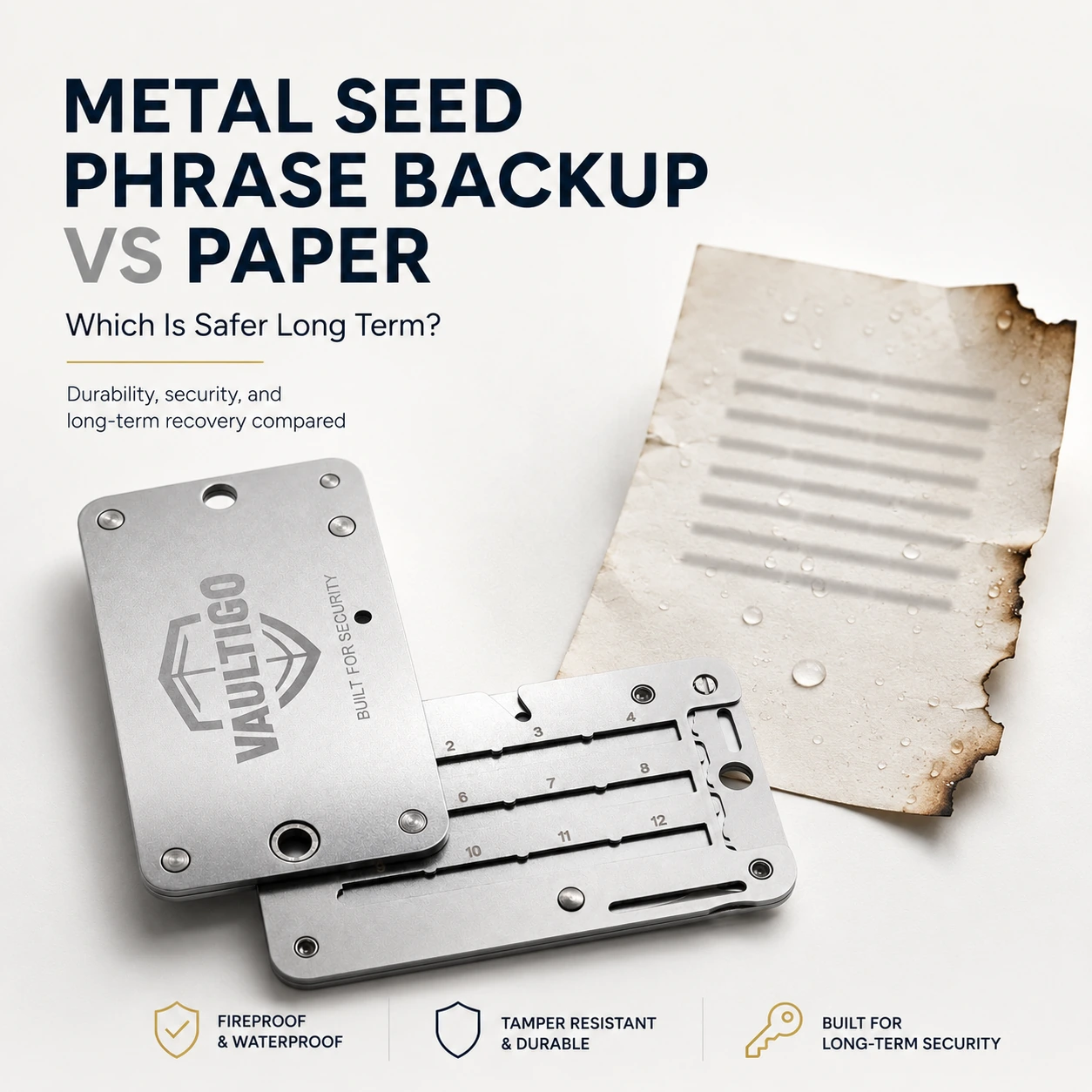
When comparing a metal seed phrase backup vs paper, metal is generally the stronger choice for long-term physical resilience. Steel and titanium backups are far better suited to surviving water, heat, tearing, abrasion, and years of storage than an ordinary sheet of paper.
But that does not mean metal is automatically safer in every respect.
Paper can be easier to conceal, easier to replace, inexpensive, and perfectly adequate in a carefully controlled environment. Metal solves primarily a durability problem. It does not solve theft, unauthorized access, incorrect word order, poor passphrase management, or a badly designed recovery plan.
For significant cryptocurrency holdings that may remain in self-custody for years, the more useful conclusion is:
Paper can be a valid offline backup. Metal is usually the more resilient long-term backup. Neither is secure if the recovery information is exposed or recorded incorrectly.
That distinction matters because your seed phrase may outlive the hardware wallet it was created with.
Why Your Seed Phrase Matters More Than the Hardware Wallet
A hardware wallet is replaceable.
The recovery information protecting the wallet is much harder to replace.
A seed phrase, also called a recovery phrase or mnemonic phrase, represents the recovery information from which a deterministic wallet can reconstruct its keys. BIP39 is one widely used standard for expressing this information as a human-readable sequence of words.
If your Ledger, Trezor, or another hardware wallet:
stops working,
is lost,
is stolen,
is damaged,
is reset,
the recovery phrase can be used to reconstruct the wallet in a compatible recovery environment.
Ledger describes the seed phrase as the backup used to regain access if something happens to the hardware device. It also warns that anyone who obtains the phrase may gain access to the associated accounts.
This makes the recovery medium unusually important.
You are not protecting an ordinary password.
You are protecting information that may need to remain:
accurate,
readable,
private,
recoverable,
for many years.
Paper Seed Phrase Backup: Why It Is Still Used
Paper is sometimes dismissed too quickly.
Writing a recovery phrase on paper has several genuine security advantages.
It is:
offline,
inexpensive,
easy to understand,
easy to replace before funds are deposited,
independent of software,
independent of batteries,
independent of a manufacturer.
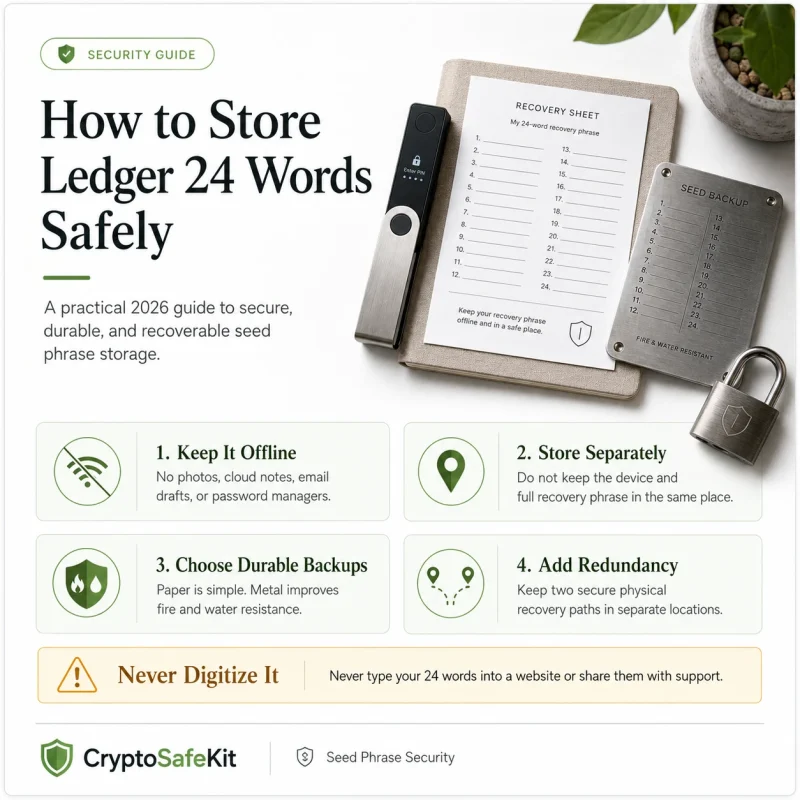
Ledger itself defines a recovery sheet as a physical paper backup for recording recovery words offline.
For a beginner setting up a hardware wallet, paper also reduces one major risk:
digital exposure.
The seed does not need to enter:
a computer,
smartphone,
cloud account,
password manager,
email,
screenshot library.
That is important.
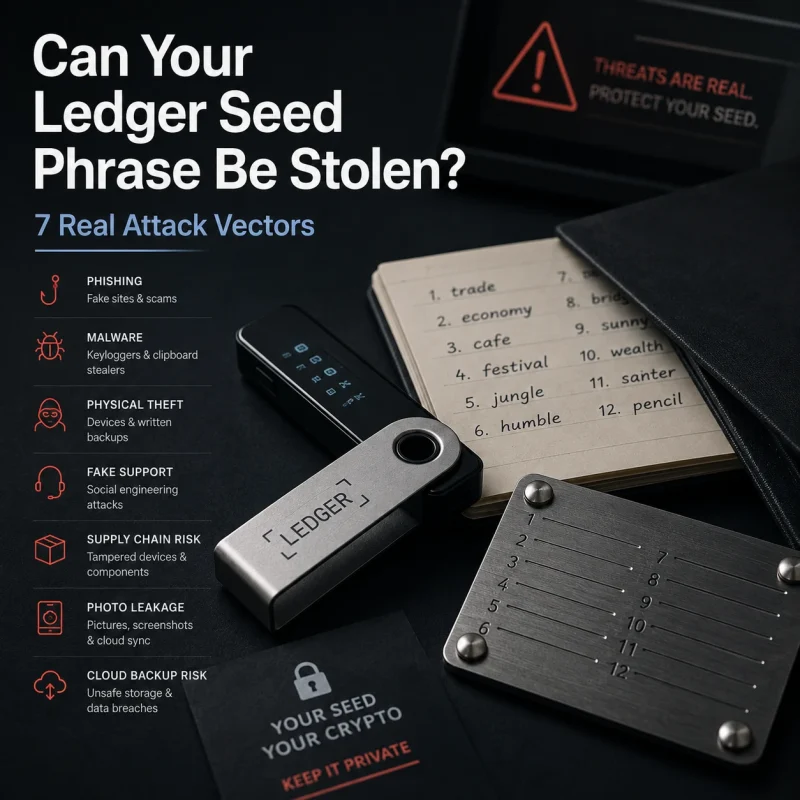
Ledger specifically advises users not to enter their seed phrase into internet-connected devices or store photographs of it online because doing so creates additional attack paths.
So paper is not an inherently bad backup.
Its weakness is somewhere else.
The Main Problem With Paper: Physical Failure
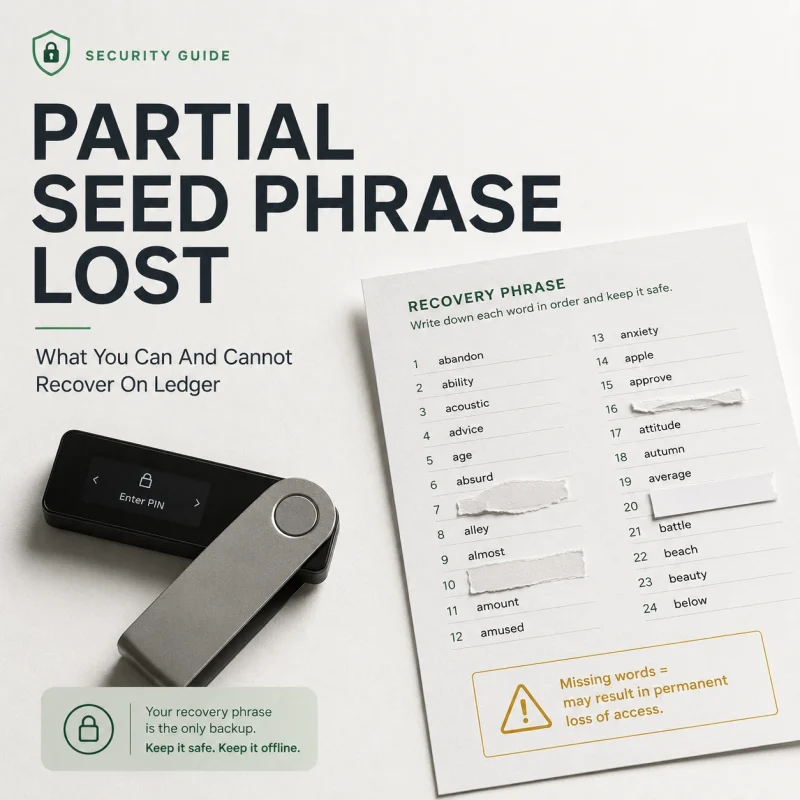
A paper seed phrase can be cryptographically perfect while being physically fragile.
The risks are ordinary.
That is what makes them dangerous.
Water
A pipe leaks.
A basement floods.
A fire sprinkler activates.
A drink spills inside a desk drawer.
Depending on the ink, paper type, duration of exposure, and storage method, a recovery sheet may smear, deform, tear, or become difficult to read.
Ledger specifically identifies water as a risk to paper recovery backups.
Fire
Paper is combustible.
A recovery sheet stored in the same home as the hardware wallet creates a particularly obvious correlated risk:
one fire can affect both the device and the backup.
That is exactly the scenario a disaster-recovery system should prevent.
Ink Degradation
Not every pen is archival.
Trezor notes that common dye-based inks can fade over long periods, particularly when exposed to light, humidity, or heat, while archival pigment-based inks are more suitable for permanent records.
Tearing and Abrasion
Paper can:
fold,
crease,
tear,
rub against other objects,
lose ink or graphite through repeated handling.
These risks sound trivial until the damaged area contains word #17 of a 24-word recovery phrase.
Accidental Disposal
This is one of the most underestimated threats.
To another person, a seed phrase may look like:
an old handwritten note,
a meaningless numbered word list,
obsolete paperwork.
During:
moving,
cleaning,
renovation,
estate management,
someone may discard it without understanding what it controls.
No hacker is required.
Hypothetical Example: The Backup That Looked Like Trash
Imagine a Ledger owner creates a 24-word recovery phrase in 2026.
The hardware wallet goes into a safe.
The recovery sheet goes inside an envelope in another drawer.
Seven years later, the family moves house.
Someone finds the envelope.
There is no obvious explanation on it.
It contains a handwritten list of words.
It gets thrown away.
The Ledger still works, so nobody notices.
Three years later, the device fails.
The real security failure did not occur when the Ledger broke.
It happened three years earlier when the only recovery backup disappeared.
That is the kind of problem long-term backup design must address.
What a Metal Seed Phrase Backup Changes
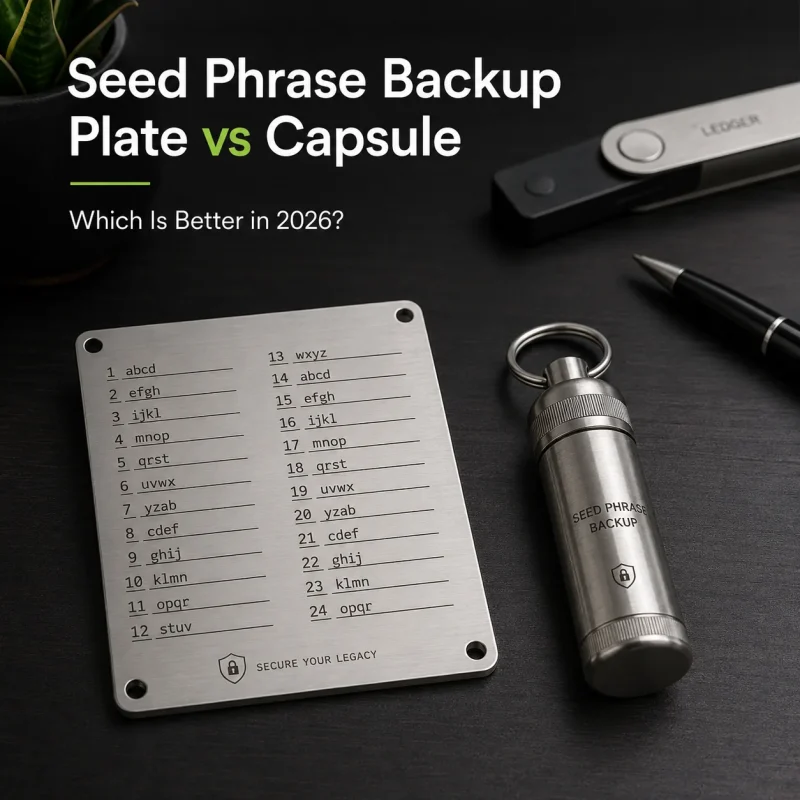
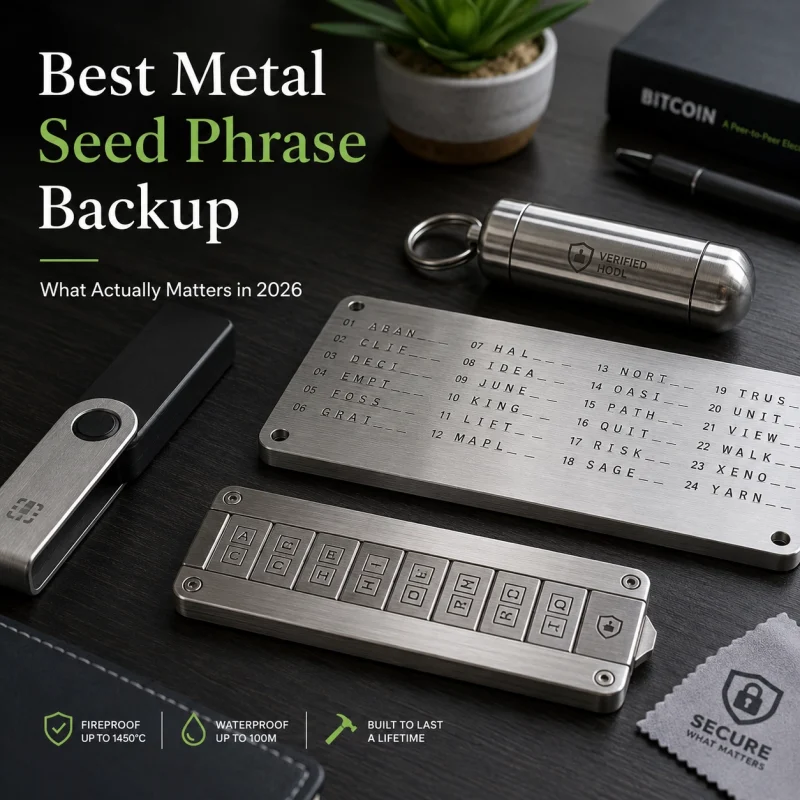
A metal seed phrase backup replaces fragile paper with a physically durable material such as stainless steel or titanium.
The purpose is not stronger encryption.
Metal does not change your cryptography.
It changes the physical failure model.
Ledger currently recommends durable physical materials such as metal for users looking to protect recovery information from environmental damage and specifically identifies fire and water resilience as reasons to consider metal storage.
Trezor similarly describes metal as substantially more resistant to fire and water than paper, while acknowledging that metal is less discreet and harder to modify.
That is a much more accurate description than calling metal “100% secure.”
Metal Seed Phrase Backup vs Paper: Direct Comparison
| Security Factor | Paper Backup | Metal Backup |
|---|---|---|
| Offline storage | Excellent | Excellent |
| Fire resilience | Weak | Significantly stronger |
| Water resilience | Weak to moderate depending on protection | Stronger |
| Tear resistance | Weak | Strong |
| Long-term readability | Depends heavily on ink/paper/storage | Generally stronger |
| Easy to correct | Excellent | Depends on system |
| Easy to conceal | Excellent | Moderate |
| Setup cost | Very low | Higher |
| Theft protection | None by itself | None by itself |
| Digital attack exposure | Low if kept offline | Low if kept offline |
| Accidental disposal risk | Higher | Usually lower |
| Long-term physical resilience | Moderate with careful storage | Usually superior |
The most important line in this comparison is:
Theft protection: neither.
A stainless steel plate sitting openly on a desk is not safer than paper hidden inside a secure location.
Metal solves durability.
Storage strategy solves physical access.


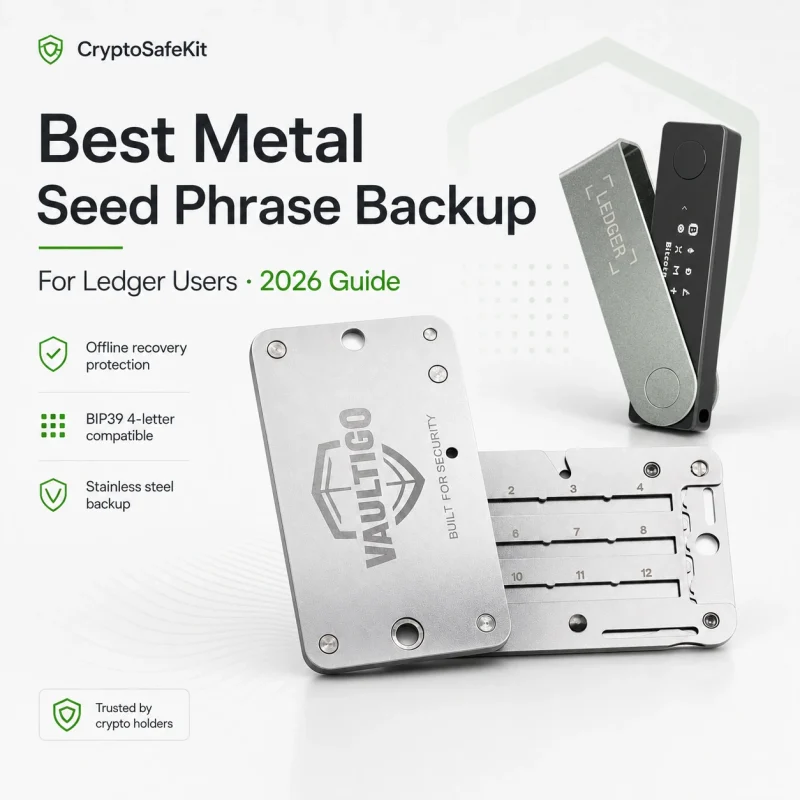
VAULTIGO 4-Letter Metal Seed Phrase Backup System
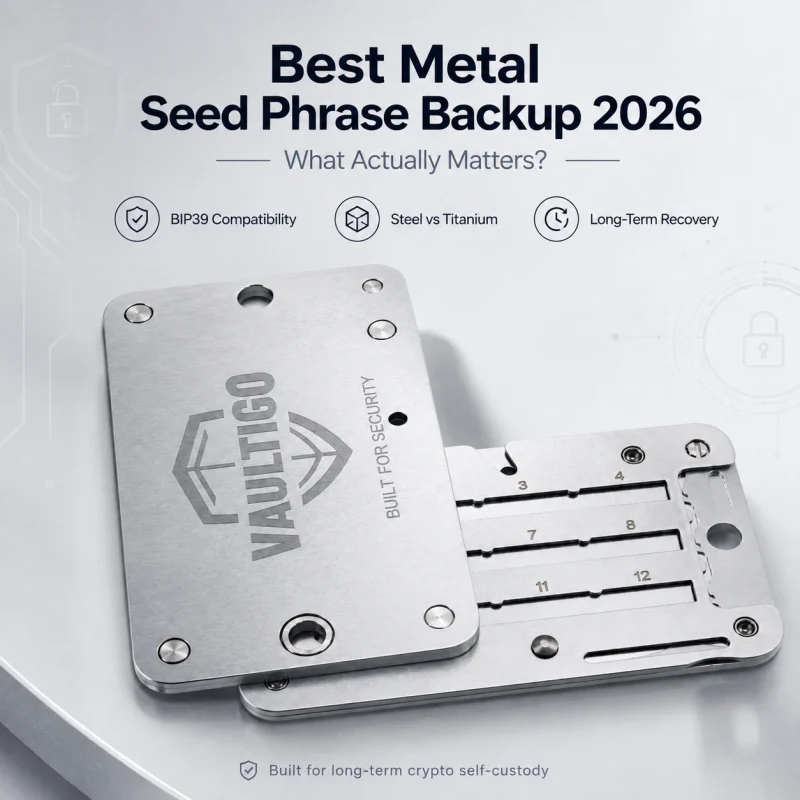
Original price was: $99.00.$59.99Current price is: $59.99.VAULTIGO 4-Letter Metal Seed Phrase Backup is a reusable stainless steel backup system designed to store your recovery words offline. Built for standard English BIP39 seed phrases, each recovery word can be identified by its first four letters, helping you create a compact, organized, and durable backup without punching, engraving, or hammering.
- Stores the first 4 letters of each recovery word
- Designed for standard English BIP39 word lists
- No punching, engraving, or hammering required
- Reusable metal letter tiles
- Water and corrosion resistant stainless steel design
- Lockable structure for added physical protection
- Ideal for hardware wallets, cold wallets, and long-term crypto self-custody
Fire Resistance: Metal Has the Clear Advantage
This is the easiest difference to understand.
Paper burns.
Metal requires dramatically harsher physical conditions before losing structural integrity.
However, “fireproof seed phrase backup” should be used carefully.
Real fires vary in:
peak temperature,
exposure duration,
oxygen availability,
building materials,
structural collapse,
cooling method.
A manufacturer may publish a fire test or temperature claim.
That does not mean the product is guaranteed to survive every conceivable building fire.
The responsible conclusion is:
Metal seed storage significantly improves fire resilience compared with ordinary paper, but no backup should be described as indestructible.
Ledger currently recommends durable metal backup materials specifically as protection against physical environmental threats.
Water and Humidity: Another Strong Case for Metal
Water does not need to destroy an entire piece of paper to create a problem.
It only needs to make one or two recovery words ambiguous.
Possible paper failure modes include:
ink bleeding,
paper fibers separating,
mold,
staining,
adhesive damage,
handwriting becoming unreadable.
Trezor recommends higher-quality acid-free paper and protective sleeves when users choose paper storage, while noting that stainless steel provides a tougher physical option.
Metal is therefore particularly attractive when backups may be stored:
in basements,
near plumbing,
in humid climates,
for multiple decades.
But material grade and construction still matter.
“Made of metal” alone is not a meaningful security specification.
Long-Term Readability: The Real Objective
This is where many buyers get distracted by marketing.
Your recovery plate does not need to win a destruction competition.
It needs to remain recoverable.
Imagine a plate that survives extreme heat but leaves several characters unreadable.
It failed.
Imagine another backup with less impressive marketing specifications that remains completely legible.
It succeeded.
Long-term recovery depends on:
Correct information
Correct order
Legible characters
Known recovery format
Secure physical possession
Material comes after those fundamentals.
Paper Has One Important Advantage: Simplicity
Paper is exceptionally simple.
You can clearly write:
word
word
word
and continue through the recovery phrase.
There is almost no decoding process.
Metal systems can introduce more complexity.
Depending on the product, users may need to:
insert character tiles,
punch letters,
punch numeric indexes,
engrave characters,
use only abbreviated prefixes.
Every additional transformation creates an opportunity for human error.
Expert Analysis: For some users, a correctly written paper backup stored in a highly protected location may be safer than a complicated metal system they set up incorrectly.
The best storage medium is not merely the strongest material.
It must also minimize user error.
BIP39 and the First Four Letters
Some metal backups do not store every letter of every word.
This can be legitimate for compatible BIP39 wordlists.
The BIP39 specification says its wordlist is constructed so the first four letters can uniquely identify each word.
For example:
abandon → aban
ability → abil
about → abou
This allows certain metal systems to conserve physical space while still preserving enough information for recovery.
However, this should not be generalized to every mnemonic system or every language.
BIP39 itself cautions about non-English wordlists and notes that wallet implementations overwhelmingly support the English list.
CryptoSafeKit’s current VAULTIGO 4-Letter documentation therefore limits its intended four-letter method to standard English BIP39 seed phrases, unless compatibility is specifically confirmed by the wallet provider.
That limitation is important.
Reusable Metal vs Permanent Metal
Not every metal backup works the same way.
There are two broad approaches.
Reusable Character Systems
The user inserts characters or tiles into a metal enclosure.
Advantages:
mistakes can be corrected,
no hammer required,
no engraving required,
easy to reuse before deployment.
The VAULTIGO 4-Letter Metal Seed Phrase Backup follows this general approach and stores first-four-letter BIP39 information without requiring punching, engraving, or hammering.
This format is particularly attractive for users who are uncomfortable permanently striking characters into metal.
Its limitation is equally important:
Reusable systems contain more movable components than a simple engraved plate.
The assembly must be secured correctly.
Permanent Punch or Engraved Plates
These use:
center punches,
alphabet stamps,
engraved lines,
drilled patterns.
Advantages:
permanent marking,
few moving components,
simple object after setup.
Disadvantages:
errors are harder to correct,
alignment matters,
setup takes more care.
Neither design is automatically superior.
Choose based on the failure mode you are most likely to encounter.
Stainless Steel vs Titanium
Once users decide to move away from paper, the next question is often:
steel or titanium?
Both can provide excellent long-term physical storage.
Stainless Steel
Common backup systems use grades such as:
304 stainless steel
316 stainless steel
High-quality stainless steel offers substantial:
mechanical durability,
corrosion resistance,
heat resilience.
It is also widely available and generally less expensive than titanium.
Titanium
Titanium is attractive because of its:
corrosion resistance,
strength-to-weight characteristics,
suitability for demanding environments.
However, material prestige should not override practical recovery design.
A titanium plate with incorrectly punched words is worthless.
A correctly configured stainless steel system can be completely adequate for many users.
CryptoSafeKit currently carries both stainless-steel VAULTIGO systems and a dedicated VAULTIGO Titanium Seed Phrase Backup Plate, allowing the recovery medium to be selected according to the user’s physical-storage requirements rather than treating one metal as universally superior.
Where Paper Can Actually Be the Better Choice
Metal should not be recommended blindly.
Paper can make sense when:
holdings are small,
the wallet is temporary,
the recovery phrase will soon be migrated,
the paper is stored in a professional physical environment,
a second durable backup already exists,
discretion matters more than environmental resilience.
Trezor makes an important observation: metal is physically tougher, but paper can be more discreet and easier to update.
Imagine two storage locations.
Location A
A professionally controlled, dry, fire-rated secure facility containing archival-quality paper.
Location B
A metal seed plate sitting openly in an unlocked drawer.
Location A may have the better overall security model.
Material alone never tells the whole story.
Where Metal Clearly Makes More Sense
Metal becomes easier to justify when:
crypto will be stored for many years,
holdings are significant,
the wallet is part of an inheritance plan,
the backup location has realistic water exposure,
a house fire is part of the threat model,
the user moves frequently,
the backup may remain untouched for a decade.
For these scenarios, a durable metal seed phrase backup removes several avoidable physical weaknesses of paper.
That is particularly important because the recovery phrase may need to survive multiple hardware-wallet generations.
A Metal Backup Does Not Protect Against Theft
This deserves its own section.
Suppose a thief finds:
Paper backup:
24 readable recovery words.
Or:
Metal backup:
24 readable recovery words.
Cryptographically, the problem is essentially the same.
The attacker may possess what is required to reconstruct the wallet.
The thickness of the steel does not matter.
Metal seed storage therefore requires two independent security questions:
Question 1: Will the backup survive?
This is where metal helps.
Question 2: Will unauthorized people find it?
This is a storage-location problem.
Do not confuse the two.
Should You Keep Multiple Seed Phrase Copies?
Redundancy can improve disaster recovery.
Ledger currently recommends considering multiple physical copies stored in separate secure locations.
But every additional complete copy increases exposure.
If you create five complete seed plates, you have created five places from which the wallet may be compromised.
For many users, a reasonable design could involve:
one primary durable backup,
one carefully controlled secondary backup,
hardware stored separately.
The exact number depends on the threat model.
There is no universal “correct” number.
Should You Split the Seed Phrase?
Be careful.
Manually dividing a conventional seed phrase into arbitrary pieces can create a recovery system that is difficult for you—or your heirs—to reconstruct correctly.
Ledger discusses splitting recovery information as one possible advanced strategy, but also emphasizes correct implementation.
For advanced users who genuinely need distributed recovery, standardized multi-share or multisignature systems are generally more appropriate topics to research than inventing a personal secret-sharing scheme.
Complexity is itself a threat.
What About the BIP39 Passphrase?
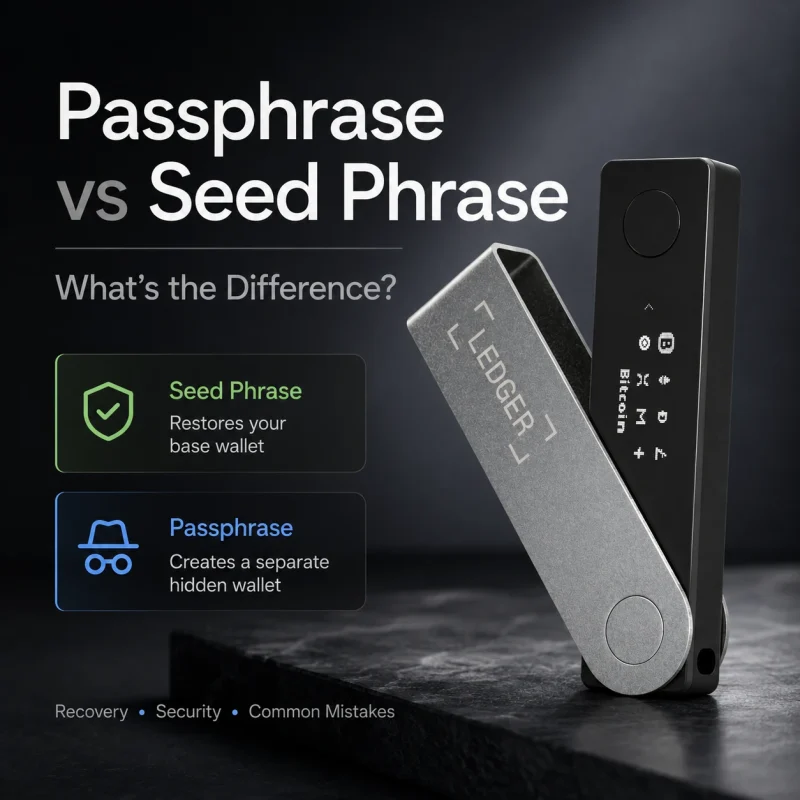
A BIP39 passphrase creates a different wallet from the same mnemonic.
The BIP39 specification defines the passphrase as part of the mnemonic-to-seed derivation process; every passphrase produces a valid derived seed, while only the correct one reconstructs the intended wallet.
That means a seed backup can be physically perfect while recovery still fails because the passphrase is gone.
Do not automatically engrave the passphrase next to the seed.
Doing so can eliminate much of the security separation the passphrase was intended to provide.
Instead, design a separate recovery strategy.
Common Paper Seed Phrase Storage Mistakes
Using low-quality paper for decade-long storage
Writing with fading or water-sensitive ink
Keeping paper near pipes or humid locations
Laminating without understanding moisture risks
Folding the sheet repeatedly
Leaving it in an ordinary desk drawer
Storing hardware wallet and seed together
Photographing the paper “just in case”
Uploading a photo to cloud storage
Never confirming that the backup still exists
Trezor specifically advises higher-quality paper and appropriate protective sleeves when users choose paper, and warns that environmental conditions matter.
Common Metal Seed Phrase Storage Mistakes
Buying a backup incompatible with the wallet format
Punching before checking spelling
Recording words in the wrong order
Assuming four letters work for every wordlist
Misreading a numerical BIP39 indexing system
Leaving the plate somewhere obvious
Storing the passphrase beside the seed
Keeping every backup in the same location
Photographing the finished plate
Assuming metal equals indestructible
Metal fixes paper’s physical weaknesses.
It does not fix careless operational security.
From a Practical Security Perspective: Upgrade Based on Holdings and Time
A useful way to decide is to evaluate two variables:
How important would recovery failure be?
and
How long must the backup survive?
Temporary / Low-Value Wallet
Paper may be completely reasonable.
Multi-Year Hardware Wallet
Metal becomes easier to justify.
Significant Long-Term Holdings
A durable physical backup should be seriously considered.
Estate or Inheritance Storage
Long-term readability and recovery instructions become particularly important.
The cost of the backup medium should be considered against the consequence of losing the only valid recovery path—not simply against the price of the hardware wallet.
How I Would Build a Long-Term Recovery Stack
A resilient self-custody setup should not rely on one object.
Layer 1: Hardware Wallet
Examples include Ledger, Trezor, or another appropriate signing device.
Its purpose is transaction authorization and private-key isolation.
Layer 2: Seed Phrase Backup
This survives device failure.
Layer 3: Durable Recovery Medium
For significant multi-year holdings, this is where metal becomes useful.
CryptoSafeKit’s VAULTIGO 4-Letter Metal Seed Phrase Backup is designed around the first-four-letter property of standard English BIP39 phrases and does not require punching, engraving, or hammering.
Layer 4: Secure Location
The backup should remain physically inaccessible to unauthorized people.
Layer 5: Geographic Separation
Do not make one building the failure point for every recovery component.
Layer 6: Recovery Documentation
Future recovery should not depend entirely on your memory.
Do not write secrets unnecessarily, but document enough non-secret information that you understand:
which wallet standard was used,
whether a passphrase exists,
which backup belongs to which wallet,
what recovery procedure is expected.
Metal Seed Phrase Backup vs Paper Security Checklist
Before deciding that your backup is finished:
Confirm your wallet’s exact recovery format.
Confirm every recovery word.
Confirm the exact word order.
Keep the phrase completely offline.
Never photograph the paper or metal backup.
Never type the seed into a website for verification.
Protect against fire and water.
Protect against unauthorized physical access.
Keep the hardware wallet and backup appropriately separated.
Use four-letter abbreviation only with a compatible wordlist.
Keep any BIP39 passphrase under a deliberate separate recovery plan.
Review the physical backup periodically.
Make sure the recovery process remains understandable years later.
Do not rely on a single electronic device as your final recovery path.
FAQ
Is a metal seed phrase backup safer than paper?
For long-term physical durability, generally yes.
Metal is substantially more resistant than ordinary paper to fire, water, tearing, and environmental degradation. Ledger currently recommends durable physical media such as metal for long-term seed storage.
However, metal does not automatically provide stronger protection against theft or unauthorized access.
Is paper safe for storing a seed phrase?
Paper can be a valid offline backup when stored correctly.
High-quality paper, durable markings, environmental protection, and secure physical storage can substantially improve reliability. Trezor specifically discusses archival-quality materials as a viable paper-backup approach.
Paper’s major disadvantage is lower physical resilience.
What is the best way to store a seed phrase long term?
For significant multi-year self-custody, a durable offline physical backup stored in a controlled secure location is generally preferable to relying solely on ordinary paper.
Ledger’s current guidance recommends durable physical material and separate secure backup locations.
Is stainless steel good for seed phrase storage?
Yes, appropriately designed stainless-steel systems are widely used for physical seed backups.
Material grade matters, but so do marking depth, construction, readability, corrosion environment, and setup accuracy.
Steel alone does not make a poor recovery design safe.
Is titanium better than stainless steel?
Not automatically.
Titanium has excellent material properties, but a correctly configured stainless-steel backup can provide strong long-term physical resilience.
Choose based on the complete recovery system rather than material prestige alone.
Can I store only four letters of each seed word?
For compatible standard English BIP39 wordlists, the specification states that the first four letters uniquely identify the word.
Do not assume that rule applies to every wallet standard or language.
Should I keep both paper and metal backups?
That can provide redundancy, but each complete copy creates another physical exposure point.
If you maintain multiple copies, store them according to a deliberate threat model rather than keeping everything together.
Should the metal seed backup be stored with my Ledger?
Generally, putting both in exactly the same vulnerable location creates correlated risk.
A burglary, fire, or other single-location disaster could affect both.
Ledger’s current guidance recommends considering separate secure locations for recovery copies.
Final Verdict: Metal Wins Long-Term Durability, Not Every Security Category
The metal seed phrase backup vs paper debate becomes simple once you separate physical durability from confidentiality.
Paper is:
inexpensive,
offline,
easy to understand,
discreet,
easy to correct.
Metal is:
substantially more durable,
better suited to fire and water exposure,
resistant to tearing and fading,
better suited to multi-year recovery planning.
For temporary wallets or carefully controlled storage, paper can still be reasonable.
For meaningful cryptocurrency holdings expected to remain in self-custody for years, a properly configured metal seed phrase backup is generally the stronger recovery medium.
But buying metal is not the end of the security process.
A metal plate stored in an obvious location is vulnerable.
A titanium plate containing the wrong seed is useless.
A fire-resistant backup photographed and uploaded to cloud storage has lost one of the main benefits of cold storage.
The objective is not simply to make the seed physically stronger.
It is to create a recovery system that remains:
accurate, private, readable, durable, and recoverable.
For standard English BIP39 users who want to reduce setup complexity, systems such as the VAULTIGO 4-Letter Metal Seed Phrase Backup offer one approach by using reusable first-four-letter storage instead of requiring every recovery word to be permanently punched.
For users preferring permanent markings, stainless-steel or titanium punch plates may be more appropriate.
What matters most is not whether your backup looks impressive today.
It is whether it still gives you access to your wallet when the hardware device is gone ten years from now.
Security Disclaimer
This article is for educational purposes only and does not constitute financial, investment, tax, legal, or trading advice. CryptoSafeKit sells VAULTIGO seed phrase backup products and therefore has a commercial relationship with products mentioned in this article.
No paper, metal backup, hardware wallet, safe, or recovery strategy eliminates every security risk. Always confirm compatibility with your wallet’s current official documentation before recording recovery information. Never disclose your seed phrase, private keys, PIN, or BIP39 passphrase to CryptoSafeKit, a hardware-wallet manufacturer, an engraving company, a website, cloud service, support agent, or other third party.