

Seed Phrase Storage: Dangerous Mistakes and Reliable Long-Term Backup Strategies

A hardware wallet can fail, disappear or become obsolete.
Your recovery phrase is what may allow you to reconstruct the wallet on a compatible replacement device. That makes it one of the most important parts of a self-custody system.
It is also one of the most dangerous.
A complete recovery phrase can often recreate the wallet without the original hardware device or its PIN. Anyone who obtains it may be able to control the same accounts as the legitimate owner.
This creates a difficult balance:
A backup must survive fire, water, decay, loss and device failure.
It must remain accessible during a genuine recovery.
It must not become easy for someone else to discover, copy or photograph.
It must remain understandable years after it was created.
The safest approach is not simply to hide the phrase more carefully.
It is to design a complete recovery system around realistic physical, digital and human threats.
Critical security rule: Never enter a hardware-wallet recovery phrase into a website, cloud document, support form, browser extension, ordinary software wallet or unfamiliar application.
What a Recovery Phrase Actually Protects
For wallets using BIP39, a mnemonic phrase represents information that is converted into a binary seed. That seed can then be used to derive a hierarchy of wallet keys and addresses. The order of the words is part of the backup and cannot be rearranged without changing the result.
The phrase is therefore more than a password.
A password usually grants access to an account maintained by a service. A recovery phrase can recreate the cryptographic keys themselves.
That distinction has serious consequences.
If someone steals your exchange password, the exchange may be able to freeze the account or help you reset access.
If someone obtains your complete self-custody recovery phrase, there may be no administrator who can stop that person from restoring the wallet elsewhere.
Ledger describes its Secret Recovery Phrase as the human-readable backup from which the wallet’s private keys are derived. Its current guidance recommends maintaining backups in two secure locations.
Seed Phrase Storage Is a Balance Between Two Risks
Every storage plan must address two competing risks.
Risk 1: Permanent loss
You could lose access because the backup is:
Destroyed
Discarded
Misplaced
Made unreadable
Stored in an inaccessible location
Dependent on a person who is no longer available
Recorded incorrectly
Risk 2: Unauthorized recovery
Someone else could gain access because the backup is:
Photographed
Uploaded to the cloud
Copied by malware
Found during a burglary
Viewed by a household member
Exposed during travel
Stored with the hardware wallet
Distributed to too many people
A good plan does not eliminate one risk by making the other unacceptable.
For example, keeping ten copies may reduce the chance of losing every copy. It also creates ten opportunities for disclosure.
Keeping one copy in an obscure location reduces duplication but creates a single point of failure.
Seed Phrase Storage Methods Compared
| Storage method | Main advantage | Main weakness |
|---|---|---|
| Paper backup | Inexpensive and easy to create | Vulnerable to water, fire, fading and disposal |
| Phone photograph | Convenient to access | May be copied, synchronized or stolen remotely |
| Cloud document | Accessible from multiple devices | Creates an online target and account dependency |
| Password manager | Encrypted and searchable | Remains part of a connected digital environment |
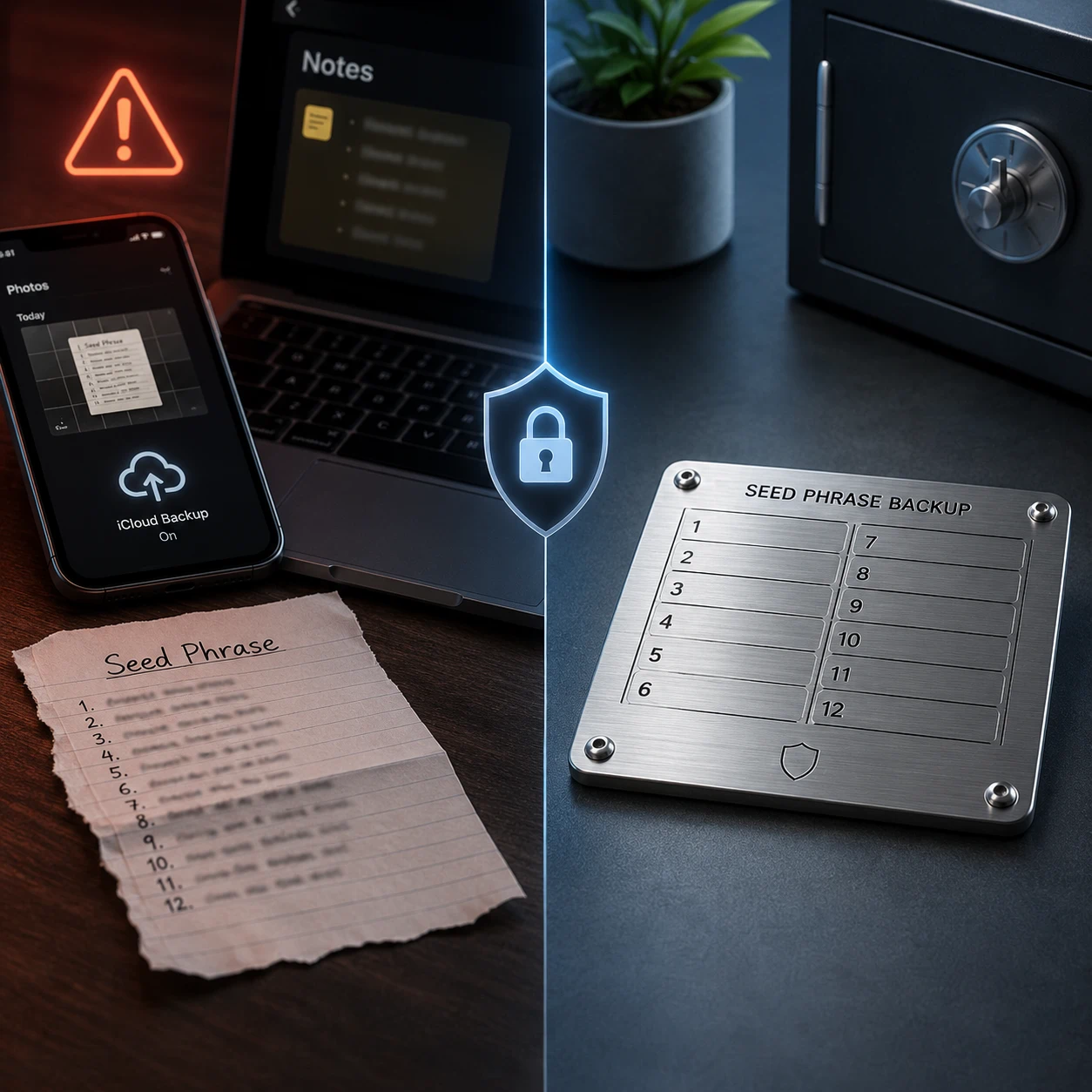
| Metal seed plate | More durable than ordinary paper | Does not prevent theft or unauthorized reading |
| Multiple complete copies | Simple redundancy | Every copy can independently restore the wallet |
| Manual phrase split | Appears to distribute risk | Easy to misunderstand or make unrecoverable |
| Standardized threshold backup | Requires several shares for recovery | More complex to create, document and maintain |
| Multisig | Distributes transaction authority across keys | Requires several backups plus wallet configuration |
No storage method is secure without an appropriate location, recovery procedure and access-control plan.


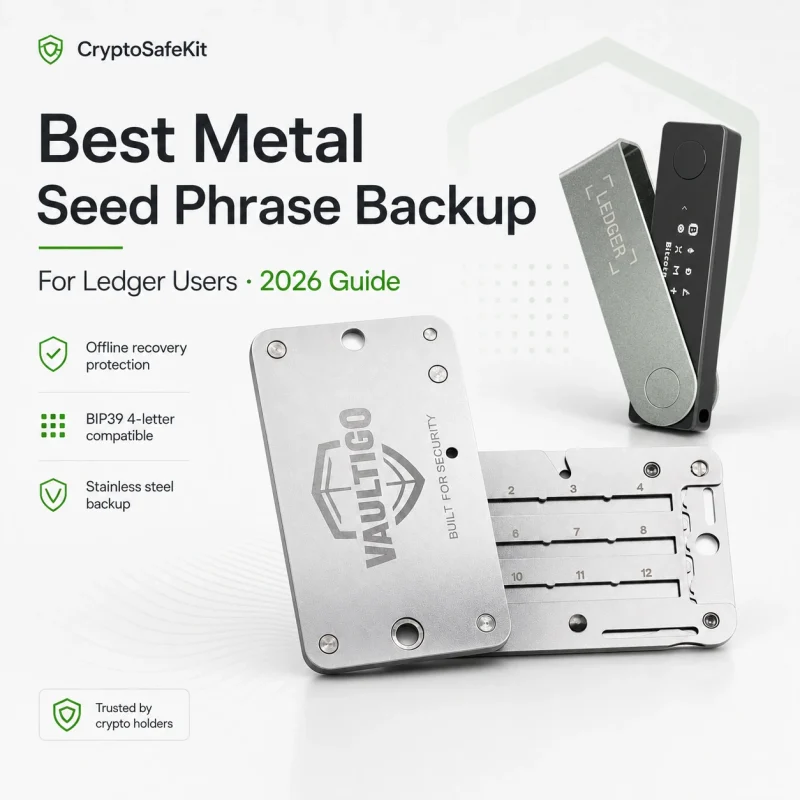
VAULTIGO 4-Letter Metal Seed Phrase Backup System
Original price was: $99.00.$59.99Current price is: $59.99.VAULTIGO 4-Letter Metal Seed Phrase Backup is a reusable stainless steel backup system designed to store your recovery words offline. Built for standard English BIP39 seed phrases, each recovery word can be identified by its first four letters, helping you create a compact, organized, and durable backup without punching, engraving, or hammering.
- Stores the first 4 letters of each recovery word
- Designed for standard English BIP39 word lists
- No punching, engraving, or hammering required
- Reusable metal letter tiles
- Water and corrosion resistant stainless steel design
- Lockable structure for added physical protection
- Ideal for hardware wallets, cold wallets, and long-term crypto self-custody
Dangerous Mistake 1: Photographing the Recovery Phrase
A phone camera turns a private physical secret into digital data.
Even when you do not intentionally upload the image, it may appear in:
Automatic photo backups
Cloud synchronization
Shared albums
Deleted-image storage
Device migrations
Application caches
Computer photo libraries
A phone can also be lost, repaired, remotely accessed or infected.
Deleting the visible photo does not prove that every synchronized or cached copy has disappeared.
A recovery phrase should not be photographed for convenience, documentation or “temporary backup.”
CryptoSafeKit and VAULTIGO likewise warn users not to photograph completed seed backups or upload images of them to cloud storage.
Dangerous Mistake 2: Using Notes, Email or Cloud Documents
Typing a phrase into a notes application, email draft, spreadsheet or cloud document exposes it to a much larger system.
The phrase may pass through:
Device memory
Clipboard history
Keyboard prediction
Browser storage
Cloud servers
Account backups
Search indexes
Shared-device access
Even strong account encryption does not change the fact that the recovery phrase now depends on the security of an internet-connected account and every device authorized to access it.
Ledger’s current storage guidance specifically warns against unencrypted digital formats such as cloud storage, note applications and screenshots.
Editorial recommendation: A conventional digital copy should not be the default backup for a hardware-wallet seed phrase.
Highly specialized encrypted backup systems exist, but they require separate key management, software maintenance and recovery documentation. They may create more complexity than they remove for most individuals.
Dangerous Mistake 3: Relying on One Ordinary Paper Copy
Paper remains useful because it is offline, inexpensive and easy to inspect.
Its weakness is physical fragility.
A paper backup can be damaged by:
Water
Humidity
Smoke
Fire
Mold
Ink fading
Tearing
Insects
Accidental disposal
Paper can still be appropriate when it is stored inside a controlled environment and supported by another independent backup.
The mistake is not writing the phrase on paper.
The mistake is assuming that one unprotected paper card will remain readable and available for decades.
When Paper Can Still Be Reasonable
Paper may be suitable when:
It is used as an initial verified record.
It is stored in a sealed, controlled location.
Another independent backup exists elsewhere.
The owner periodically checks its physical condition.
It is not carried or handled unnecessarily.
Do not destroy a known-good paper record immediately after transferring the phrase to another medium. Verify the replacement first.
Dangerous Mistake 4: Keeping Every Backup in the Same Building
Two copies inside the same home do not provide strong disaster separation.
A single event could affect both:
Fire
Flood
Burglary
Property seizure
Unauthorized household access
Accidental disposal during a move
Ledger’s current best-practice guidance recommends two secure storage locations rather than one concentrated location.
A second location should represent a genuinely different failure zone.
That does not mean the backup must be on another continent. It means one realistic incident should not destroy or expose every copy.
Hypothetical Example
A user keeps one paper backup in a desk and one metal backup in a safe located in the same room.
This provides material redundancy: one copy is paper and the other is metal.
It does not provide meaningful geographic redundancy. A burglary or building fire may still affect both.
A stronger arrangement would place the second backup in a separately controlled location with a different physical risk profile.
Dangerous Mistake 5: Creating Too Many Complete Copies
Every complete copy can normally restore the entire wallet.
Creating additional copies may improve availability, but it also expands the physical attack surface.
Copies may be:
Found by relatives
Seen by cleaners or contractors
Photographed by visitors
Misplaced during travel
Mishandled by a trusted person
Included in property inventories
Discarded after the owner’s death
For many individual users, two complete offline backups in two separate secure locations provide a practical starting point.
A third may be justified for international travel, inheritance, business continuity or severe regional-disaster risk.
Beyond that point, a standardized threshold or multisignature arrangement may be more appropriate than distributing additional complete phrases.
For a more detailed decision framework, see CryptoSafeKit’s guide to how many seed phrase backups you should keep.
Dangerous Mistake 6: Manually Splitting the Words
A common homemade system stores:
Words 1–12 in one place
Words 13–24 somewhere else
Others create overlapping fragments or remove selected words from each copy.
This may feel safer because no location contains the entire phrase. It can also create a fragile recovery process that the owner or beneficiary cannot reconstruct later.
Manual splitting can fail because:
Word order is forgotten.
One fragment is mislabeled.
Recovery instructions are lost.
One part is mistaken for an incomplete backup and discarded.
The split exposes enough information to reduce the search space.
Future wallet software does not understand the custom scheme.
Do not confuse manual splitting with cryptographic secret sharing.
Standardized Multi-Share Backup
Trezor’s Multi-share Backup divides wallet recovery data into several shares and requires a chosen threshold of shares for recovery. Individual shares are not simply arbitrary sections of one conventional phrase.
A 3-of-5 arrangement, for example, creates five shares and requires any three valid shares to recover the wallet.
This can reduce the impact of one lost or exposed location, but it introduces operational complexity.
Before using a threshold system, confirm:
Your wallet supports the format.
You understand the recovery threshold.
Every share is labeled correctly.
Enough shares will remain accessible.
Beneficiaries understand the process.
You have tested the official recovery workflow.
Dangerous Mistake 7: Storing the Device and Recovery Phrase Together
A locked hardware wallet and a recovery phrase do not provide the same security boundary.
The hardware wallet may require its PIN and physical interaction.
The recovery phrase may allow someone to reconstruct the wallet on another compatible device without the original hardware wallet or its PIN.
Storing both in the same case allows one theft to capture:
The signing device
The wallet backup
Information identifying the owner’s crypto activity
Keep the hardware wallet and at least one complete recovery backup in separate physical locations.
The objective is not to make the device difficult for you to use. It is to avoid one incident compromising every recovery component.
Dangerous Mistake 8: Never Verifying the Backup
A backup that looks complete may still contain a mistake.
Common errors include:
Misspelled words
Incorrect numbering
Reversed order
Missing words
Repeated words
Unclear handwriting
Marks placed in the wrong grid
A backup recorded from the wrong wallet
Use the hardware-wallet manufacturer’s official backup-verification function where available.
Do not verify a recovery phrase by entering it into:
A website
A search engine
A browser extension
An online BIP39 checker
A support message
An ordinary software wallet
A metal plate does not correct transcription errors. It preserves whatever was recorded, including mistakes.
Verify Before Destroying the Original
When transferring a phrase from paper to metal:
Work in a private location without cameras.
Compare each word or encoded entry carefully.
Preserve the exact order.
Complete the manufacturer-supported backup check.
Inspect the metal markings for readability.
Keep the original known-good record until verification is complete.
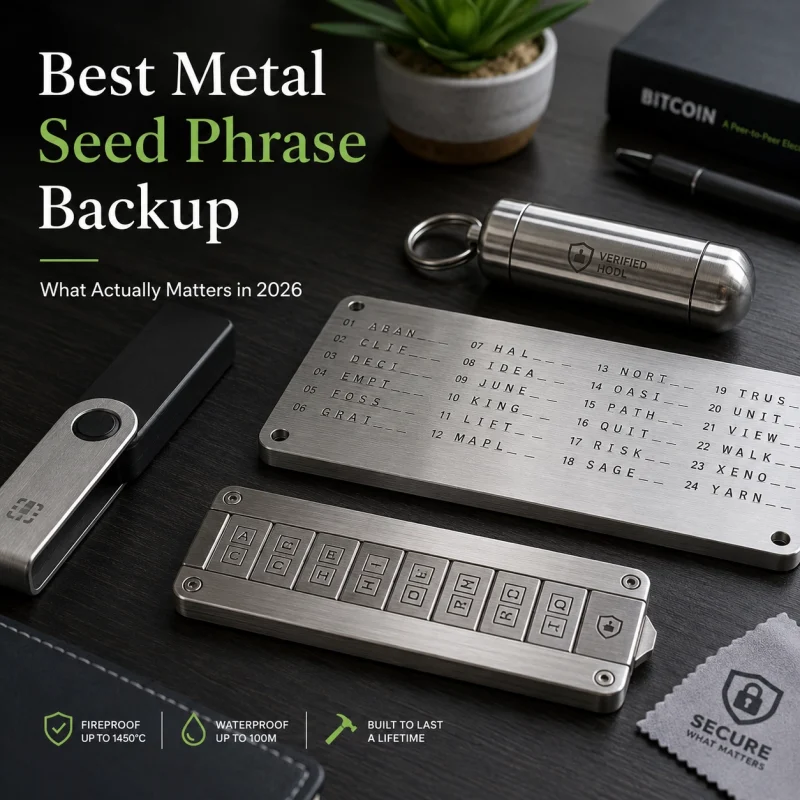
Some metal systems record only the first four letters of each English BIP39 word. The BIP39 English list is designed so that the first four letters uniquely identify each word. Confirm that your wallet uses the correct BIP39 language and that the storage product’s encoding method is compatible before relying on an abbreviated format.
Dangerous Mistake 9: Assuming Metal Solves Every Problem
Metal seed backups can improve resistance to several risks that affect ordinary paper.
Potential advantages include better resistance to:
Moisture
Fading
Tearing
Physical wear
Long-term material degradation
Some heat exposure
Trezor and Ledger both offer or discuss metal storage as a more durable physical alternative to paper.
However, “metal” is not one universal specification.
Performance depends on:
Alloy
Thickness
Construction
Engraving or punch depth
Fasteners
Corrosion resistance
Storage conditions
Product testing
Do not assume that every metal plate is fireproof, waterproof, crushproof or corrosion-proof.
Those are product-specific claims that require verifiable testing.
What Metal Does Not Prevent
A metal seed plate does not prevent:
Theft
Photography
Coercion
Unauthorized reading
Incorrect word entry
Loss of the storage location
A weak inheritance plan
A compromised optional passphrase
Metal improves physical durability. It does not replace physical access control.
VAULTIGO products are designed as offline physical recovery records. They do not upload, synchronize or transmit the phrase, but the owner must still protect the completed plate from unauthorized access.
Dangerous Mistake 10: Ignoring the Optional Passphrase
Some wallets allow an additional passphrase to be combined with the recovery phrase.
Every exact passphrase may create a different valid wallet.
That can add protection if the seed phrase is stolen, but it also creates another permanent recovery dependency.
A passphrase can be lost through:
Misspelling
Capitalization errors
Added spaces
Memory failure
Incomplete inheritance instructions
Do not store the passphrase beside every complete seed backup if that would remove its protective value.
At the same time, do not rely entirely on memory for a passphrase protecting assets that must remain recoverable for many years.
The seed phrase and passphrase need separate but coordinated storage plans.
Building a Reliable Long-Term Seed Phrase Strategy
A practical plan for many individual hardware-wallet users contains the following elements.
1. Two verified offline backups
Maintain two complete, independently verified copies.
One may be paper in a controlled environment. The other may be a durable metal backup.
The correct combination depends on the risks at each location.
2. Two separate security zones
Store the copies far enough apart that one realistic physical incident cannot affect both.
Evaluate:
Fire zones
Flood zones
Household access
Burglary exposure
Legal access
Institutional access rules
Travel availability
3. No routine digital copy
Do not photograph, scan, email or upload the phrase.
A non-electronic backup removes many remote attack paths, although it still requires physical protection.
4. A tested verification process
Confirm that the recorded phrase belongs to the intended wallet.
Do not wait until the original hardware wallet fails before discovering a transcription mistake.
5. Separate device storage
Keep the primary hardware wallet away from at least one complete recovery backup.
6. Minimal recovery instructions
Create an instruction document explaining:
Which wallet the backup relates to
The backup format
Whether a passphrase is required
Which compatible device or standard is needed
Where authorized recovery instructions can be found
Do not include the recovery words in the general instruction document.
7. Periodic review
Review the plan after:
Moving home
Changing countries
Marriage or divorce
Death of a trusted person
Changing storage providers
Fire, flood or burglary
Changing the wallet structure
Updating inheritance arrangements
You do not need to expose every word during every review. Confirm that the locations remain secure, accessible and physically intact.
Distributed Storage, Multi-Share Backup or Multisig?
These approaches solve different problems.
Multiple complete copies
Each copy can independently restore one wallet.
Best for: Simple personal redundancy
Main risk: Any one copy can compromise the wallet
Multi-share or threshold backup
Several shares are created, and a defined number are required for recovery.
Best for: Users who need distributed recovery without placing a complete secret in one location
Main risk: More complex documentation and recovery
Multisignature wallet
Several independent keys control one wallet, and a threshold of signatures is required to spend.
Best for: Shared custody, high-consequence personal storage and organizational control
Main risk: Each signer needs its own backup, and the multisig policy or descriptor must also be preserved
Multisig does not remove seed phrase storage. It changes how many independent keys are required to authorize a transaction.
CryptoSafeKit’s multisig hardware wallet guide explains these additional configuration and recovery requirements.
What to Do If a Seed Phrase May Be Exposed
Moving the physical backup does not make the words secret again.
If someone may have photographed, copied or viewed the complete phrase, treat the wallet as potentially compromised.
A cautious response is to:
Initialize a trusted hardware wallet as a completely new wallet.
Generate a new recovery phrase.
Record and verify the new backup offline.
Generate a receiving address.
Verify the address on the new hardware wallet.
Send a small test transaction.
Move the remaining assets after confirmation.
Retire the old wallet once the migration is complete.
Do not enter the exposed phrase into an online “security checker” or recovery service.
Do not publicly disclose that a high-value wallet may be compromised.
Choosing a Metal Seed Backup
A suitable metal backup should match:
Your wallet’s word count
Its backup standard
The language of the word list
Your preferred recording method
The storage environment
The number of copies required
Check whether the system uses:
Full words
First-four-letter encoding
Numbered word indexes
Letter tiles
Punch grids
Engraving
No format is automatically best for every user.
The most important factors are accurate recording, readable recovery, durable construction and secure storage.
Readers building a more durable offline recovery plan can review CryptoSafeKit’s VAULTIGO metal seed backup options. The collection includes stainless-steel plates and related tools for physically recording wallet recovery information without cloud storage or electronic synchronization.
Final Thoughts
The recovery phrase is often more valuable to an attacker than the hardware wallet itself.
The device may be protected by a PIN, secure hardware and transaction confirmation. The phrase may recreate the wallet elsewhere.
Reliable seed phrase storage therefore requires more than hiding a piece of paper.
A strong practical plan usually includes:
Offline recording
Accurate word order
Verification through the official device workflow
Two secure and physically separated backups
Durable materials where environmental risks justify them
Separation from the hardware wallet
Clear passphrase handling
Periodic review
A documented emergency and inheritance process
Paper remains useful but fragile.
Digital storage is convenient but creates additional connected-system exposure.
Metal improves durability but does not prevent theft.
Distributed copies improve availability but increase the number of access points.
Threshold backups and multisig can reduce single points of failure, but only when the owner can maintain the added complexity.
The objective is not to build the most elaborate recovery system.
It is to build the simplest system that can survive the threats you actually face—without creating a recovery process that you or your beneficiaries cannot execute.
5. Security Disclaimer
This article is provided for general educational and crypto-security purposes only. It does not constitute financial, investment, legal, tax, insurance, estate-planning or individualized cybersecurity advice.
Recovery standards, device compatibility and manufacturer-supported backup processes can change. Verify current procedures through the official documentation for your hardware wallet before creating, modifying or testing a production backup.
CryptoSafeKit and VAULTIGO will never ask you to submit a recovery phrase, private key, device PIN, wallet password or optional passphrase through a website, email, cloud service, support form, chat or remote-access session.
No paper, metal, digital, threshold or multisignature backup method is free from theft, physical damage, procedural error or loss.
6. FAQ
What is the safest way to store a seed phrase?
For many individuals, two verified physical backups stored offline in separate secure locations provide a practical baseline. One may be recorded on durable metal where fire, moisture or long-term degradation is a significant concern.
Is it safe to take a picture of a recovery phrase?
No conventional phone photograph should be treated as safe storage. The image may be copied to cloud backups, synchronized devices, caches or deleted-file storage without the owner realizing it.
Is paper safe for long-term seed phrase storage?
Paper can work in a controlled location, but it is vulnerable to water, fire, fading, tearing and accidental disposal. It is stronger when used with another independent backup.
Is a metal seed plate better than paper?
Metal generally offers greater physical durability than ordinary paper. It does not prevent theft, photography, coercion, incorrect recording or loss of the storage location.
Should I keep more than one seed phrase backup?
Many users benefit from two complete copies in separate secure locations. Additional complete copies should solve a defined risk rather than being created without a storage plan.
Can I split a 24-word phrase into two groups of 12?
Manual splitting is not equivalent to standardized secret sharing. It may create an undocumented and fragile recovery process. Use a wallet-supported threshold backup when distributed recovery is required.
Should I store my passphrase with my seed phrase?
Storing both together may remove the passphrase’s additional protection. Separating them requires a carefully documented recovery plan so that authorized recovery remains possible.
What should I do if someone sees my seed phrase?
Treat the wallet as potentially compromised. Create a new wallet with a new recovery phrase, verify it and transfer assets after a small test transaction.