

How to Store Seed Phrase Long Term: Security Guide

Introduction: Your Seed Phrase Is the Real Recovery Key
If you already use a hardware wallet, protecting the device itself is only part of the job.
Your recovery phrase is more important.
A Ledger Nano S Plus, Nano X, Flex, Stax, or another hardware wallet can be lost, damaged, reset, or replaced. As long as you still possess the correct recovery phrase, you can generally restore the wallet using compatible hardware. But if someone else obtains that phrase, they may be able to reconstruct the wallet without possessing your original device or knowing its PIN.
Ledger describes its 24-word Secret Recovery Phrase as the backup from which wallet access can be restored, while BIP39 defines the standardized mnemonic mechanism used by many deterministic wallets.
That creates two competing security requirements:
Your seed phrase must remain available to you for decades, while remaining unavailable to everyone else.
Long-term seed storage therefore has to address more than theft. It must survive fire, flooding, moisture, corrosion, accidental disposal, relocation, inheritance events, and ordinary human forgetfulness.
The best storage strategy is not simply the toughest piece of metal available. It is a carefully designed recovery system.
What Long-Term Seed Phrase Storage Must Protect Against
Before choosing paper, metal, a home safe, or multiple locations, define the threats you are actually trying to control.
A seed backup faces five major categories of risk:
| Threat | What Can Happen | Primary Defense |
|---|---|---|
| Fire | Paper burns or becomes unreadable | Durable metal backup and appropriate safe |
| Water | Ink runs, paper degrades, documents mold | Water-resistant physical medium and storage |
| Corrosion | Poorly protected metal may deteriorate over time | Appropriate corrosion-resistant material |
| Theft | Someone copies or removes the phrase | Access control, concealment, geographic strategy |
| Loss | Backup is misplaced, discarded, or destroyed | Carefully controlled redundancy |
Paper is especially vulnerable to environmental damage. Ledger specifically warns that ink can wear away and that water or fire can make a paper recovery phrase unusable. Trezor similarly recommends considering durable metal for long-term recovery backups.
Metal improves physical resilience, but it does not solve the secrecy problem.
A stainless steel plate containing all 24 words is still effectively a bearer credential. If a burglar can read it, the fact that it survived a fire does not help you.
Long-term storage therefore has to balance two properties:
Durability — can you still recover the wallet after a disaster?
Confidentiality — can an unauthorized person recover it before you do?
Both matter.
Seed Phrase Storage by Security Level
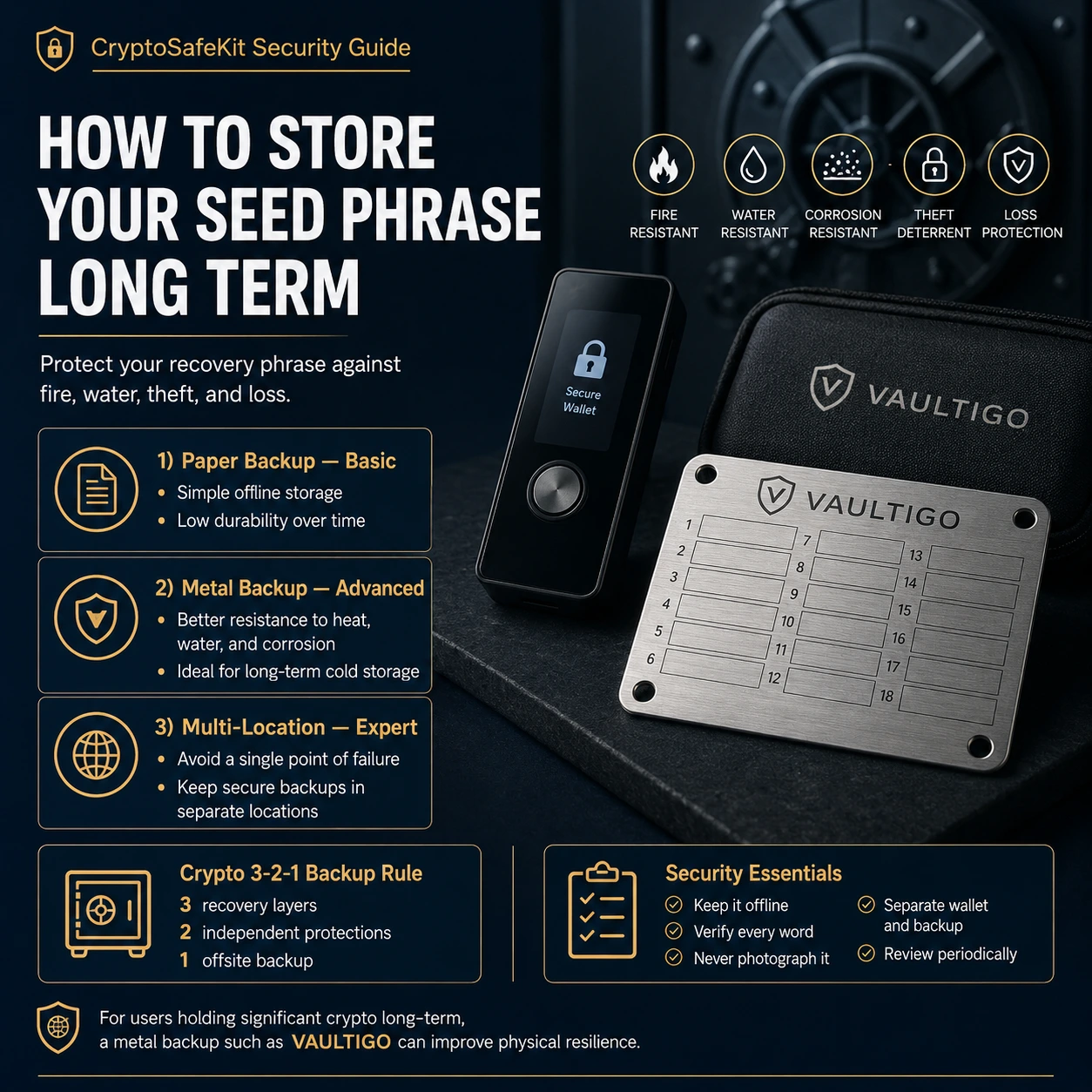
Level 1: Paper Backup — Basic Protection
Writing a recovery phrase on paper remains a valid offline backup method when it is handled correctly.
Its major advantage is simplicity. There is no software, battery, encryption key, electronic controller, or proprietary format that can fail. You can visually inspect every word and its order.
Its weaknesses are physical.
Paper can burn, tear, absorb water, develop mold, fade, or simply be mistaken for an unimportant document and thrown away.
If you use paper:
- Write the phrase clearly by hand.
- Confirm every word and its exact position.
- Never print it using an internet-connected printer.
- Store it inside a controlled, dry location.
- Keep it away from obvious valuables if possible.
- Do not photograph it as a secondary backup.
Ledger and Trezor both advise keeping recovery phrases away from internet-connected devices and digital storage.
For modest holdings, a carefully secured paper backup may be adequate.
For assets you expect to protect through several decades, however, paper introduces unnecessary environmental risk.
Level 2: Metal Backup — Advanced Long-Term Protection
For serious long-term cold storage, metal is usually the logical upgrade from paper.
A properly designed stainless steel or titanium backup significantly improves resistance to common physical failure modes such as water exposure, crushing, tearing, and fire conditions that would destroy ordinary paper. Trezor specifically recommends durable materials such as stainless steel or titanium for BIP39 backups exposed to long-term disaster risk.
Metal systems generally use one of several recording methods:
- engraved letters,
- stamped or punched characters,
- movable letter tiles,
- marked grids,
- or abbreviated BIP39 word prefixes.
The last approach is possible because the standard English BIP39 wordlist was constructed so that the first four letters are sufficient to uniquely identify a word.
This does not mean you should arbitrarily abbreviate non-BIP39 recovery systems. Confirm the exact backup format and wordlist used by your wallet.
Metal Seed Phrase Backup vs Paper
The practical difference is straightforward.
Paper primarily protects you from losing the hardware wallet.
Metal protects you from losing the hardware wallet and several common environmental events that could simultaneously destroy a paper recovery sheet.
But metal should never be described as universally “indestructible” or completely “fireproof.”
Actual resilience depends on material, thickness, construction, marking method, storage environment, exposure duration, and the conditions of the disaster.
A better security goal is failure resistance, not invulnerability.
After transferring your phrase to metal, verify every character against the original while you are still in the secure setup environment. A highly durable backup containing one incorrect word is still a failed backup.
Level 3: Multi-Location Storage — Expert Protection
Once holdings become significant, the next question is usually:
Should I keep more than one seed phrase backup?
Sometimes yes—but every additional complete copy creates another potential theft location.
Geographic redundancy reduces correlated disaster risk. If your hardware wallet and only seed backup are both inside the same house, a single fire, burglary, or major natural disaster could compromise both.
Ledger’s current seed-storage guidance discusses keeping physically protected copies in separate secure locations, while Trezor emphasizes choosing storage arrangements according to your personal threat model.
The mistake is assuming that “more copies” automatically means “more security.”
Three copies sitting in three unlocked drawers create worse security than one well-controlled backup.
A strong multiple seed backup locations strategy requires independent failure domains.
For example:
- primary hardware wallet under your operational control,
- durable recovery backup in a protected home location,
- secondary recovery backup in a geographically separate controlled location.
The locations should not be vulnerable to the same fire, flood, burglary, or accidental disposal event.
Adapting the 3-2-1 Backup Rule for Crypto
The traditional 3-2-1 data-backup rule means keeping three copies of important data, on two different storage types, with one copy offsite. CISA and other cybersecurity authorities use this framework for ordinary data resilience.
Seed phrases require a modification because a recovery phrase is not ordinary data.
Every readable copy is also a credential capable of granting wallet access.
A practical crypto adaptation is:
3 recovery layers: your operational hardware wallet plus two verified offline recovery backups.
2 independent physical protections: use separate failure environments—and, where appropriate, different physical media or enclosures.
1 geographically separate backup: at least one recovery copy should not share the same disaster zone as the primary wallet and backup.
This is deliberately different from blindly making three identical copies of your seed.
For cryptocurrency, redundancy and confidentiality move in opposite directions. Add backups only when each additional location is protected well enough to justify the additional exposure.
Advanced Security Analysis: Understand the Real Attack Surface
Environmental damage is only half of the threat model.
The more dangerous scenario is often silent disclosure.
Digital Capture and Malware
A photograph, cloud note, email draft, document scan, or seed phrase entered into a website converts an offline secret into a digital target.
Hardware wallets are designed partly to keep sensitive key material away from general-purpose internet-connected computers. Typing the recovery phrase into one defeats an important part of that isolation.
Ledger explicitly advises users not to enter or photograph their recovery phrase on internet-connected devices.
The risk is not theoretical.
In February 2026, South Korea’s National Tax Service reportedly published a photograph that exposed the recovery phrase associated with seized cryptocurrency. Approximately $4.8 million in tokens was subsequently transferred from the wallet, providing an unusually clear demonstration that possession of the phrase can bypass possession of the original hardware device.
Physical Theft
A thief does not necessarily need to steal your hardware wallet.
Finding your recovery plate may be more valuable.
Do not label a container with descriptions such as:
“Bitcoin Seed”
“Ledger Recovery Phrase”
“Crypto Backup”
Physical security should delay discovery as well as unauthorized access.
Supply-Chain Manipulation
Never use a recovery phrase supplied on a printed card inside the box by a seller.
A legitimate hardware-wallet setup should generate the wallet secret during initialization. A prewritten recovery phrase may already be known to an attacker.
Social Engineering and Phishing
No legitimate support technician needs your recovery phrase to troubleshoot routine hardware-wallet problems.
Ledger explicitly states that anyone requesting the Secret Recovery Phrase should be treated as a scammer.
BIP39 Passphrases
Advanced users may add a BIP39 passphrase to create a separate wallet derived from the same mnemonic.
This is sometimes informally called a “25th word,” although the passphrase does not have to be a single word.
A correctly implemented passphrase can reduce the consequences of seed-only disclosure because the seed without the correct passphrase derives a different wallet. Ledger describes its passphrase feature as creating a separate set of accounts.
However, a passphrase introduces another catastrophic-loss possibility:
forget the passphrase, and your seed phrase alone will not recover the passphrase-protected wallet.
Do not add complexity you cannot reliably preserve.
Eight Seed Phrase Storage Mistakes to Avoid
- Taking a screenshot or photo.
Photo libraries, backups, malware, app permissions, and accidental sharing create unnecessary exposure. - Keeping the hardware wallet and only seed backup together.
One burglary or disaster can eliminate both layers. - Using one paper backup indefinitely.
Paper is vulnerable to fire, moisture, fading, tearing, and accidental disposal. - Making too many full copies.
Every complete copy creates another location from which the wallet can be stolen. - Splitting 24 words into two 12-word halves without understanding the tradeoff.
This is not cryptographic secret sharing. Lose either half and recovery fails. It should not be confused with a properly designed threshold scheme such as Shamir-based backup. - Inventing a personal substitution cipher.
Years later, you—or your heirs—may forget how it works. Complexity can become another single point of failure. - Failing to verify the finished backup.
Wrong word order, ambiguous handwriting, incomplete metal markings, or transcription errors may only become visible after the hardware wallet fails. - Creating a passphrase wallet without a recovery plan.
A passphrase strengthens some threat models but creates another secret that must survive for as long as the wallet does.
Improving Long-Term Crypto Security
For users holding significant crypto long term, the strongest approach usually combines several independent controls rather than relying on one product.
Start with a reputable hardware wallet. Ledger devices such as the Nano S Plus, Nano X, Flex, and Stax use Secure Element technology to isolate sensitive key operations from the general-purpose computer or phone used to interact with the wallet. A PIN helps control access to the physical device, but neither the PIN nor Secure Element can protect your funds if the complete recovery phrase itself is exposed and restored elsewhere.
Next, strengthen the physical backup.
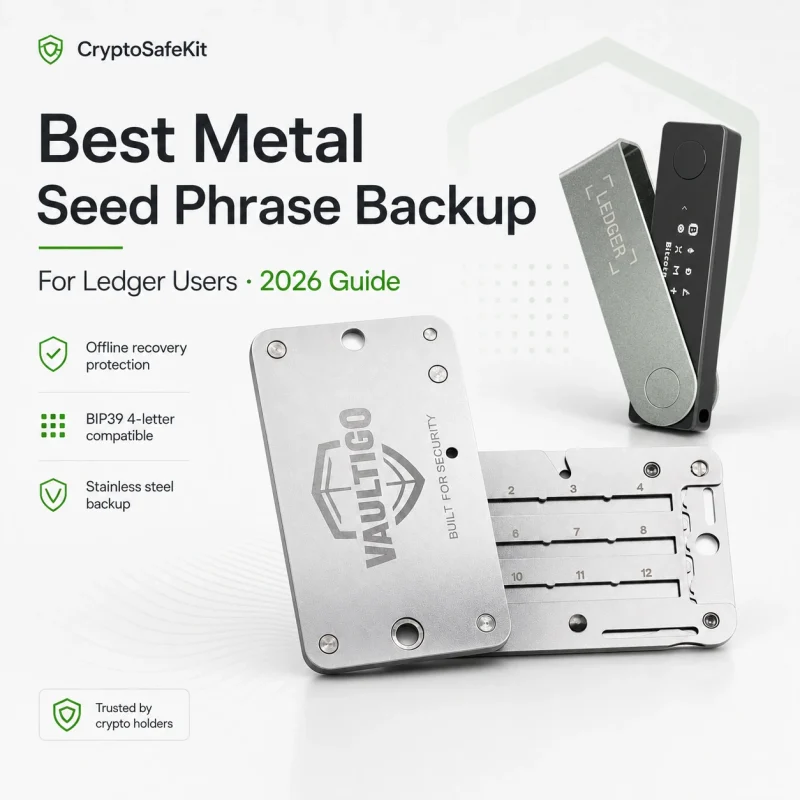
For users holding significant crypto long-term, a metal backup such as the VAULTIGO 4-Letter Metal Seed Phrase Backup can provide a more durable recovery medium than paper. CryptoSafeKit’s product specification describes the system as a reusable stainless-steel backup designed for standard English BIP39 phrases and using the first four letters of each word.
This approach takes advantage of the first-four-letter uniqueness property defined for the BIP39 wordlist. The product is positioned for long-term physical protection against risks including fire, water, and corrosion rather than making unrealistic claims of indestructibility.
A metal plate should still be placed somewhere with appropriate access control.
Metal improves survivability.
A safe, vault, carefully selected location, geographic redundancy, and disciplined secrecy improve security.
You need both.
Security Checklist for Long-Term Seed Storage
Before considering your cold-storage setup complete, verify the following:
- Recovery phrase was generated by the wallet itself.
- All words and their order have been verified.
- No photo, screenshot, email, or cloud copy exists.
- The phrase has never been entered into an untrusted website or app.
- Long-term holdings use a physically durable backup medium where appropriate.
- Hardware wallet and recovery backup are not stored together.
- At least one recovery path survives a major home disaster.
- Additional backup locations have strict access control.
- Any BIP39 passphrase is included in the recovery strategy.
- Trusted heirs can eventually locate the recovery instructions without unnecessarily exposing the seed today.
- Backup condition and location are reviewed periodically.
- You know exactly what you would do if the seed were suspected of compromise.
FAQ
Q: What is the best way to store a 24-word seed phrase long term?
A: For significant long-term holdings, a strong approach is to keep the recovery phrase completely offline, record it on a durable metal medium, secure it against unauthorized access, and maintain carefully controlled geographic redundancy when your threat model justifies it.
The most important principle is balancing loss prevention with theft prevention.
Q: Is metal seed phrase storage better than paper?
A: Metal generally provides substantially better physical resilience against fire, water, tearing, and long-term environmental damage. Paper can still provide an effective offline backup when properly protected, but it has a higher risk of physical degradation. Ledger and Trezor both recommend considering durable metal recovery solutions for these risks.
Q: Should I keep multiple copies of my seed phrase?
A: Multiple copies can protect against localized disasters, but every full copy also increases the number of places from which an attacker can obtain your wallet credentials.
For many users, two carefully secured, geographically separated physical backups offer a more sensible balance than distributing many copies.
Q: Can I split my 24-word seed phrase between two locations?
A: You can physically split a phrase, but simply storing words 1–12 in one location and 13–24 in another is not the same as cryptographic secret sharing.
It eliminates redundancy because losing either half prevents recovery. Advanced users who require distributed recovery should investigate standardized threshold or multisignature approaches instead of improvising their own system.
Q: Can I store my seed phrase in a bank safe deposit box?
A: A secure offsite vault can reduce the risk that a home fire, flood, or burglary destroys every recovery path. However, an offsite location should be evaluated for access control, privacy, availability, and how recovery would work during an emergency or inheritance event.
It should be part of a complete system, not your only recovery location.
Q: Is it safe to store a seed phrase in a password manager?
A: For a hardware wallet intended to provide cold-storage isolation, entering the recovery phrase onto a general-purpose computer or smartphone changes the threat model significantly.
Hardware-wallet manufacturers generally recommend keeping recovery phrases offline and avoiding digital copies.
Q: Are the first four letters of each BIP39 word enough?
A: For the standard BIP39 wordlist, the specification states that the wordlist is designed so the first four letters uniquely identify each word.
This should not automatically be assumed for every wallet format, language, or non-BIP39 wordlist. Confirm compatibility before using abbreviated storage.
Q: How often should I check my seed phrase backup?
A: Long-term holders should periodically inspect their physical backup and confirm that their recovery plan still makes sense.
You do not need to expose or repeatedly handle the phrase unnecessarily. The objective is to verify that the backup still exists, remains readable, its storage location is accessible, and your broader recovery or inheritance strategy has not become outdated.
Conclusion
Learning how to store seed phrase long term is ultimately about designing for two failures at the same time: losing access and giving access away.
Paper offers simple offline protection.
Metal improves physical durability.
Geographic redundancy improves disaster resilience.
Strong access control protects against theft.
Passphrases, multisignature wallets, and distributed recovery systems can strengthen advanced setups, but they also increase operational complexity.
For long-term crypto holders, the goal should never be the most complicated security system possible. It should be the simplest system that reliably survives your realistic threat model.
Protect the hardware wallet, but treat the seed phrase as the deeper security boundary.
If your recovery phrase remains private, durable, verifiable, and recoverable when you actually need it, your self-custody system is doing its job.