

Seed Phrase Backup Methods Compared: Paper, Metal Backup Plates, Shamir Backup, and Long-Term Storage

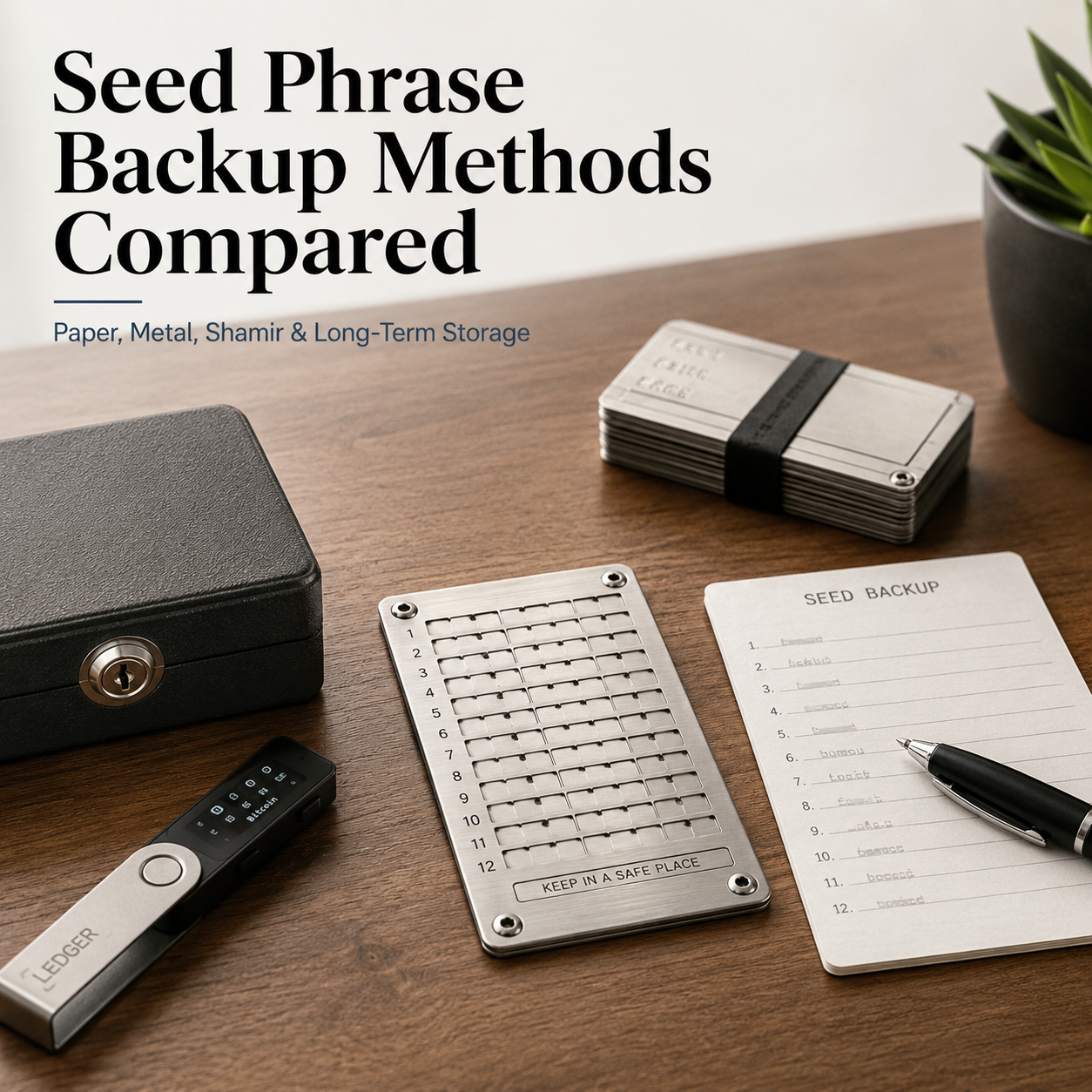
Many people are willing to spend hundreds of dollars on a hardware wallet, but they hesitate to spend much less on properly backing up their seed phrase.
That is backwards.
A hardware wallet can be replaced. A damaged device can be swapped. A wallet app can be reinstalled. But if your seed phrase is lost, destroyed, stolen, or exposed, the problem becomes much more serious.
Your seed phrase, also called a recovery phrase or seed recovery phrase, is the master backup to your wallet. It is what allows you to restore access to your crypto if your hardware wallet is lost, damaged, reset, or replaced.
In other words, your hardware wallet protects your private keys during daily use, but your seed phrase protects your long-term ability to recover your assets.
This is why seed phrase storage is not a small detail. It is one of the most important parts of crypto self-custody.
In this guide, we will compare the most common seed phrase backup methods, including paper, waterproof paper, metal seed phrase backup plates, encrypted USB drives, Shamir Backup, and multi-location physical storage. The goal is not to overhype one method or dismiss everything else. The goal is to help you choose the right backup strategy based on your asset size, risk level, and long-term needs.
What Makes a Good Seed Phrase Backup?
Before comparing different backup methods, we need to define what a good seed phrase backup should actually do.
A proper backup should protect your recovery phrase from realistic threats, not just look secure on paper.
1. Fire Resistance
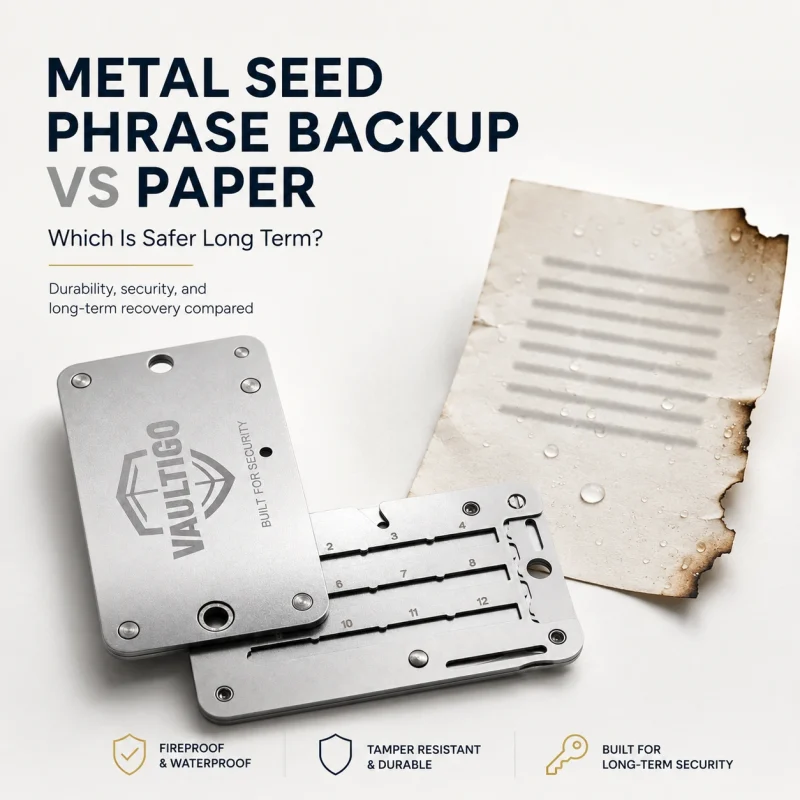
Paper burns easily. A house fire, electrical accident, kitchen fire, warehouse fire, or unexpected disaster can destroy a paper seed phrase in minutes.
If you are holding crypto for years, fire resistance matters. This is one of the main reasons metal seed phrase backups became popular among long-term holders.
2. Water Resistance
Water damage is more common than many people expect.
Floods, leaks, humidity, storms, basement water damage, and even a spilled drink can destroy or blur a paper backup. Ink can run. Paper can tear. Mold can develop over time.
A serious backup method should not fail just because it gets wet.
3. Corrosion Resistance
If your recovery phrase needs to survive five, ten, or even twenty years, corrosion resistance becomes important.
This is why stainless steel is widely used for seed phrase backup plates. It is durable, relatively affordable, and resistant to many common forms of corrosion. Titanium is also used in premium backups, while softer metals may not be as suitable for harsh long-term storage environments.
4. Magnetic Resistance
A seed phrase backup should not depend on magnetic or electronic storage.
USB drives, hard drives, SD cards, and laptops can fail, degrade, become corrupted, or become unreadable. A physical engraved or stamped backup does not depend on electricity, batteries, file systems, or software compatibility.
5. Long-Term Durability
A good backup should survive normal life events: moving houses, humidity, physical pressure, accidental drops, storage changes, and years of neglect.
If a backup becomes unreadable after a few years, it is not a reliable long-term storage method.
6. Privacy and Concealment
A seed phrase should not be easy for strangers to identify.
Writing “Bitcoin Wallet Backup” on an envelope and putting it in a drawer is not a good security practice. A good storage method should be discreet enough that it does not attract attention while still being accessible to you when needed.
7. No Digital Exposure
This is one of the most important rules.
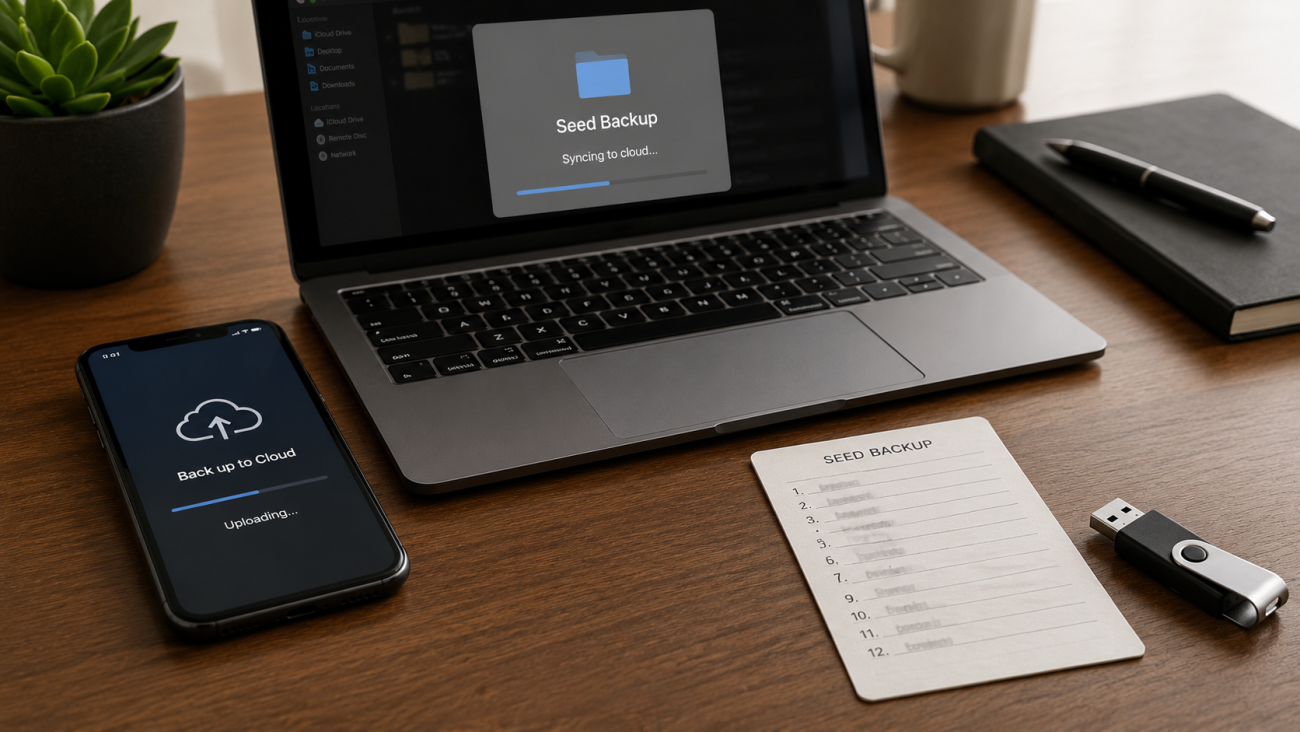
Your seed phrase should not be photographed, typed into a phone, saved in cloud storage, stored in an email draft, uploaded to Google Drive, kept in a password manager, or written into a text file.
Once your seed phrase becomes digital, it can potentially be stolen remotely.
8. Recoverable by You or Trusted Family
There is also a balance to consider.
If you hide your seed phrase so well that even you cannot find it, the backup has failed. If your family or designated heir has no way to locate or understand your recovery plan, your assets may become inaccessible in an emergency.
A good backup system should be private, but not impossible to recover.
Seed Phrase Backup Method Comparison
Now let’s compare the most common storage methods.
Method 1: Regular Paper Backup
This is the method most beginners use when setting up their first hardware wallet.
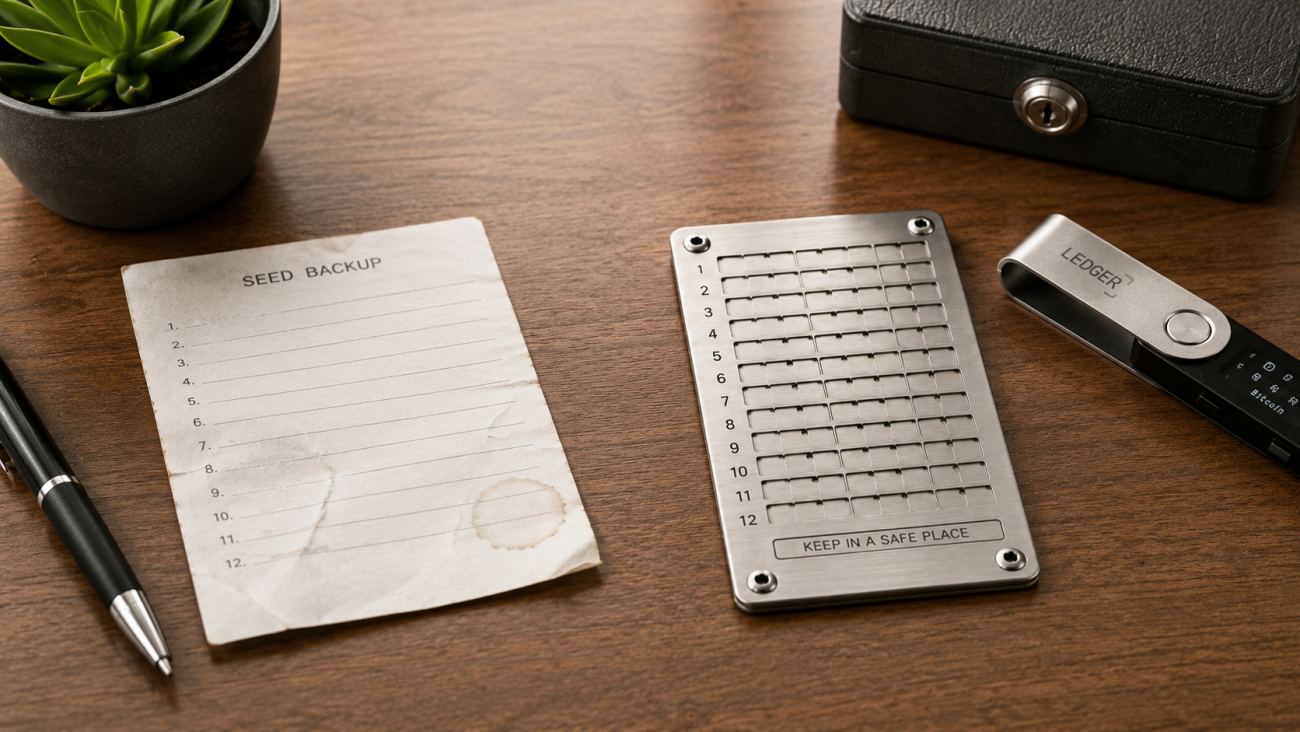
The device shows 12, 18, or 24 recovery words, and the user writes them down on the recovery sheet that comes in the box.
Pros
Regular paper backup has one major advantage: it is simple.
It costs almost nothing. It is easy to understand. It requires no special tools. You can complete it immediately during wallet setup.
For someone learning how hardware wallets work, paper is the most accessible starting point.
Cons
The problem is durability.
Paper is vulnerable to fire, water, humidity, insects, ink fading, tearing, and accidental disposal. It is also easy for another person to photograph or copy.
Many people store their paper backup in the same box as the hardware wallet, in a drawer, inside a notebook, or between books. During cleaning, moving, or renovation, it may be thrown away by mistake.
Another common issue is handwriting. If the words are written quickly or unclearly, you may struggle to read them years later.
Best For
Paper backup is only suitable for small balances, temporary storage, or beginners who are still learning the recovery process.
It is not ideal for long-term storage of meaningful crypto holdings.
Practical Tips
If you use paper temporarily, write clearly with a durable pen, create at least two copies, store them separately, never photograph them, and never keep them with the hardware wallet.
Do not label the paper with obvious phrases such as “Bitcoin seed phrase” or “crypto wallet backup.”
Method 2: Waterproof or Fire-Resistant Paper
Some users choose waterproof paper, fire-resistant paper, or special recovery cards designed to be more durable than regular paper.
This is a small upgrade, but it is still not the same as a metal backup.
Pros
Waterproof or reinforced paper is better than regular paper in certain conditions. It may resist moisture better, handle light wear better, and remain readable longer than ordinary paper.
It is also inexpensive and easy to use.
Cons
The main weakness is that it still depends on written ink or printed text.
Waterproof does not always mean fireproof. Fire-resistant does not always mean it can survive a serious house fire. Some materials may resist brief exposure but fail under extreme heat, long-term humidity, or physical damage.
In many cases, this method is best viewed as an upgraded paper backup, not a true long-term cold storage solution.
Best For
This method can work for users with smaller holdings who want something better than regular paper but are not ready to purchase a metal seed phrase backup.
It is also reasonable as a temporary backup while preparing a more durable solution.
Practical Tips
Do not rely on marketing terms alone. Check what the material is actually designed to resist. Store multiple copies separately and avoid treating this as a permanent solution for large holdings.
Method 3: Metal Seed Phrase Backup Plate
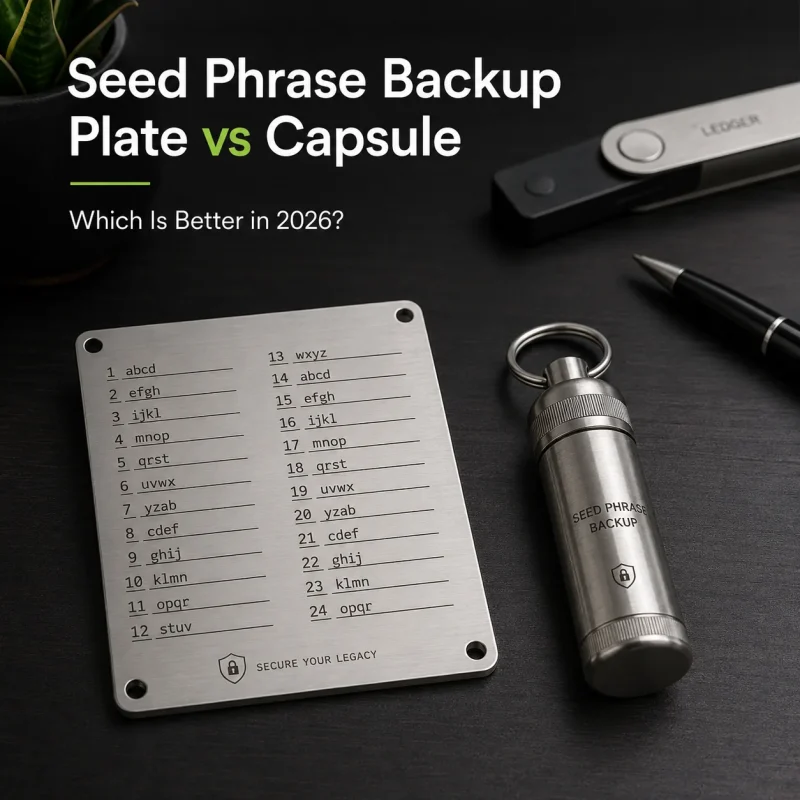
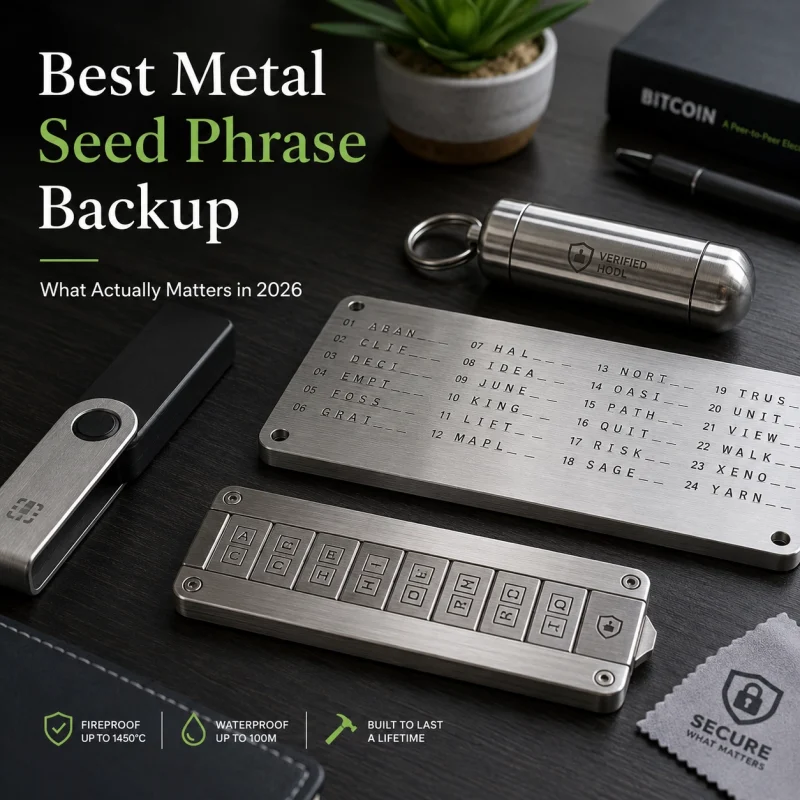
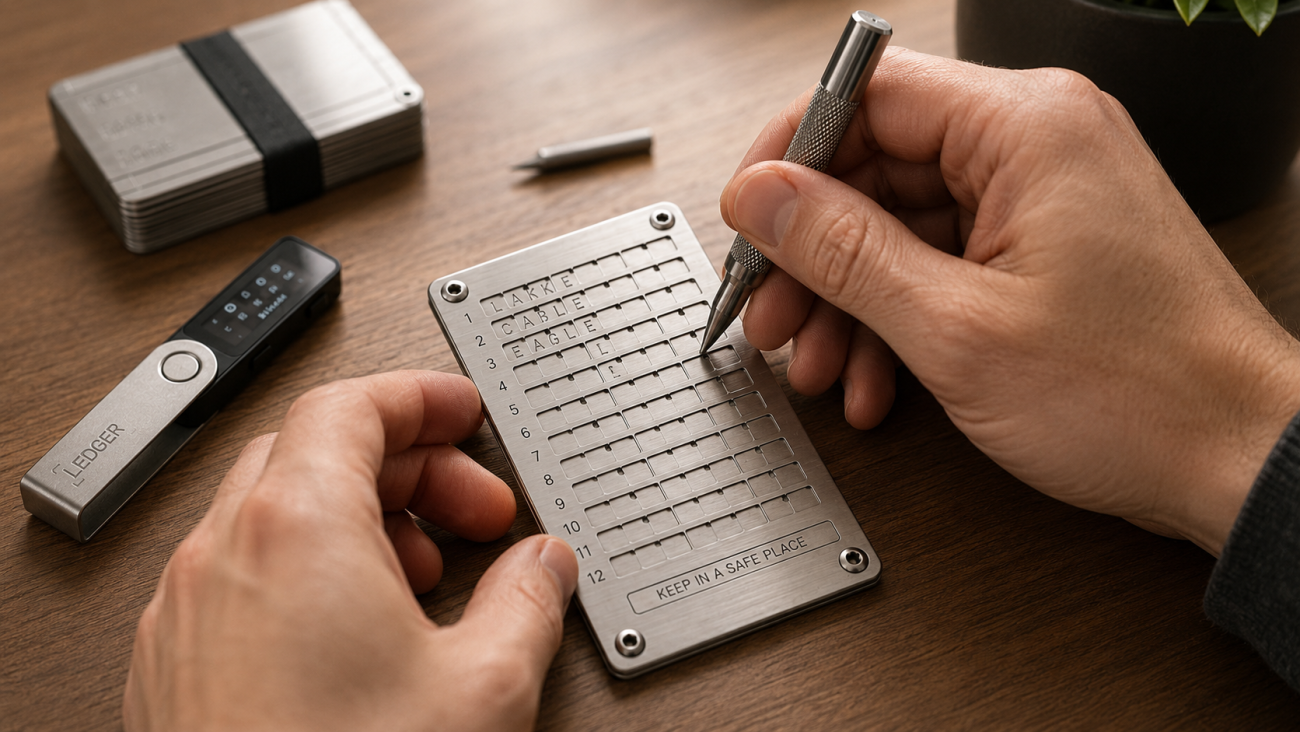
A metal seed phrase backup plate is currently one of the most practical and widely recommended solutions for long-term crypto recovery phrase storage.
The idea is simple: instead of writing your seed phrase on paper, you stamp, engrave, or assemble the words or letters on a durable metal plate.
Why Metal Backups Are Popular
Metal backups do not rely on ink, batteries, files, apps, or cloud storage.
They are designed to resist fire, water, corrosion, impact, and long-term physical degradation much better than paper. They also avoid the remote hacking risks that come with digital storage.
For most long-term holders, this is the best balance between security, usability, and cost.
Metal Material Comparison
| Material | Strengths | Weaknesses | Best For |
|---|---|---|---|
| Stainless Steel | Durable, corrosion-resistant, affordable, widely used | Not completely immune to extreme corrosive environments | Most long-term holders |
| Titanium | Lightweight, strong, excellent corrosion resistance | More expensive | Premium users and high-budget storage setups |
| Copper | Easy to engrave, solid physical feel | More prone to oxidation and discoloration | Lower-risk or collectible use cases |
Pros of Metal Seed Phrase Backup Plates
Metal backup plates are much more durable than paper. They are resistant to water, do not depend on ink, are not affected by magnets, and can survive long-term storage better than most alternatives.
They are especially useful when paired with a hardware wallet. The hardware wallet protects transaction signing, while the metal backup protects recovery.
Cons
Metal backups cost more than paper. They also require careful setup. If you stamp or engrave the wrong word, correcting it can be difficult.
Another important point: a metal backup is still sensitive information. If someone finds it and understands what it is, your wallet may be at risk. It must still be stored discreetly and securely.
What to Look for When Buying One
When choosing a metal seed phrase backup, look at:
Material quality;
Plate thickness;
Stamping or engraving depth;
Support for 12-word and 24-word phrases;
Ease of reading;
Resistance to heat and corrosion;
Whether the backup remains intact if dropped or shaken;
How discreetly it can be stored.
The depth of the letters matters. Very shallow engraving may become harder to read after heat exposure, corrosion, or physical wear.
Plate thickness also matters. Very thin metal can bend, warp, or deform more easily.
Best For
Metal seed phrase backup plates are best for medium to large holdings, long-term crypto investors, Bitcoin holders, Ethereum holders, stablecoin holders, and anyone using a hardware wallet for serious self-custody.
For most users with meaningful long-term holdings, a stainless steel seed phrase backup is one of the best value options.
Method 4: Encrypted USB Drive or Hard Drive Backup
This is a method I strongly discourage for most users.
Some people think they are being smart by typing their seed phrase into a text file, encrypting it, and storing it on a USB drive or external hard drive.
It may sound advanced, but it creates serious risks.
Why This Is Risky
The biggest problem is that the seed phrase becomes digital.
Once you type your recovery phrase into a computer, you have to trust that computer completely. But most people cannot verify whether their device is free from malware, keyloggers, clipboard monitors, hidden screen capture tools, cloud sync, indexing services, or compromised software.
Even if the file is encrypted, the seed phrase may have been exposed during typing, saving, copying, or temporary storage.
There are also long-term problems:
USB drives fail.
Hard drives fail.
Files become corrupted.
Encryption passwords are forgotten.
Future operating systems may not read the file.
Family members may not know how to decrypt it.
Best For
For 99% of users, this method is not recommended.
It may be usable only for highly technical users who understand air-gapped systems, offline encryption, secure operating environments, and long-term data recovery. Even then, it is usually unnecessary compared with a durable offline physical backup.
Conclusion
A seed phrase backup should be simple, offline, and physically durable.
An encrypted USB backup may look sophisticated, but for most users, it increases the attack surface instead of reducing risk.
Method 5: Shamir Backup
Shamir Backup is an advanced backup method designed to reduce single-point-of-failure risk.
Instead of storing one complete recovery phrase in one place, Shamir Backup splits the recovery secret into multiple shares. You can define how many shares are required to recover the wallet.
For example, in a 2-of-3 setup, three shares are created, and any two of them can restore the wallet. One share alone is not enough.
Pros
Shamir Backup reduces the risk of one lost or stolen backup compromising everything. If one share is lost, the wallet may still be recoverable. If one share is stolen, the thief may not have enough information to access the funds.
It is useful for multi-location storage, family planning, business treasury management, and high-value crypto custody.
Cons
The main drawback is complexity.
Users must understand how many shares exist, how many are needed for recovery, where they are stored, and how to recover the wallet when needed.
If the setup is too complex, the owner may accidentally lock themselves out. Family members may also struggle to understand the recovery process.
Compatibility is another issue. Not every wallet supports the same Shamir implementation, so users must confirm device and software support before relying on it.
Best For
Shamir Backup is best for advanced users, large holdings, multi-location storage, shared custody situations, and people who fully understand recovery thresholds.
It is not the best starting point for beginners.
Practical Tips
Keep the threshold simple.
Do not store all shares in the same location.
Do not let one person easily access enough shares.
Write clear recovery instructions without exposing sensitive details.
Check regularly that each share is still readable and accessible.
Method 6: Physical Safe + Multi-Location Storage
This is a more professional backup strategy for users with significant holdings.
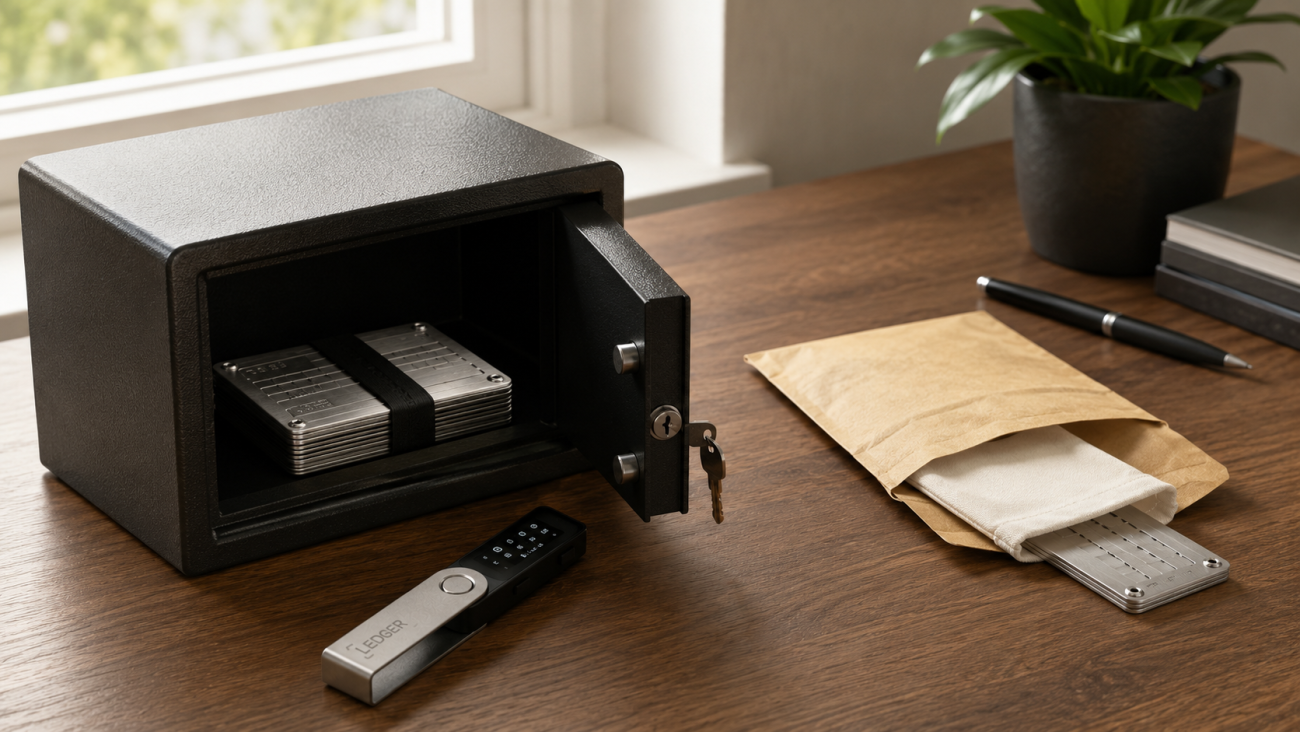
The idea is to avoid keeping all recovery information in one location. For example, you may store one metal backup in a home safe and another backup in a secure off-site location.
Advanced users may combine physical safes, metal backups, passphrases, Shamir Backup, and trusted inheritance planning.
How It Works
A practical setup may include:
One metal backup stored in a home safe;
Another backup stored in a separate secure location;
Hardware wallet stored separately from the recovery phrase;
Clear but discreet recovery instructions;
Optional passphrase protection;
Optional Shamir Backup for larger holdings.
Pros
This reduces single-location risk. A house fire, burglary, flood, or accidental disposal is less likely to destroy all recovery options.
It is especially useful for long-term holders, families, and people with significant digital assets.
Cons
This method requires more planning. It may involve more cost, more storage locations, more documentation, and more operational discipline.
If the system becomes too complicated, future recovery may become difficult.
Another risk is privacy. The more people or locations involved, the more carefully you need to manage who knows what.
Best For
This is best for high-value crypto holders, long-term investors, family wealth planning, and professional self-custody setups.
For beginners, it may be unnecessary at first. For serious long-term holders, it becomes increasingly important.
Recommended Backup Strategy by User Type
Not everyone needs the same setup. The right method depends on how much crypto you hold, how long you plan to hold it, and how much complexity you can manage.
1. Beginner with Small Holdings
Recommended setup:
Paper backup or waterproof paper;
Two copies stored separately;
No digital backup;
Basic wallet recovery practice.
For beginners, the first goal is to understand the process.
Learn how to generate the seed phrase yourself, write it down offline, make a small test transaction, and understand how wallet recovery works.
At this stage, the biggest risk is usually not the material of the backup. The biggest risk is not understanding how important the recovery phrase is.
2. Medium-Sized Long-Term Holdings
Recommended setup:
Hardware wallet;
Stainless steel seed phrase backup plate;
At least two separate storage locations.
This is the best value setup for most serious users.
If your holdings are worth enough that losing them would genuinely hurt, paper backup is no longer enough. A stainless steel recovery phrase backup provides much better durability without making the system too complicated.
This setup is practical, affordable, and easy to maintain.
3. Large Holdings
Recommended setup:
Hardware wallet;
Metal seed phrase backup;
Multiple secure locations;
Optional passphrase;
Optional Shamir Backup;
Physical safe or professional storage;
Regular recovery checks.
For larger holdings, the goal is to reduce single points of failure.
You should consider fire, flood, theft, accidental loss, inheritance, memory failure, and access planning.
The best solution is not always the most expensive product. It is a system you understand, can maintain, and can recover from.
Golden Rules for Seed Phrase Backup
No matter which method you choose, these rules apply.
1. Never Digitize Your Seed Phrase
Do not take photos.
Do not make screenshots.
Do not save it in cloud storage.
Do not email it to yourself.
Do not store it in phone notes.
Do not keep it in a password manager.
Once your seed phrase becomes digital, it can potentially be stolen remotely.
2. Keep at Least Two Backups in Separate Locations
One backup is a single point of failure.
Fire, water damage, theft, moving mistakes, or accidental disposal can destroy one copy. Two backups stored separately are much safer.
3. Check Your Backup Periodically
Every 6 to 12 months, check that your backup is still readable and stored safely.
Look for:
Fading;
Corrosion;
Physical damage;
Location changes;
Unauthorized access risk;
Missing parts or unclear words.
Do not photograph your backup during inspection. Do not open it in front of cameras or strangers.
4. Do Not Tell Unnecessary People About Your Backup
Privacy is part of security.
You do not need to tell friends how much crypto you hold. You do not need to show your metal backup. You do not need to explain your storage locations to people who do not need to know.
The fewer people who know, the lower the risk.
5. Do Not Store the Hardware Wallet and Seed Phrase Together
A hardware wallet and seed phrase should not be kept in the same place.
The hardware wallet is the lock.
The seed phrase is the master key.
Keeping them together removes an important layer of protection.
Final Recommendation: What Should Most Users Choose?
For most users, the best seed phrase storage method is:
Hardware wallet + stainless steel seed phrase backup + two separate storage locations
This setup is simple enough to use, strong enough for long-term holding, and much safer than paper or digital storage.
It protects against:
Paper damage;
Fire and water exposure;
Ink fading;
Cloud leaks;
USB failure;
Single-location loss;
Hardware wallet damage.
For most long-term crypto holders, this is the most practical and cost-effective seed phrase backup strategy.
Recommended Product: CryptoSafeKit Stainless Steel Seed Phrase Backup


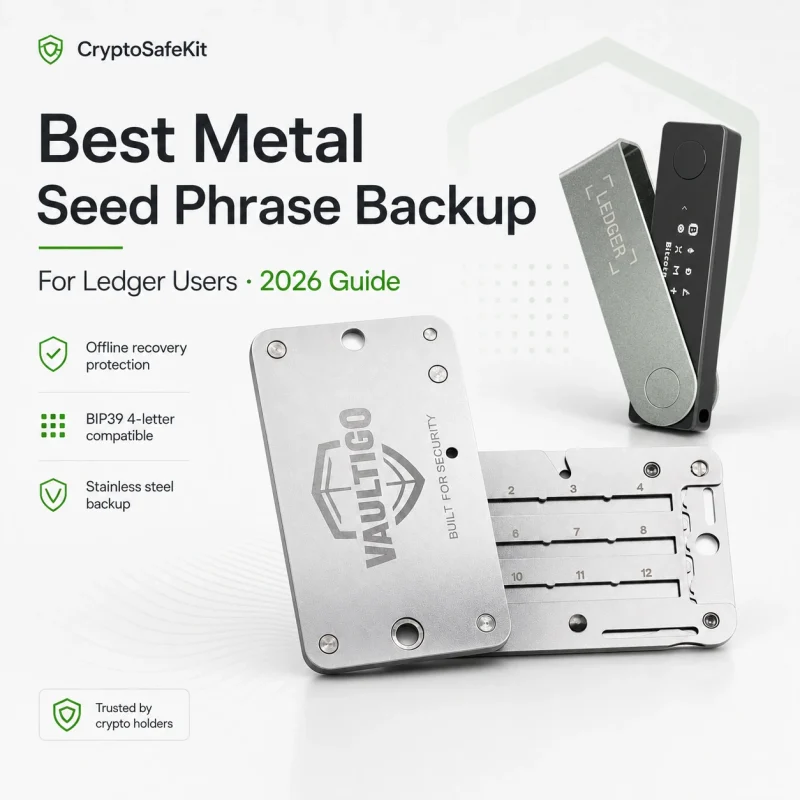
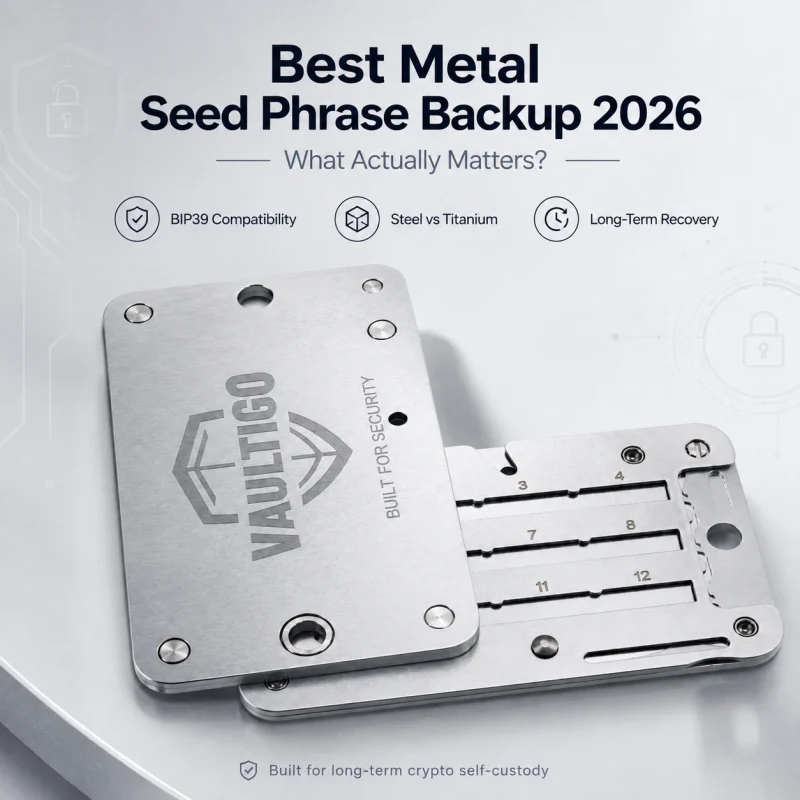
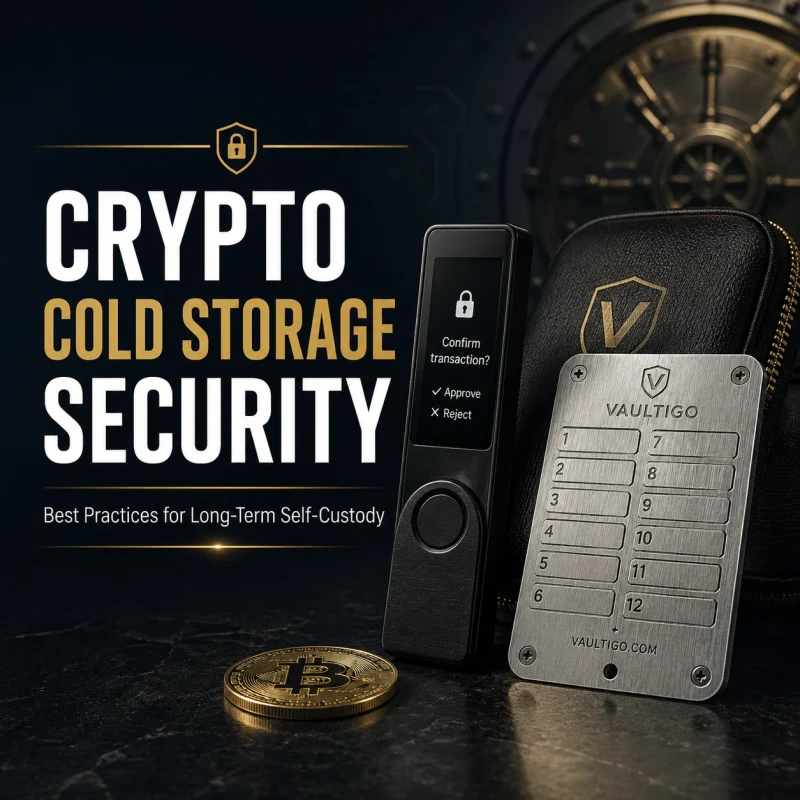
VAULTIGO 4-Letter Metal Seed Phrase Backup System
Original price was: $99.00.$59.99Current price is: $59.99.VAULTIGO 4-Letter Metal Seed Phrase Backup is a reusable stainless steel backup system designed to store your recovery words offline. Built for standard English BIP39 seed phrases, each recovery word can be identified by its first four letters, helping you create a compact, organized, and durable backup without punching, engraving, or hammering.
- Stores the first 4 letters of each recovery word
- Designed for standard English BIP39 word lists
- No punching, engraving, or hammering required
- Reusable metal letter tiles
- Water and corrosion resistant stainless steel design
- Lockable structure for added physical protection
- Ideal for hardware wallets, cold wallets, and long-term crypto self-custody
If you are looking for a simple, durable, and long-term seed phrase storage method, the CryptoSafeKit Stainless Steel Seed Phrase Backup is designed for users who want stronger protection than paper.
It is suitable for Ledger, Trezor, and other hardware wallet users who need to protect 12-word or 24-word recovery phrases offline.
A stainless steel backup is not a magic solution by itself. It must be combined with good security habits:
Record the phrase offline;
Never photograph it;
Never upload it to the cloud;
Store it separately from the hardware wallet;
Keep at least two backups if possible;
Check the backup periodically.
A hardware wallet protects the signing process. A metal seed phrase backup protects the recovery process.
Together, they create a stronger cold storage system.
Crypto security does not begin and end with buying a hardware wallet. It begins when you take those 12 or 24 words seriously.
Protect the phrase.
Protect the recovery path.
Protect your future access.