





Traveling with a Hardware Wallet: Airport Security, Customs, Seed Phrase Safety, and Practical Travel Tips

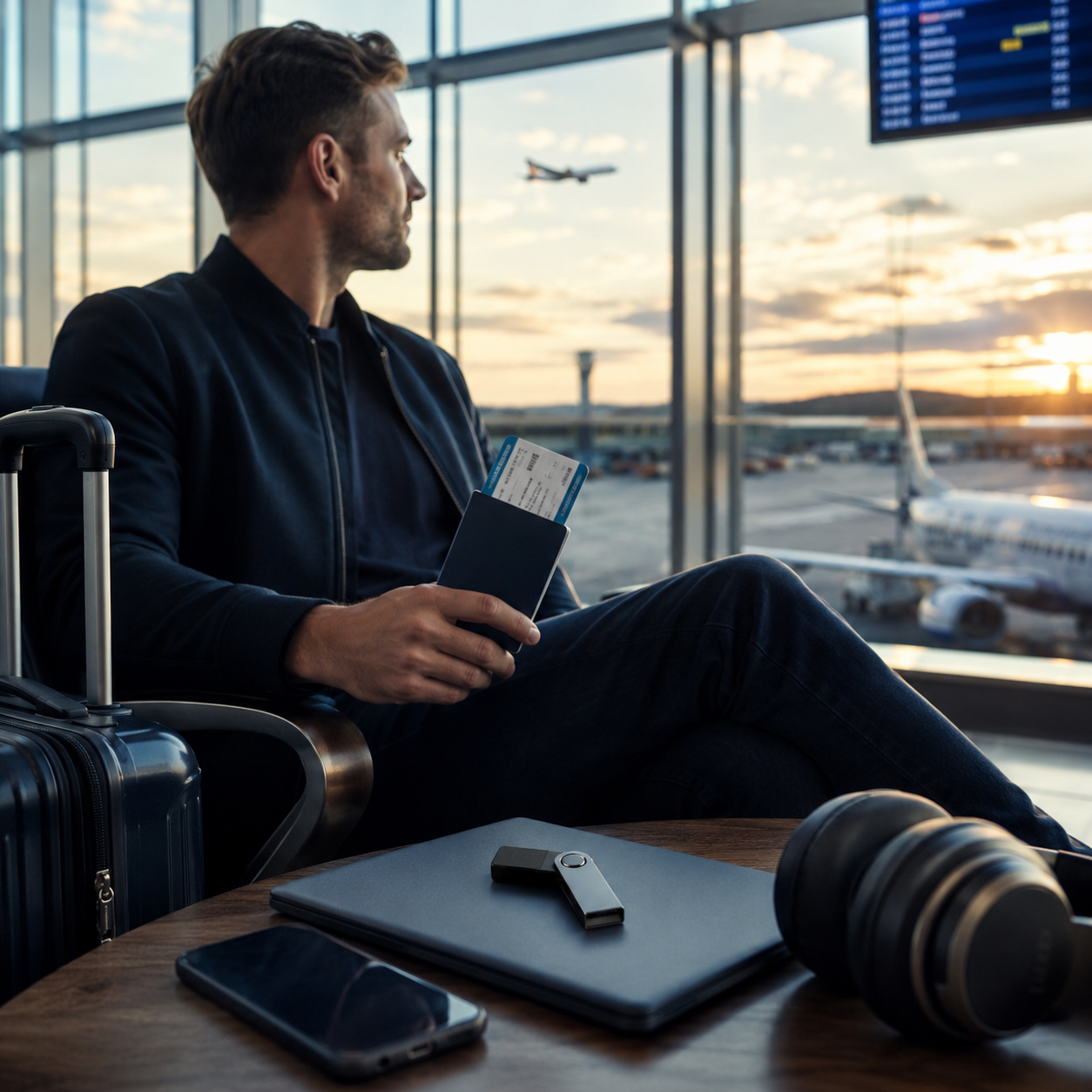
I travel quite often, and over the years I have carried a hardware wallet through airports, hotels, border checks, long layovers, and more countries than I can easily count.
When I first started traveling with crypto, I was honestly nervous.
A hardware wallet looks like a small electronic device, but behind that small device could be access to a meaningful amount of Bitcoin, Ethereum, stablecoins, or other digital assets. Every time I packed my bag, I had the same questions:
Will airport security ask about it?
Can customs confiscate it?
What if someone steals my bag?
Should I carry my seed phrase with me?
Is it safe to use a hardware wallet while traveling?
This guide is based on practical travel experience, not theory. It is not about hiding assets illegally or avoiding lawful border rules. The goal is simple:
Travel legally, reduce unnecessary exposure, and protect your private keys and recovery phrase.
Will Airport Security or Customs Have a Problem with a Hardware Wallet?
In most cases, a hardware wallet does not cause special issues at airport security.
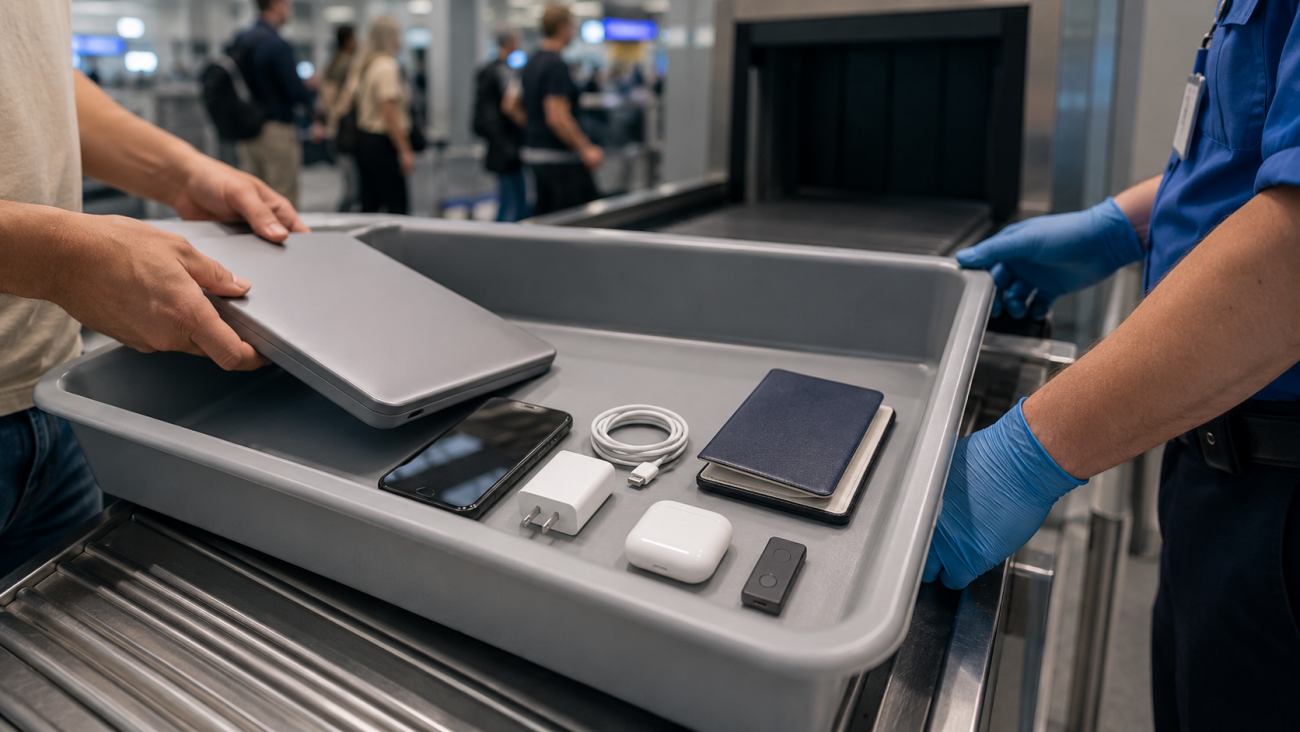
To airport screening staff, a hardware wallet usually looks like a small electronic device, USB device, or compact gadget. Security screening is generally focused on dangerous items, batteries, weapons, explosives, liquids, and prohibited objects — not whether your device is a crypto wallet.
Devices like Ledger, Trezor, and similar cold wallets are usually treated like ordinary electronics as long as they are not modified and do not contain anything prohibited.
However, you should understand the difference between airport security screening and border or customs inspection.
Airport security is mainly about flight safety. They may ask you to remove electronics from your bag, scan your luggage, or in some countries ask you to power on electronic devices.
Customs and border officers have a different role. They may inspect luggage, ask questions about items you are carrying, and in some jurisdictions have authority to examine electronic devices under certain circumstances.
For most ordinary travelers, a hardware wallet will pass through security without attention. But international travel always depends on the destination country, local rules, and the discretion of border officials.
A simple way to think about it:
Domestic flights: usually treated like a normal electronic accessory.
International flights: airport security is usually fine, but border rules vary by country.
Customs risk: usually low for the device itself, but you should understand the laws of the destination country.
A hardware wallet is not the same as carrying physical cash, but crypto regulations differ from country to country. Some places are crypto-friendly, some are restrictive, and some have unclear or changing rules.
Before traveling, always check the destination country’s rules on cryptocurrency, electronic devices, financial declarations, and digital asset activity.
Will a Hardware Wallet Be Confiscated?
For normal legal travel, a hardware wallet is generally unlikely to be confiscated just because it is a hardware wallet.
It is not a weapon.
It is not cash.
It is not a prohibited battery pack.
It is usually just a small electronic signing device.
That said, customs officers may still inspect belongings depending on the country and situation. If you are entering a jurisdiction with strict crypto regulations, or if your travel pattern raises questions, you may face more scrutiny.
My personal rule is this:
Do not rely on assumptions. Check local laws before traveling.
Also, do not travel with a hardware wallet that looks suspicious, modified, damaged, or intentionally disguised in a way that could create unnecessary questions. Keep it simple and ordinary.
5 Ways to Carry a Hardware Wallet While Traveling
There is no perfect method for everyone. The best approach depends on your travel style, the value of your assets, how often you need to transact, and your personal risk tolerance.
Here are five practical options.
Option 1: Carry It with You
This is the method I use most often.
I keep the hardware wallet in my carry-on bag, usually inside a small electronics pouch with ordinary items like cables, adapters, earbuds, and a USB drive. I do not put it in checked luggage, and I do not make it visually obvious.
Advantages
You always know where the device is.
It is less likely to be lost with checked luggage.
You can access it if needed during the trip.
It stays under your control.
Disadvantages
You must protect it from theft.
You may be carrying it through crowded airports, trains, hotels, and public spaces.
If your entire backpack is stolen, the device is gone.
My practical tip: do not carry it in branded packaging that says “crypto,” “Bitcoin,” “hardware wallet,” or anything similar. Keep it boring.
The best travel security is often low visibility.
Option 2: Put It in Checked Luggage
I do not recommend this.
Checked luggage can be lost, delayed, opened for inspection, damaged, or stolen. Even if the hardware wallet itself is PIN-protected, you do not gain much by placing it in a bag you cannot control.
There is also the battery consideration. Some hardware wallets have built-in batteries. Airline rules around lithium batteries usually favor keeping battery-powered electronics in carry-on luggage rather than checked baggage.
Even if your device has a very small battery, the practical answer is still the same:
Do not put your main hardware wallet in checked luggage.
The risk is not worth it.
Option 3: Split the Device and Recovery Backup
This is one of the best approaches for serious travelers.
You may carry the hardware wallet, but leave the seed phrase backup in a secure location. Or you may carry a secondary wallet with only limited funds while keeping your main wallet and backup stored separately.
The core idea is simple:
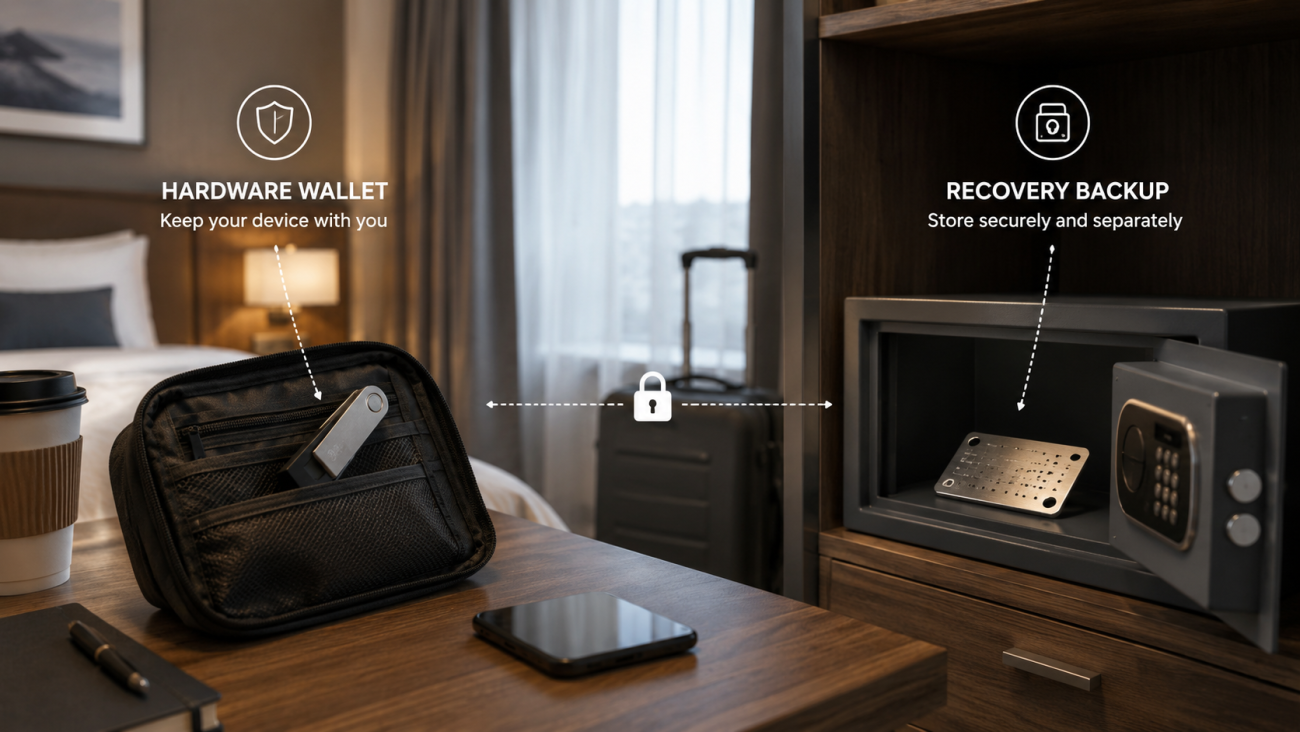
Never carry the device and the recovery phrase together.
If someone steals your hardware wallet but does not have the PIN or seed phrase, your funds are not immediately accessible. But if someone steals both the hardware wallet and the recovery phrase, your entire wallet may be compromised.
Advantages
Reduces single-point-of-failure risk.
Protects you if your bag is stolen.
Good for medium- or high-value holdings.
Disadvantages
If the device is lost while traveling, you may not be able to restore access immediately.
Requires planning before the trip.
May be inconvenient for frequent transactions.
For most short trips, this is my preferred setup:
Carry the hardware wallet if needed, but do not travel with the main seed phrase backup.
Option 4: Ship the Hardware Wallet to Your Destination
I generally do not recommend this, except for low-value backup devices.
Shipping adds uncertainty. Packages can be delayed, lost, opened, damaged, or rerouted. More importantly, if a device is handled by multiple parties before it reaches you, the chain of custody becomes less clear.
A hardware wallet is secure only when:
It comes from a trusted source;
It has not been tampered with;
You initialize it yourself;
You generate the recovery phrase yourself;
You verify the official software source.
Shipping a main wallet to your destination usually creates more risk than convenience.
If you must ship a device, treat it as a spare device only, not your primary wallet controlling meaningful funds.
Option 5: Use a Multi-Location Backup Strategy
This is more suitable for experienced users, long-term travelers, expats, or people with significant crypto holdings.
You may keep your main hardware wallet in one secure location, store a backup device somewhere else, and keep recovery backups separated across trusted locations.
This setup can reduce risk, but it can also become complicated.
If you are new to self-custody, do not overcomplicate your security system too early. A system you do not fully understand can become its own risk.
For advanced users, however, multi-location storage can be useful.
How to Make a Hardware Wallet Less Obvious
This is not about illegal concealment. It is about avoiding unnecessary attention.
I do not travel with original hardware wallet packaging. I do not use cases labeled “crypto wallet” or “Bitcoin wallet.” I do not discuss my holdings in airports, taxis, hotel lobbies, or public spaces.
Practical tips:
Keep the device in a normal electronics pouch;
Store it with ordinary cables, adapters, or earbuds;
Do not use crypto-branded cases while traveling;
Do not operate the wallet in public areas;
Do not talk about carrying a cold wallet;
Do not keep the hardware wallet and seed phrase in the same bag;
Use a strong PIN;
Check battery and firmware before the trip.
I once saw someone using a hardware wallet in an airport lounge while checking a large exchange balance on a laptop. That is not confidence. That is unnecessary exposure.
You never know who is watching, what cameras are around, or who may overhear your conversation.
Stay low-profile.
Should You Travel with Your Seed Phrase?
This is the most important part of the entire guide.
In most cases, I do not recommend traveling with your main seed phrase.
Your seed phrase is far more sensitive than the hardware wallet itself. If someone gets your recovery phrase, they may be able to restore your wallet and move your funds without needing the physical device.
Never do these things:
Do not take a photo of your seed phrase;
Do not store it in your phone notes;
Do not upload it to iCloud, Google Drive, Dropbox, or email;
Do not keep it in the hardware wallet box;
Do not put it in the same bag as the hardware wallet;
Do not label it clearly as “seed phrase” or “crypto recovery”;
Do not leave it loose in a hotel room.
If you are only taking a short trip, leave your main seed phrase backup in a secure location.
If you absolutely must carry a recovery backup internationally, you should think very carefully about legality, privacy, physical security, and how to avoid obvious labeling. Even then, device and backup should be separated.
For long-term storage, a metal seed phrase backup is better than paper, but that does not mean you should casually travel with it.
A metal backup protects against fire, water, corrosion, and physical damage. It does not protect against someone physically finding it.
Using a Hardware Wallet While Traveling
Travel introduces new risks: public networks, unfamiliar devices, hotel rooms, border checks, and location-based account security triggers.
Here are the main things I pay attention to.
Can You Use a Hardware Wallet on Public WiFi?
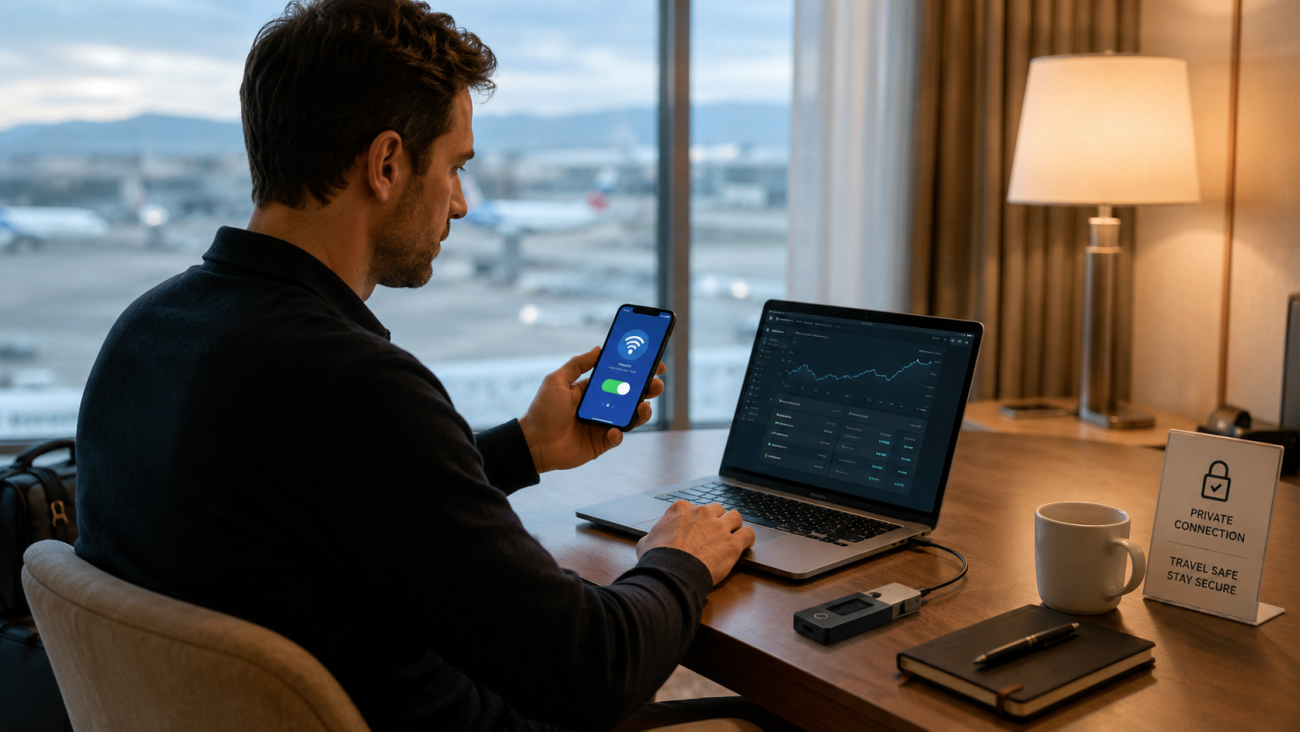
Technically, yes. But I do not recommend making large transactions on public WiFi.
The main risk is not that public WiFi can directly steal your private key from the hardware wallet. A properly used hardware wallet keeps the key offline. The bigger risks are fake websites, DNS hijacking, malicious portals, session theft, or tricking you into downloading fake wallet software.
My preference:
Use your own mobile hotspot;
Avoid open airport or cafe WiFi for transactions;
Use official apps only;
Verify addresses on the hardware wallet screen;
Avoid making large transfers while rushed or distracted.
Checking a balance is one thing. Signing a major transaction is another.
Never Plug Your Hardware Wallet into a Hotel Computer
This is one of my strictest rules.
Do not plug your hardware wallet into hotel business center computers, internet cafe computers, shared office computers, or someone else’s laptop.
You do not know what software is installed. There may be malware, keyloggers, fake wallet apps, remote access tools, or browser extensions designed to steal data.
Use your own laptop or phone. Use official wallet software. Verify the source before installing anything.
A hardware wallet reduces risk, but it does not make unknown computers safe.
Be Careful with Exchange and Account Security While Abroad
Hardware wallets are not the only issue when traveling.
Your exchange account, email, 2FA app, phone number, SIM card, and withdrawal settings may also be affected when you travel.
Some exchanges may trigger risk controls when you log in from a new country, new IP address, or new device. You may face:
Extra verification;
Withdrawal delays;
Account reviews;
2FA problems;
Email login issues;
SIM roaming problems.
Before traveling, check that your email, authenticator app, backup codes, and account security settings are working.
Do not wait until you are in another country to discover that you cannot receive verification codes.
What If You Lose Your Hardware Wallet While Traveling?
First, do not panic.
Losing a hardware wallet does not automatically mean losing your crypto.
If your device is protected by a strong PIN and the thief does not have your seed phrase, your funds are usually not immediately accessible.
The key question is:
Was the recovery phrase also lost or exposed?
If the Seed Phrase Is Safe
When you return to a secure environment:
Get a new hardware wallet;
Restore the wallet using your recovery phrase;
Check whether assets are still there;
Consider moving funds to a new wallet;
Stop using the lost device’s wallet setup.
If you believe the lost device may be at risk and the funds are significant, move funds to a freshly generated wallet as soon as possible.
If the Seed Phrase May Be Compromised
This is more urgent.
Use a safe device and trusted wallet software;
Restore access immediately;
Move assets to a new wallet with a new seed phrase;
Do not continue using the old recovery phrase;
Check token approvals and transaction history;
Act quickly.
If someone has the recovery phrase, the PIN on the hardware wallet does not matter. The seed phrase can restore the wallet elsewhere.
My Recommended Travel Setup
For short trips, my recommendation is:
Carry the hardware wallet if necessary, but do not carry the main seed phrase.
For trips where you may need to make transactions:
Carry the hardware wallet, use your own phone or laptop, use mobile hotspot when possible, and send a small test transaction before any large transfer.
For long-term travel or living abroad:
Separate your main wallet, backup device, and recovery phrase storage across secure locations. Use a metal seed phrase backup for long-term durability.
For larger holdings:
Do not rely on one device, one location, or one backup. Build a layered security system.
A strong travel setup should survive one thing going wrong. If your entire crypto security depends on one backpack, one phone, one device, and one seed phrase stored together, that is not a secure setup.
Final Thoughts: Travel with Crypto Quietly and Carefully
Traveling with a hardware wallet is not something to fear, but it is something to take seriously.
Most airport security checks will treat a hardware wallet like a normal electronic device. Customs problems are uncommon for ordinary travelers, but regulations differ by country, so you should always check destination rules before you go.
The real risks are usually not airport scanners.
The real risks are theft, careless storage, public WiFi, hotel computers, exposed seed phrases, and poor planning.
My personal travel rule is simple:
Legal travel, low visibility, separated backups, trusted devices only, and a recovery plan before departure.
If you follow those principles, carrying a cold wallet through airport security and across borders becomes much less intimidating.
Crypto gives you the ability to carry financial access across the world.
But that freedom comes with responsibility.
Protect the device.
Protect the seed phrase.
Protect your privacy.
And never make your entire security system depend on a single point of failure.