

Coldcard Seed Vulnerability: Build Multi-Layer Cold Storage Security to Avoid Mass Seed Theft

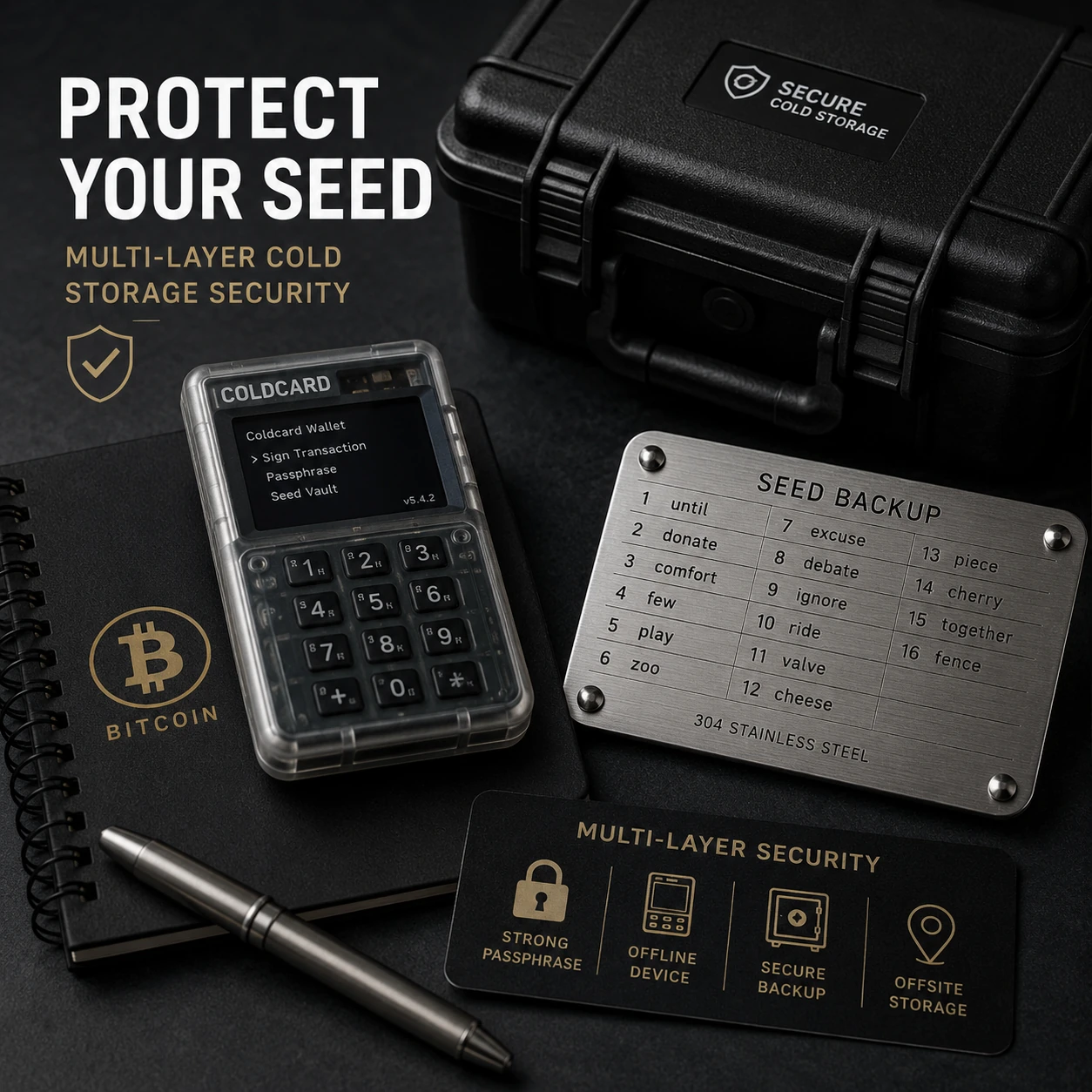
An offline hardware wallet can protect a private key from an infected laptop and still fail if the private key was created from weak randomness.
That is the most important lesson from the 2026 COLDCARD seed-generation vulnerability.
Coinkite disclosed that affected firmware could generate recovery seeds with substantially less effective entropy—cryptographic unpredictability—than intended. For affected wallets, installing corrected firmware is not enough: the old seed remains weak, so users must generate a new seed under fixed firmware and migrate funds to new addresses.
This does not mean cold storage has failed.
It means cold storage is a system, not a device.
A resilient setup needs independent defenses for seed generation, private-key isolation, transaction verification, recovery backups, physical security, geographic redundancy, and incident response. If every layer ultimately depends on one vulnerable seed, one implementation error can still compromise the entire wallet.
What the Coldcard Seed Vulnerability Actually Changed
COLDCARD’s security model is designed around offline Bitcoin signing, but a hardware wallet still has to create the secret it later protects.
That first step is critical.
When a hierarchical deterministic wallet is created, it starts with unpredictable entropy. In BIP39, that entropy is converted into a human-readable mnemonic and later used to derive the cryptographic seed from which wallet keys can be generated. The BIP39 specification defines mnemonic lengths corresponding to 128–256 bits of initial entropy.
A recovery phrase can therefore look completely normal while still having been generated from a defective randomness source.
What went wrong
Official Disclosure — Coinkite: The company says the affected seed-generation path used substantially weaker randomness than intended. Its current technical analysis estimates approximately 40 bits of effective entropy for certain affected Mk2/Mk3 seeds and roughly 72 bits for later affected Mk4/Q/Mk5 configurations, rather than the intended 128-bit security target. Coinkite states that these figures are current estimates, not universal guarantees about every attack scenario.
That does not mean attackers discovered the seed phrase by physically opening every device.
The dangerous condition existed when the wallet was created. Once funds were associated with addresses derived from a weak enough seed, an attacker could potentially search a dramatically smaller range of possibilities than would be feasible for a correctly generated cryptographic secret.
The crucial remediation rule
A firmware patch changes what the device does next.
It cannot retroactively add entropy to recovery words generated months or years earlier.
For an affected seed, the remediation chain is:
fixed firmware → new entropy → new seed → new addresses → asset migration
Coinkite explicitly instructs affected users to generate a fresh seed after updating and move funds rather than continuing to use the old seed.
That principle applies far beyond COLDCARD.
If a manufacturer ever confirms that an already-created private key, seed, derivation method, or signing key has been compromised, changing the wallet application or PIN usually does not repair the underlying cryptographic secret.
Why Offline Wallets Are Not Invulnerable
“Offline” describes one part of the threat model.
It mainly reduces exposure to attackers who would otherwise reach wallet secrets through an internet-connected operating system, browser, application, or remote-access channel.
A dedicated hardware signer can significantly reduce risks from:
Malware attempting to read software-wallet keys
Malicious browser extensions
Keyloggers targeting wallet passwords
Remote compromise of ordinary local key files
Clipboard manipulation when device-screen verification is used
Unauthorized transaction signing without physical interaction
But none of those protections guarantee that the initial secret was generated correctly.
Cold storage has several independent failure domains
A long-term Bitcoin wallet can fail at different stages:
Generation failure: weak or defective entropy creates guessable keys.
Firmware failure: an implementation error compromises security assumptions.
Supply-chain failure: the device arrives modified or preconfigured.
Signing failure: the owner approves a malicious or altered transaction.
Backup failure: the recovery phrase is destroyed, stolen, photographed, or copied incorrectly.
Passphrase failure: an additional secret is forgotten or recorded incorrectly.
Physical failure: the signer and backup are lost in the same incident.
Recovery failure: the owner cannot reproduce the wallet years later.
Inheritance failure: nobody else knows how to recover funds when the owner cannot.
A wallet sitting disconnected in a safe protects against only some of these.
The goal of coldcard seed vulnerability protection—and hardware-wallet security generally—should therefore be to prevent any one failure domain from controlling the entire outcome.
Build Cold Storage in Layers, Not Around One Device
A robust long-term Bitcoin setup can be viewed as seven security layers.
You do not necessarily need every advanced feature. The objective is to select enough independent controls that a single realistic failure does not destroy confidentiality or recoverability.
Layer 1: Verify Firmware Before Generating the Seed
Seed generation is one of the highest-consequence moments in the wallet’s lifetime.
Once a wallet has been funded, changing firmware does not automatically change the keys already protecting those funds.
Before initializing a new hardware wallet:
Obtain current firmware information from the manufacturer’s official site.
Review current security advisories.
Install required updates through the official workflow.
Verify device authenticity where the manufacturer provides that capability.
Only then generate the long-term recovery material.
For current COLDCARD users, Coinkite’s advisory lists model-specific fixed firmware versions and stresses that users should not generate replacement seeds until the relevant fix is installed.
Why recording the setup date matters
You do not need to digitally record the seed to maintain useful operational records.
A private inventory can safely record non-secret information such as:
Hardware-wallet model
Approximate initialization date
Firmware used during setup
Wallet fingerprint or another non-secret identifier
Backup type
Number of backup locations
Whether an optional passphrase is used
Do not place recovery words, private keys, PINs, or passphrases in that inventory.
If a vulnerability appears three years later, knowing when and under which firmware the wallet was created can make incident triage considerably easier.
Layer 2: Protect the Private Key With a Dedicated Signer
After secure generation, the next objective is key isolation.
A dedicated hardware wallet keeps signing operations away from an ordinary computer or browser environment.
Different manufacturers implement this boundary differently.
For example, Ledger’s current documentation states that its devices generate their default 24-word BIP39 recovery phrase from 256 random bits produced by the True Random Number Generator within the device’s Secure Element. This is a manufacturer-documented architecture, not proof that any implementation can never contain a future flaw.
COLDCARD uses a different architecture and has historically documented multiple entropy and hardware-security sources across its designs. Its 2026 disclosure is a reminder that the implementation path must actually invoke the protections the design intends to use.
What the signer should protect
The hardware layer should help isolate:
Private keys
Seed-derived signing secrets
Transaction signing
PIN-controlled physical access
Trusted transaction verification where a screen is present
It still does not decide whether the destination address belongs to the intended recipient.
The user remains part of the security boundary.
Layer 3: Verify Transactions Independently
Strong keys do not prevent authorized theft.
If a malicious computer tells a hardware wallet to send Bitcoin to an attacker’s address and the owner confirms that address without checking it, the signer may perform exactly what it was asked to do.
Before significant transfers:
Verify the complete destination on the trusted hardware display where supported.
Confirm the amount.
Confirm the network.
Do not copy an address from old transaction history without independently checking it.
Use a small test transaction for a new destination when appropriate.
Reject unexplained signing requests.
For Bitcoin-only cold storage, reducing transaction frequency can also reduce operational exposure. A vault wallet used a few times per year has a different threat surface from a wallet that signs transactions every day.
Layer 4: Protect the Recovery Phrase From Both Loss and Theft
A hardware wallet is replaceable.
The recovery material may not be.
Ledger describes the recovery phrase as the root from which wallet access can be restored and advises keeping it offline rather than storing it electronically.
A useful recovery backup must satisfy two competing requirements:
Availability: You must still be able to recover it after device loss or damage.
Confidentiality: Nobody unauthorized should be able to obtain it.
Solving only one creates another problem.
A single paper copy
Advantages:
Simple
Cheap
Easy to audit visually
Requires no electronics
Risks:
Moisture
Ink degradation
Tearing
Accidental disposal
Fire or other environmental damage
Easy photography or copying
Metal recovery storage
Metal does not make a seed cryptographically stronger.
It changes the physical storage medium.
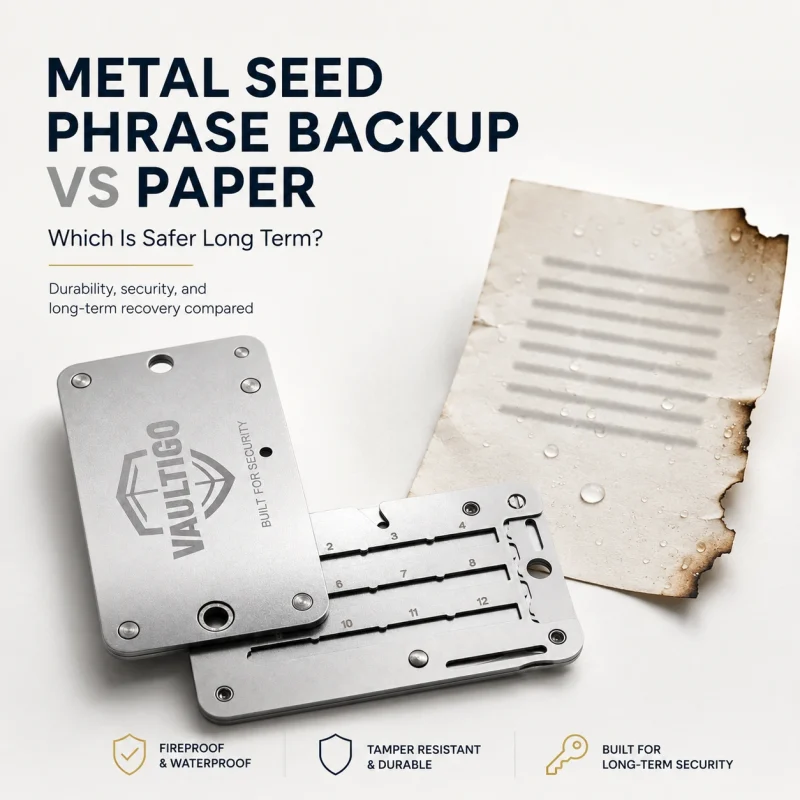
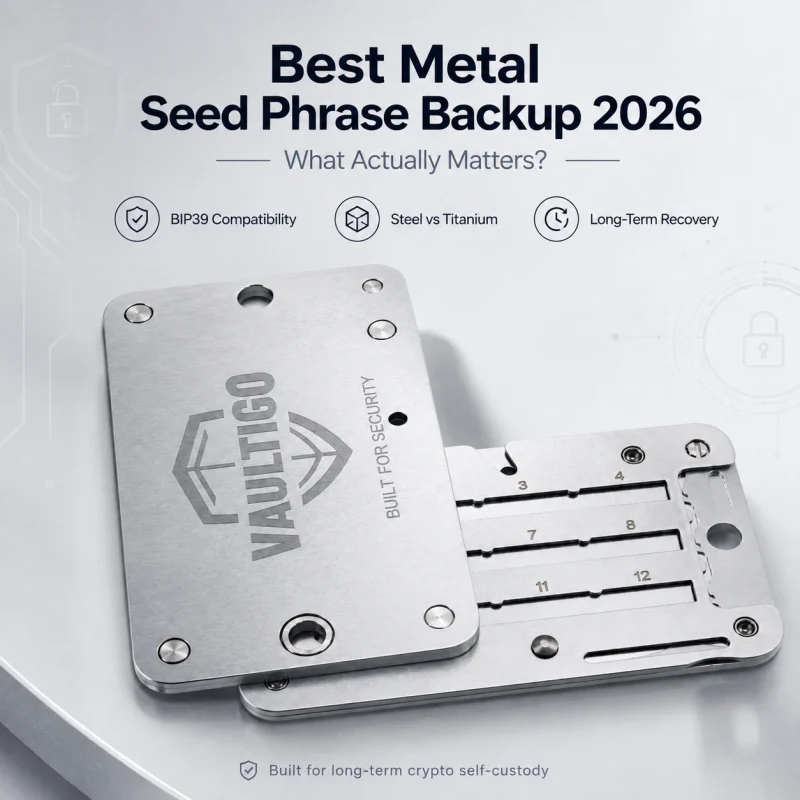
CryptoSafeKit’s VAULTIGO Keychain Seed Phrase Backup Plate, for example, records up to 24 recovery words offline using a dot-punch grid across rotating stainless-steel plates rather than relying on paper, ink, batteries, or an online service.
That can improve physical resilience, but a metal backup can still be:
Stolen
Photographed
Incorrectly marked
Misplaced
Stored beside the hardware wallet
Exposed by someone who discovers the location
Do not confuse physical durability with secrecy.
Layer 5: Create Redundancy Without Multiplying Exposure
One backup creates a single point of physical failure.
Ten complete seed copies create ten possible theft points.
The objective is controlled redundancy.
A typical long-term holder might keep:
One primary offline backup
One secondary backup in a physically independent location
The correct number depends on theft risk, disaster exposure, access control, and succession requirements. CryptoSafeKit’s separate seed-backup guide discusses the trade-off between too few copies and excessive exposure.
Do not invent your own seed-splitting scheme
Avoid improvised approaches such as:
Words 1–12 in one place and 13–24 somewhere else
Every second word at another location
Partial screenshots
Homemade encryption clues
Splitting phrases among relatives without documentation
These arrangements can create unknown security properties and serious recovery problems.
For users who genuinely need threshold recovery, standardized alternatives exist.
Trezor’s Multi-share Backup is based on SLIP39, a standardized Shamir secret-sharing approach in which a defined threshold of shares can reconstruct the wallet. It is a different backup architecture from simply cutting a BIP39 phrase into pieces.
Advanced backup systems can reduce some single-location risks, but they also increase operational complexity.
Use them only when you can test recovery correctly.
Layer 6: Consider a BIP39 Passphrase—But Understand the Cost
A BIP39 passphrase is an additional secret combined with the mnemonic when deriving the wallet seed.
Every different passphrase produces a different valid wallet. There is no central authority that can tell you whether you typed the intended one.
In the COLDCARD advisory, Coinkite states that a sufficiently strong, unique, unknown BIP39 passphrase can provide additional protection against the disclosed weak-seed condition. The company still recommends migrating affected users to a freshly generated seed rather than relying indefinitely on the passphrase to compensate for defective entropy.
Passphrase advantages
Adds an independent secret
Seed words alone may not be sufficient to access the intended wallet
Can separate wallet structures derived from the same mnemonic
Passphrase risks
Forgotten passphrase can permanently remove access
One-character differences lead to different wallets
Weak phrases may be guessable
Storing it with the seed defeats much of the separation
Inheritance becomes more complicated
An undocumented passphrase can turn a valid backup into an unusable recovery plan
A passphrase should not be used merely because it sounds more advanced.
For many users, a correctly generated hardware wallet plus well-designed physical backup is safer than an elaborate system they cannot reliably recover.
Layer 7: Have a Key-Rotation and Incident-Response Plan
Long-term holders often think of a seed as permanent.
Operationally, it should be treated as replaceable when evidence justifies replacement.
A key-rotation plan answers:
What happens if the manufacturer announces a seed-generation flaw?
What happens if a backup location may have been accessed?
What happens if the signer is stolen?
What happens if the optional passphrase is exposed?
What happens if the wallet software identifies a critical signing defect?
The response to a compromised seed is different from the response to a lost hardware device.
Lost device, seed still confidential
You may be able to restore using the existing recovery material on verified compatible hardware.
Seed potentially exposed
Generate an entirely new wallet and migrate assets.
Seed generated by defective randomness
Use fixed firmware or another verified signer, create fresh recovery material, verify new addresses, and migrate.
PIN exposed but device controlled
Change the PIN according to manufacturer procedures where appropriate; evaluate whether physical access occurred.
Passphrase exposed
Evaluate the wallet as though an additional security boundary has been lost. Depending on seed confidentiality, migration may be appropriate.
The COLDCARD incident demonstrates why “I have the seed safely stored” is not always the end of the security conversation.
Should You Add Multisig After the Coldcard Vulnerability?
For high-consequence Bitcoin storage, multisignature can reduce dependence on one seed and one signer.
In a typical multisig policy, spending requires signatures from multiple independently controlled keys. A 2-of-3 setup, for example, can tolerate loss of one key while preventing a thief with only one key from spending.
This can reduce several single-point-of-failure risks, provided the keys are genuinely independent.
A serious setup should avoid:
Generating every key on the same potentially affected device
Storing all signers in one location
Storing all recovery backups together
Using identical passphrases without understanding the implications
Losing the wallet descriptor or configuration information required for recovery
Building multisig before mastering single-signature recovery
Multisig adds failure modes as well as defenses.
For many users, a well-managed single-signature hardware wallet remains more recoverable than a poorly documented multisig configuration.
Expert analysis: Move to multisig because your threat model justifies multiple independent signing authorities—not because a news headline made single-signature storage feel obsolete.
A Practical Multi-Layer Architecture for Long-Term Bitcoin
For many long-term BTC holders, the following architecture is a reasonable starting framework.
Level 1: Straightforward Long-Term Holder
Use:
Verified hardware wallet
Current firmware at initialization
Fresh device-generated seed
One primary offline backup
One controlled secondary backup
Device stored separately from backups
Small test transaction before major funding
Periodic manufacturer-security review
This is relatively simple and recoverable.
Level 2: Higher-Value Single-Signature Vault
Add:
Durable metal recovery medium
Geographically separate backup locations
Dedicated vault account with minimal signing
Carefully tested BIP39 passphrase, if justified
Written non-secret recovery instructions
Spare compatible signer
The passphrase should remain separated from the seed and must be included in succession planning without placing all secrets together.
Level 3: High-Consequence Multi-Key Storage
Consider:
2-of-3 multisig
Signers from independent devices or security architectures
Independent seed generation
Geographic distribution
Metal backups for critical recovery material
Secure copies of required wallet configuration information
Tested recovery exercises
Documented inheritance process
At this level, complexity becomes a security risk of its own.
Professional review can be useful before funding a high-consequence configuration, particularly when inheritance, organizational custody, or multiple jurisdictions are involved.
How to Migrate Away From a Potentially Weak Seed
If a manufacturer determines that your seed itself may be weak, do not simply import that same seed into another hardware wallet.
That changes the device—not the secret.
A safer migration pattern is:
Verify the manufacturer’s current advisory.
Determine whether your model and original seed-generation firmware are affected. For COLDCARD, Coinkite’s current advisory should be treated as the primary source.
Prepare a known-good signing environment.
Install corrected firmware or use another verified hardware wallet.
Generate a completely new seed.
Do not reuse or lightly modify the old words.
Back up the new seed offline.
Confirm every word or share before proceeding.
Restore-test the new recovery process where practical.
Verify that you can reproduce the intended wallet before it protects a high-consequence balance.
Generate a fresh receiving address.
Verify that address on the trusted hardware display.
Send a small test amount.
Confirm that the new wallet recognizes and can control it.
Migrate the remaining funds.
Make sure you account for all relevant Bitcoin accounts and address types.
Retire the old seed.
Do not use old addresses for new deposits.
Preserve old materials temporarily if an active incident investigation requires them.
Follow the manufacturer’s current incident guidance before destroying potentially relevant hardware or records.
Do not perform a recovery migration from instructions received through unsolicited direct messages.
Security incidents attract secondary phishing campaigns.
Why a Metal Backup Cannot Fix Weak Entropy
This deserves a separate explanation because the two problems are easy to confuse.
A recovery system has two different security properties:
Cryptographic strength: Was the secret unpredictable when it was generated?
Physical resilience: Can the correctly generated secret survive until it is needed?
The COLDCARD flaw affected the first property.
Metal backup products address the second.
Putting an affected low-entropy phrase onto stainless steel does not strengthen the seed. It merely preserves that same weak seed more reliably.
The correct order is:
Generate strong recovery material.
Verify the wallet.
Then protect the backup physically.
For users who have already migrated to known-good recovery material, a metal system such as the VAULTIGO Keychain Stainless Steel Seed Phrase Backup Plate provides a non-electronic recording method that does not depend on ink or cloud storage.
Do not assign a specific fire, temperature, water, or impact rating unless that particular product has documentation supporting the claim.
Common Cold-Storage Security Mistakes
Assuming air-gapped means invulnerable.
Isolation does not repair defective key generation.
Updating firmware but retaining an affected seed.
Coinkite explicitly says the old seed must be replaced when it was generated under affected firmware.
Restoring a questionable seed onto a new hardware wallet.
The same mnemonic recreates the same underlying secret.
Keeping the signer and seed backup in one safe.
One burglary or disaster can remove both layers.
Creating too many complete copies.
Redundancy can turn into additional theft surfaces.
Manually splitting a BIP39 phrase.
Use a standardized threshold scheme when threshold recovery is genuinely needed.
Adding a passphrase without testing recovery.
Extra cryptographic complexity can create permanent loss.
Storing the phrase digitally “just temporarily.”
Screenshots, notes, email, cloud drives, and chat applications introduce online exposure.
Ignoring old firmware history.
For generation flaws, the version that created the seed may matter more than today’s installed version.
Assuming a metal backup protects against theft.
Durable media protects the record, not ownership of the secret.
Treating a hardware-wallet brand as a complete security strategy.
Recovery, verification, storage, and succession remain user responsibilities.
Multi-Layer Cold Storage Security Checklist
Before generating a wallet
Buy through a traceable source.
Check current manufacturer security advisories.
Verify device authenticity where supported.
Install trusted current firmware.
Generate the wallet yourself.
Reject any supplied recovery phrase or PIN.
During initialization
Generate recovery material only on the verified device.
Record it offline.
Verify the backup carefully.
Never photograph it.
Never upload it.
Never enter it into a website.
Document non-secret setup information separately.
Before substantial funding
Verify the receiving address on the hardware device.
Send a test transaction.
Test wallet recovery when appropriate.
Confirm that any passphrase can be reproduced exactly.
Confirm backup locations are physically independent.
Long-term storage
Separate signer and recovery backup.
Use controlled backup redundancy.
Periodically review manufacturer advisories.
Keep a non-secret wallet inventory.
Maintain an emergency migration procedure.
Plan for device failure.
Plan for owner incapacity or death.
Rotate keys when a credible compromise affects existing secrets.
FAQ
Q: What was the Coldcard seed vulnerability?
A: Coinkite disclosed that affected COLDCARD firmware could generate wallet seeds with substantially less effective entropy than intended. That reduced unpredictability could make affected seeds materially easier to search than a correctly generated cryptographic seed.
Q: Can updating Coldcard firmware protect an existing vulnerable seed?
A: No. Corrected firmware fixes future seed generation, but it cannot add randomness to a seed that already exists. Coinkite instructs affected users to generate new recovery material under fixed firmware and migrate funds.
Q: Does the Coldcard vulnerability mean all cold wallets are unsafe?
A: No. The disclosed defect concerns specific COLDCARD seed-generation implementations. The broader lesson is that offline key isolation addresses only part of the hardware-wallet threat model; generation, firmware, backups, transactions, and physical security also matter.
Q: Can a BIP39 passphrase protect a weak seed?
A: A sufficiently strong and independent passphrase can add another secret an attacker must discover. Coinkite nevertheless recommends replacing affected seeds rather than relying on a passphrase as a permanent workaround.
Q: Should I split my 24-word seed between several locations?
A: Avoid inventing your own manual splitting method. If threshold recovery is necessary, consider a standardized scheme such as SLIP39 Multi-share Backup or a properly designed multisignature wallet, and test the recovery procedure before storing significant funds.
Q: Does a metal seed plate prevent seed theft?
A: No. Metal can improve the physical storage medium, but anyone who obtains sufficient recovery information may still access the wallet. Protect the plate from unauthorized access just as carefully as a paper recovery phrase.
Q: Should high-value Bitcoin holders use multisig?
A: Multisig can reduce dependence on one signing key when its keys, devices, and locations are genuinely independent. It also increases backup and recovery complexity, so it is most appropriate when the user understands and has tested the complete recovery process.
Q: How often should I replace my seed phrase?
A: There is no need to rotate a securely generated seed simply because time has passed. Replacement becomes appropriate when there is credible evidence of exposure, weak generation, insecure backup handling, or another compromise affecting the existing keys.
Conclusion
The COLDCARD seed vulnerability changes one common assumption about cold storage:
A private key being offline is not enough if the private key was not generated securely.
The incident does not invalidate hardware wallets. It shows why serious Bitcoin custody must be designed as several independent security layers.
Start with verified firmware and strong seed generation. Isolate the private key in dedicated signing hardware. Verify every important transaction. Keep recovery information offline and physically resilient. Add redundancy without scattering complete secrets everywhere. Use passphrases, Multi-share Backup, or multisig only when their additional complexity is justified and recoverable.
And maintain one final capability that long-term holders often overlook:
the ability to abandon an old seed and migrate safely when the evidence changes.
That is what turns cold storage from a one-time device purchase into a durable security system.