





Why Crypto Prices Go Up and Down: Core Fundamental Principles Explained

Disclaimer Upfront: This article explains market mechanics for educational purposes. It does not provide investment, trading, legal, or tax advice.
Crypto prices can appear irrational.
Bitcoin may move sharply after a policy announcement. A smaller token may rise even when its underlying technology has not visibly changed. An asset can fall after apparently positive news. At other times, almost the entire crypto market moves in the same direction despite major differences between individual networks.
These movements are not always easy to interpret, but they are not driven by magic.
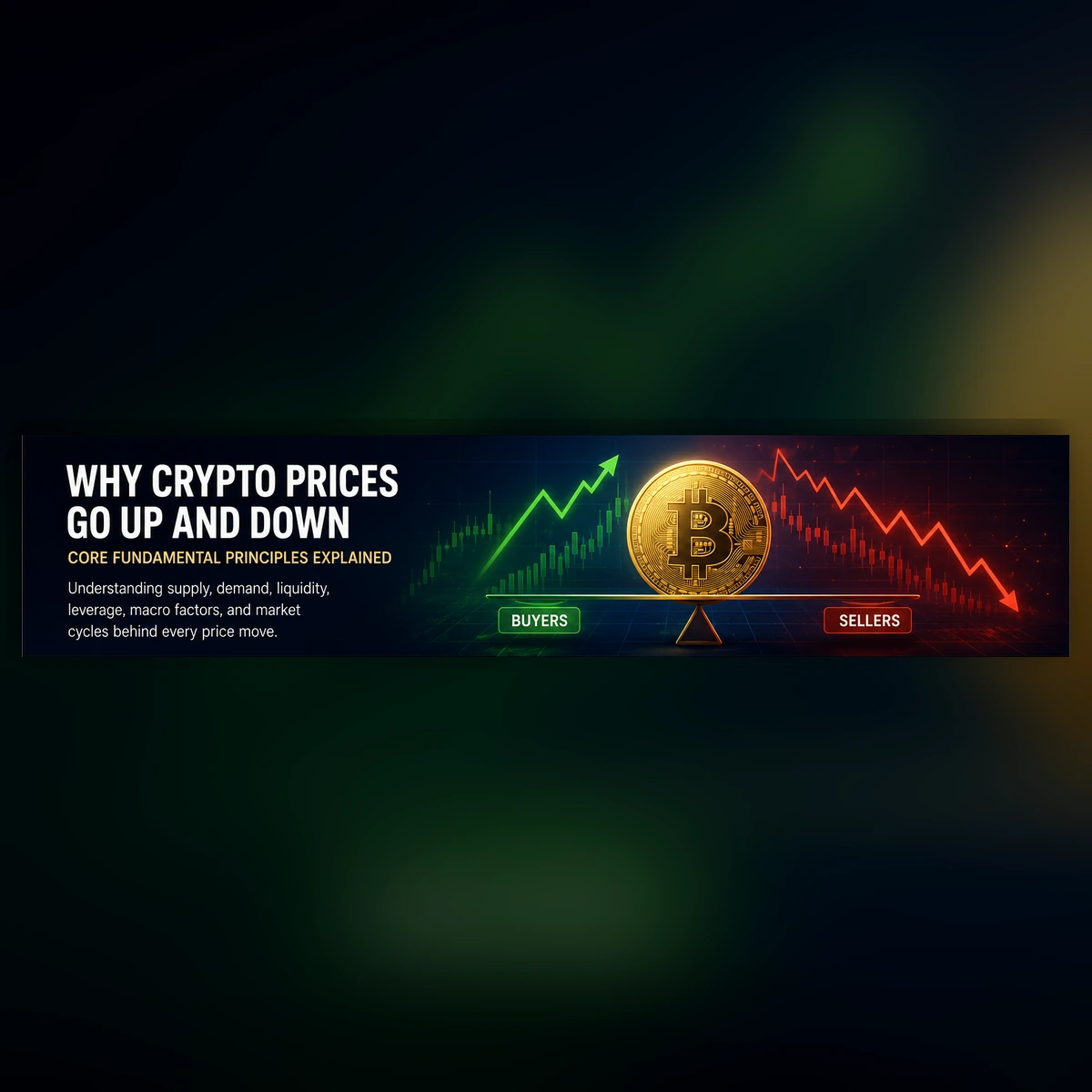
At the most basic level, a crypto price changes because buyers and sellers agree to trade at a different price than before. The size and speed of that change depend on several connected factors:
- Available supply
- Buyer demand
- Market liquidity
- Leverage and forced liquidations
- Macroeconomic conditions
- Regulatory and project-specific developments
- Expectations about future adoption and risk
This guide explains why crypto prices go up and down without making forecasts or recommending that readers buy, sell, or hold any particular asset.
The objective is to help you understand what happens beneath the headlines and price charts.
The Shortest Answer: Buyers and Sellers Set the Price
A cryptocurrency does not have an official price assigned by its blockchain.
The quoted market price is generally the price at which a buyer and seller most recently completed a trade on a particular platform.
On an order-book exchange, buyers submit bids and sellers submit offers. A transaction occurs when a buyer agrees to a seller’s price, or when a seller accepts an available bid.
Many decentralized exchanges use automated liquidity pools instead of traditional order books. The technical process is different, but the basic principle remains the same: every trade affects the price available to the next participant.
This means that price is determined at the margin.
Only a small percentage of a cryptocurrency’s total supply may be actively available for sale. When buyers become more aggressive while few holders are willing to sell, completed trades begin occurring at progressively higher prices.
When sellers become more aggressive and accept lower bids, the market price falls.
Why Market Capitalization Can Be Misleading
Market capitalization is usually calculated by multiplying an asset’s current price by its circulating supply.
For example, a token with 100 million units in circulation and a market price of $2 would have a reported market capitalization of $200 million.
That does not mean investors deposited $200 million into the token.
The latest transactions establish a reference price that is then applied to the entire circulating supply. In a thin market, a relatively small amount of new buying or selling can therefore produce a much larger change in reported market capitalization.
Market capitalization is useful for comparing the approximate size of different assets, but it should not be confused with total money invested or cash available for withdrawal.
Supply Means More Than Maximum Supply
Many beginners focus only on maximum supply.
That number may be important, but it does not provide a complete picture of the supply currently affecting the market.
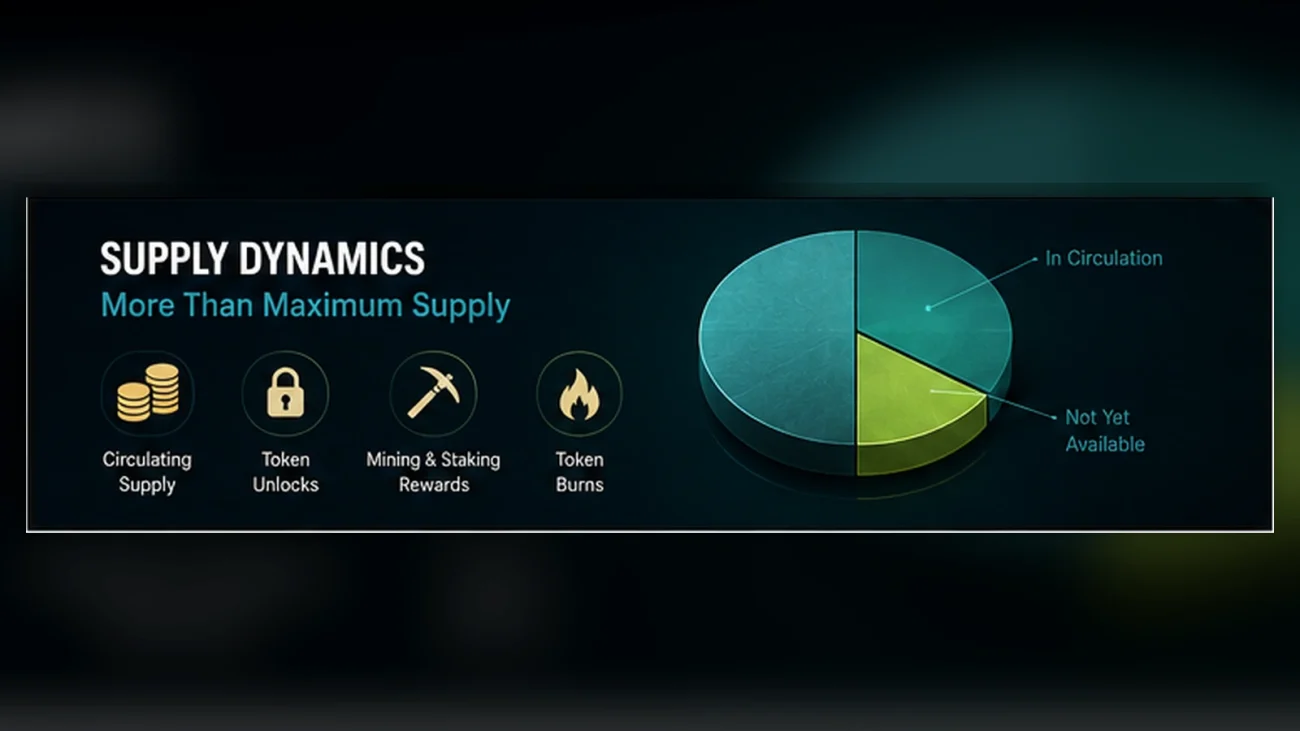
Relevant supply factors include:
- Coins already circulating
- Newly issued coins
- Mining or staking rewards
- Team and investor token unlocks
- Foundation or treasury holdings
- Tokens removed through burns
- Coins held by long-term owners who rarely sell
- Large balances concentrated in a small number of wallets
Two assets can have the same maximum supply but very different market structures.
One may already have most of its supply in circulation. Another may have large quantities scheduled to unlock over several years. Those future releases can create additional selling pressure if recipients decide to sell.
Bitcoin’s Issuance Schedule
Bitcoin follows a publicly documented issuance schedule.
New bitcoin is distributed through block rewards, and the block subsidy is reduced after every 210,000 blocks. This event is commonly called a halving.
A halving reduces the rate at which new bitcoin enters circulation. It does not guarantee that Bitcoin’s price will rise.
Price still depends on demand, available liquidity, investor positioning, macroeconomic conditions, and what the market expected before the event.
A supply reduction can influence the market, but supply never operates in isolation.
Token Unlocks and Treasury Sales
Many tokens are initially allocated among development teams, early investors, foundations, community programs, or ecosystem treasuries.
These tokens may be locked for a period and then released according to a vesting schedule.
An unlock does not automatically cause a price decline. The effect depends on:
- The size of the release
- Whether recipients intend to sell
- Existing market liquidity
- Whether the unlock was already expected
- Current buyer demand
- The concentration of token ownership
The better supply question is not simply, “How many tokens exist?”
It is: How many tokens are available to trade now, who controls them, and how could that availability change?

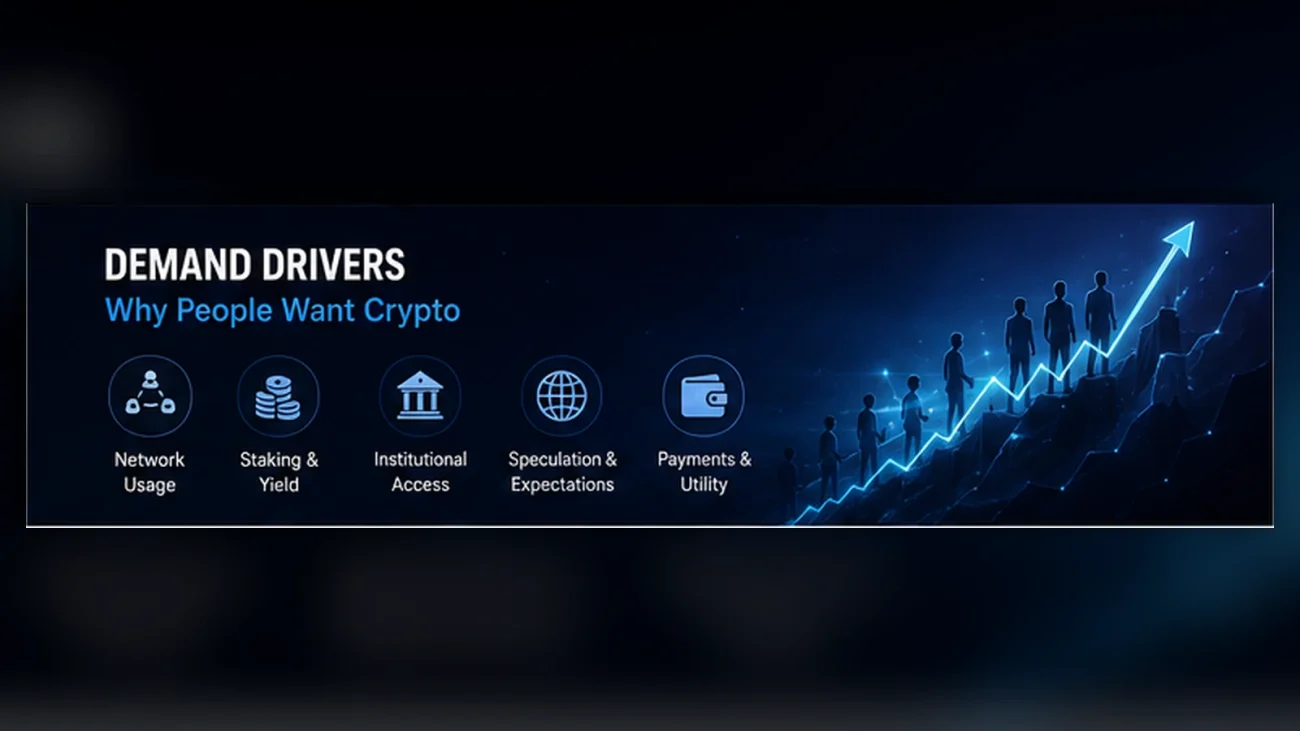
Demand Comes from Use, Access, Belief, and Expectations
Demand for a crypto asset can come from several different sources.
Some users need an asset to pay network fees. Others use it as collateral, participate in governance, access an application, settle transactions, or receive staking rewards.
Some buyers treat an asset as a long-term store of value. Others are interested only in short-term price changes.
Demand may come from:
- Network usage
- Transaction-fee requirements
- Collateral demand
- Staking participation
- Payment or settlement activity
- Institutional access
- Speculation
- Store-of-value expectations
- Community or social attention
Access also matters.
Demand can change when an asset becomes easier or more difficult to buy, custody, transfer, or use. Exchange availability, wallet support, institutional products, banking relationships, and regional restrictions can all affect participation.
Markets Price Expectations, Not Only Current Activity
Crypto markets do not respond only to what a network does today.
Participants also form expectations about:
- Future adoption
- Regulation
- Security
- Competition
- Developer activity
- Protocol upgrades
- Revenue or fee generation
- Institutional participation
A network may currently have limited usage but command a high valuation because the market expects substantial future growth.
The opposite can also happen. A network may have active users but a weak token price if the market expects declining demand, excessive token issuance, stronger competitors, or limited value flowing to the token itself.
Does Token Utility Guarantee a Higher Price?
No.
Utility can create a reason to acquire or use a token, but it does not automatically create long-term price appreciation.
The result also depends on:
- How much token demand the activity creates
- Whether users must hold the token
- How quickly the token is resold
- Whether new supply is entering the market
- Whether alternative networks offer the same service
- Whether value is captured by the token or only by the application
A useful product and a valuable token are related questions, but they are not always the same question.
For example, a token may be required briefly to complete an action but immediately sold afterward. The network may process significant activity without creating persistent holding demand.
When evaluating token utility price impact, it is necessary to understand both the utility and the token’s economic design.
Liquidity Determines How Far the Price Moves
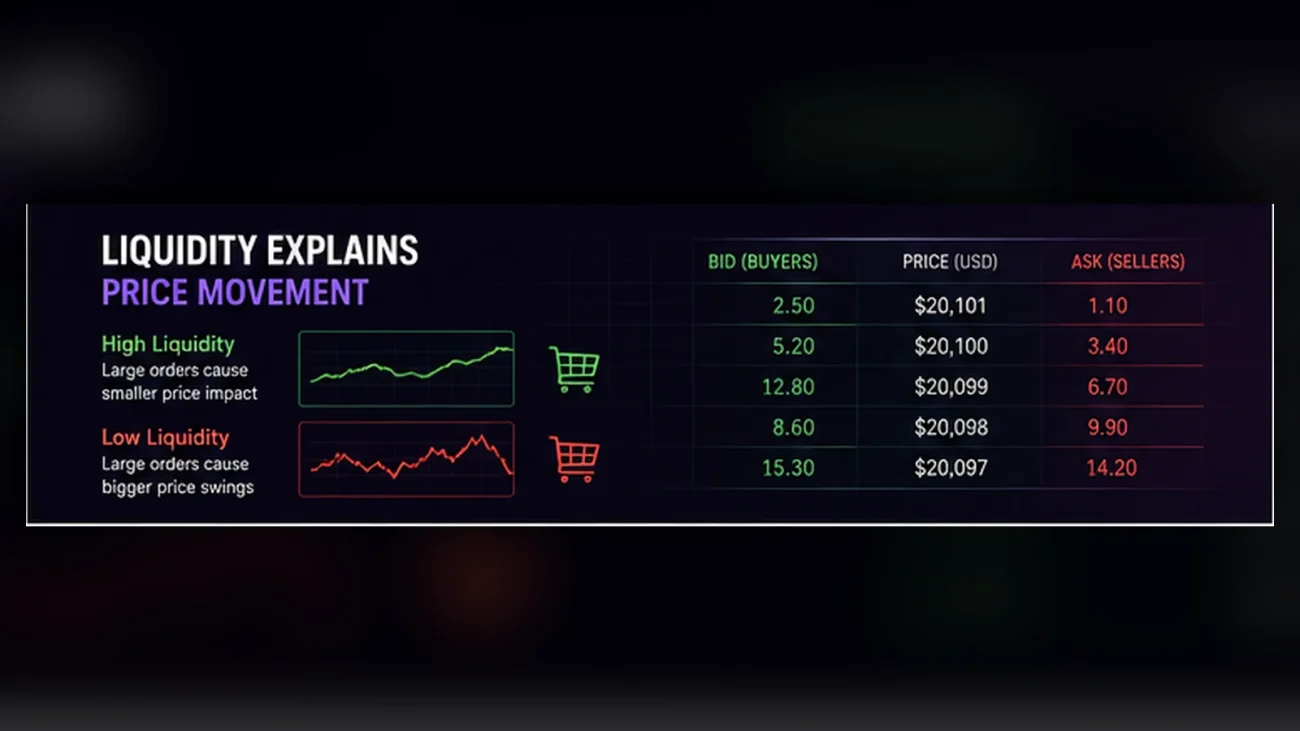
Liquidity describes how easily an asset can be bought or sold without causing a large price change.
A liquid market has many buyers and sellers across a wide range of prices. A less liquid market has fewer available orders, wider gaps between prices, or limited capital in its trading pools.
The same purchase can therefore produce very different results.
Hypothetical Example
A $100,000 purchase may cause little movement in a deep Bitcoin market with substantial trading activity.
The same $100,000 purchase could move a smaller token significantly if only a limited amount is available for sale near the current price.
The difference between the expected execution price and the price actually received is called slippage.
Slippage normally becomes more significant when:
- The asset has low trading volume
- The order is large relative to available liquidity
- Volatility is already elevated
- Market makers withdraw orders
- Liquidity is fragmented across several platforms
- A decentralized liquidity pool is relatively small
Liquidity Can Disappear During Stress
A market can appear liquid during normal conditions and become much thinner during a crisis.
Market makers may reduce exposure. Traders may cancel orders. Exchange interruptions can separate buyers from sellers. Participants may become unwilling to transact until uncertainty decreases.
When liquidity disappears, prices can move through large ranges very quickly.
This is one of the main reasons smaller cryptocurrencies are often more volatile than highly traded assets.
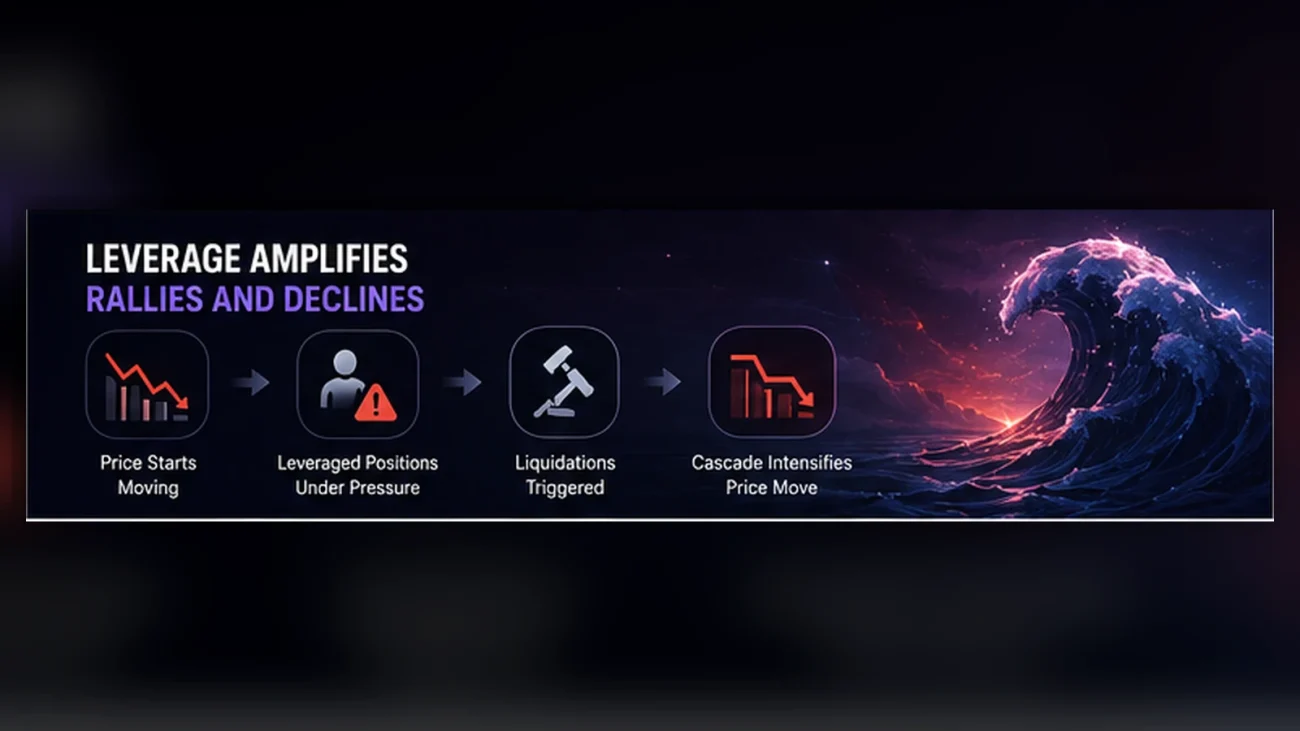
Leverage Amplifies Rallies and Declines
Leverage allows a trader to control a position larger than the collateral committed to it.
For example, a trader may deposit a relatively small amount of collateral to gain exposure to a much larger market position.
Leverage can increase potential gains, but it also creates the possibility of forced liquidation.
When a leveraged position loses too much value, the trading venue may automatically close it to prevent the account from developing a larger deficit.
A forced sale can push the price down further, causing other leveraged positions to be liquidated.
The same process can operate in the opposite direction. Traders betting on a decline may be forced to buy assets back when prices rise sharply.
This is known as a liquidation cascade.
How a Liquidation Cascade Develops
- Ordinary selling causes an initial price decline.
- Highly leveraged positions begin losing collateral value.
- Exchanges automatically close some positions.
- Those forced sales push the market lower.
- Additional liquidation levels are reached.
- The original move becomes larger and faster.
The asset’s technology or network usage may not have changed enough to justify the full size of the move.
Part of the movement may be caused by market structure rather than a fundamental change in the project.
Macroeconomic Conditions Affect Crypto Demand
Crypto markets do not operate separately from the wider financial system.
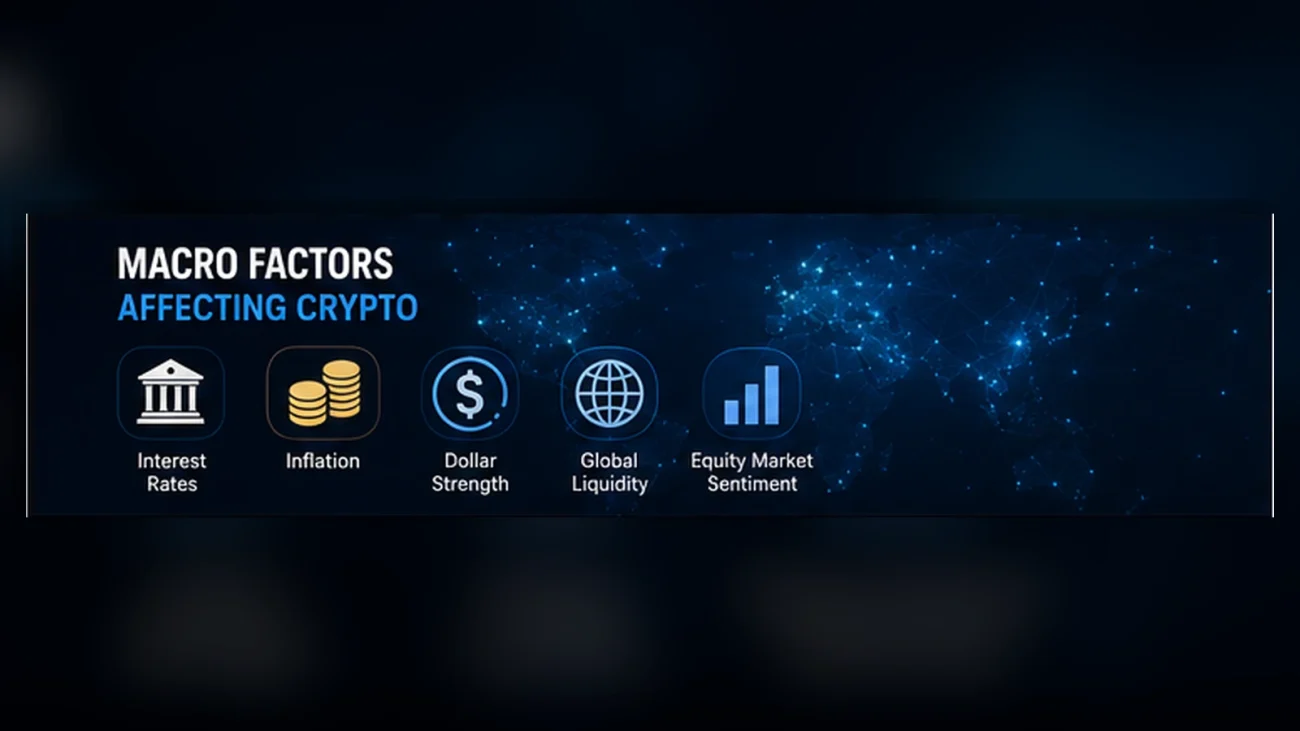
Interest rates, credit conditions, global liquidity, currency markets, equity performance, and general appetite for risk can all affect demand for crypto assets.
Relevant macro factors may include:
- Central-bank interest rates
- Inflation expectations
- Availability of credit
- US dollar strength
- Global financial liquidity
- Equity-market sentiment
- Economic uncertainty
- Demand for cash or defensive assets
When financing is inexpensive and investors are more willing to take risk, speculative assets may receive more capital and attention.
When financial conditions tighten, participants may reduce risk exposure, seek liquidity, repay debt, or prefer assets with more predictable characteristics.
Crypto and Traditional Markets Can Become More Connected
As institutional participation increases, crypto markets may become more sensitive to developments in equities, interest rates, and global liquidity.
That does not mean a single central-bank decision mechanically determines Bitcoin’s price.
The market response depends on:
- What participants expected
- How traders were positioned
- Whether the announcement was already reflected in prices
- Current liquidity
- Leverage
- Other events occurring at the same time
Macro conditions are an important driver, but they are not a complete explanation for every crypto price movement.
News Moves Prices Through Expectations
News affects crypto prices when it changes expectations about future supply, demand, access, security, or risk.
Relevant developments may include:
- Regulatory announcements
- Court decisions
- Protocol upgrades
- Security incidents
- Exchange listings or delistings
- Stablecoin reserve concerns
- Governance proposals
- Token unlocks
- Institutional access
- Changes in banking support
The headline alone does not determine the market response.
What matters is the difference between the actual outcome and what market participants already expected.
Apparently positive news may be followed by a price decline if traders expected a stronger outcome.
Negative news may produce little movement if it was widely anticipated or already reflected in the price.
This is why the phrase “buy the rumor, sell the news” is sometimes used to describe markets. It does not represent a dependable strategy. It simply reflects the fact that traders often position themselves before an expected event.
Security Incidents Can Affect More Than One Asset
A smart-contract exploit, bridge compromise, exchange failure, or stablecoin problem can affect confidence beyond the directly involved project.
Participants may sell unrelated assets to raise liquidity or reduce overall exposure.
An exchange interruption may also restrict access to buyers and sellers, creating temporary price differences across platforms.
Security events can therefore influence:
- Directly affected tokens
- Connected applications
- Collateral values
- Exchange liquidity
- Stablecoin demand
- Broader market confidence
Price effects do not prove that every affected asset shares the same technical weakness. Markets often respond to uncertainty before all facts are known.
Crypto Market Cycles Are Reinforced by Feedback Loops
Crypto markets frequently move through periods of expansion and contraction.
During an expansion:
- Prices begin rising.
- Media coverage increases.
- New participants enter the market.
- Trading activity and liquidity expand.
- Higher valuations support development and marketing.
- Increased attention may reinforce demand.
During a contraction, the same process can reverse:
- Prices fall.
- Attention decreases.
- Leveraged positions are liquidated.
- Trading activity declines.
- Funding becomes more difficult.
- Development and user incentives may slow.
- Lower participation weakens demand.
These feedback loops help explain blockchain market cycles.
However, cycles are not fixed schedules.
They are shaped by market psychology, liquidity, leverage, technology, regulation, token issuance, and macroeconomic conditions.
A pattern observed during one period does not have to repeat in the same way.
Bitcoin and Other Tokens Have Different Price Drivers
It is a mistake to analyze every cryptocurrency using the same framework.
Bitcoin
Bitcoin has:
- A publicly documented issuance schedule
- No central company that can create additional bitcoin at will
- A distributed mining network
- A large global trading market
- A strong association with scarcity and self-custody
Its price may be affected by demand for settlement, liquidity, institutional access, long-term holding, and store-of-value expectations.
Smart-Contract Network Tokens
Tokens associated with smart-contract networks may be influenced by:
- Transaction-fee demand
- Staking
- Application usage
- Developer activity
- Competing networks
- Validator incentives
- Token emissions
- Governance decisions
Application Tokens
Tokens connected to individual applications may depend more heavily on:
- User growth
- Application revenue
- Incentive programs
- Token rewards
- Governance rights
- Treasury spending
- Competition
- Whether the token is genuinely required
Stablecoins
Stablecoins are designed to track a reference value, but their prices can still move if participants become concerned about:
- Reserves
- Redemption access
- Banking partners
- Liquidity
- Smart-contract security
- Regulatory restrictions
- Operational reliability
Before asking what determines a token’s price, first identify what type of asset it is and what creates demand for it.
Common Misunderstandings About Crypto Prices
“A Token Costs Less Than One Dollar, So It Is Cheap”
Unit price says very little without considering supply.
A token priced at $0.10 with 100 billion units in circulation may have a much larger total market value than an asset priced at $1,000 with a very limited supply.
“Market Cap Is the Amount of Money Invested”
It is not.
Market capitalization is the current unit price multiplied by circulating supply. It does not represent the total amount of cash available or the amount that could be withdrawn without affecting the price.
“A Useful Network Must Have a Rising Token Price”
Not necessarily.
Network usage may not create lasting token demand. The token may have high emissions, weak value capture, strong competition, or users who need to hold it only briefly.
“A Bitcoin Halving Guarantees a Price Increase”
It does not.
A halving reduces new issuance. It does not control demand, market liquidity, leverage, macroeconomic conditions, or investor expectations.
“Social-Media Attention Proves the Fundamentals Are Improving”
Online attention can create short-term demand, especially in thin markets.
It does not necessarily indicate sustainable network use, stronger security, meaningful revenue, or long-term economic value.
Thinly traded tokens may also be vulnerable to coordinated promotion and rapid selling.
A Practical Framework for Understanding a Price Move
Instead of searching for one simple explanation, ask the following seven questions.
1. What Changed in Supply?
Look for:
- New issuance
- Token unlocks
- Mining or staking rewards
- Treasury transfers
- Burns
- Large-holder movements
- Changes in circulating supply
2. What Changed in Demand?
Consider:
- Network usage
- New market access
- Payment activity
- Collateral demand
- Institutional participation
- Speculative interest
- Changes in future expectations
3. How Liquid Is the Market?
Ask:
- How deep are the order books?
- How much liquidity is available in decentralized pools?
- Is trading concentrated on one platform?
- How much slippage would a large order create?
4. Was Leverage Involved?
A large derivatives market or concentrated leveraged positioning can amplify an otherwise ordinary move.
5. What Changed in the Macro Environment?
Review interest rates, liquidity conditions, currency markets, equity sentiment, and general demand for risk.
6. Was There an Asset-Specific Event?
Look for upgrades, security incidents, governance decisions, litigation, regulation, listings, delistings, or token unlocks.
7. Did Market Access or Custody Conditions Change?
Exchange interruptions, withdrawal restrictions, stablecoin concerns, banking problems, or intermediary failures can affect liquidity and confidence even when the blockchain continues operating normally.
This framework is intended to improve understanding. It is not a price-prediction system.
Why Volatility Makes Custody Planning More Important
Price risk and custody risk are different.
A hardware wallet cannot prevent an asset’s market value from falling. Cold storage does not remove volatility, improve a token’s economics, or make a weak project safer.
What self-custody can change is who controls transaction authorization and how exposed private keys are to online systems and third-party intermediaries.
Periods of high volatility can create operational pressure.
Users may:
- Transfer funds in a hurry
- Move assets between exchanges
- Respond to withdrawal delays
- Approve transactions without checking them carefully
- Click convincing phishing messages
- Store large balances on platforms for convenience
- Make mistakes while stressed or distracted
A planned self-custody system may reduce certain exchange and online-key risks, but it creates responsibilities of its own.
Those responsibilities include:
- Protecting the recovery phrase
- Verifying addresses on the hardware-wallet screen
- Keeping sufficient network fees available
- Avoiding malicious smart-contract approvals
- Preparing for device loss or damage
- Maintaining clear recovery instructions
- Planning for inheritance or emergency access
- Testing the recovery process safely
For a complete operational approach, read our Long-Term Cold Storage Guide
You can also review our Crypto Self-Custody Security Checklist
Hardware wallets, metal seed phrase backups, protective cases, and other security accessories can support a more structured self-custody system.
However, no wallet or physical accessory eliminates every risk.
Security still depends on correct setup, trustworthy purchasing channels, careful transaction verification, offline backup practices, and the user’s ability to recover the wallet safely.
Final Thoughts
Crypto prices move because markets continuously reassess supply, demand, liquidity, risk, and future expectations.
No single factor explains everything.
A supply reduction may matter, but only relative to demand.
Strong utility may matter, but only if the token captures that demand.
Positive news may matter, but only relative to what the market expected.
A comparatively small flow can create a large move when liquidity is thin. Leverage can then amplify the result.
Understanding these mechanisms is more useful than treating every movement as a mystery—or assuming that one headline explains the entire market.
The market price tells you where buyers and sellers most recently agreed to trade.
It does not tell you what will happen next, whether an asset is appropriate for a particular person, or how that asset should be stored.
Market analysis and asset security are separate disciplines.
Both deserve a clear process.
Frequently Asked Questions
Why Do Crypto Prices Move More Sharply Than Many Traditional Assets?
Crypto markets may have thinner liquidity, fragmented trading venues, concentrated ownership, continuous 24-hour trading, and substantial derivatives activity.
These features can allow relatively modest changes in buyer or seller activity to produce larger price movements.
What Determines Bitcoin’s Price?
Bitcoin’s price is determined by buyers and sellers trading across global markets.
Relevant factors include demand, available supply, liquidity, macroeconomic conditions, market access, leverage, and expectations about future adoption.
Bitcoin’s programmed issuance schedule affects supply growth, but it does not determine the market price by itself.
Does Market Capitalization Equal the Amount of Money Invested?
No.
Market capitalization is the current market price multiplied by circulating supply. It does not show the total cash invested or the amount that holders could withdraw at the current price.
Does a Bitcoin Halving Guarantee a Higher Price?
No.
A halving reduces the rate of new Bitcoin issuance. Demand, liquidity, leverage, macroeconomic conditions, and market expectations still influence price.
Why Are Smaller Tokens Often More Volatile?
Smaller tokens frequently have thinner order books, lower trading activity, less diversified ownership, and fewer active market makers.
A relatively small order may therefore consume a large share of available liquidity.
Do Interest Rates Affect Crypto Prices?
They can.
Interest rates and financial conditions influence the cost of capital, global liquidity, currency markets, and investor willingness to accept risk.
The relationship is not fixed and may change over time.
Does Real Token Utility Guarantee a Higher Price?
No.
Utility may create demand, but price also depends on token supply, emissions, competition, market access, token velocity, and whether users need to hold the token.
Why Can Positive News Be Followed by a Price Decline?
Markets often reflect expectations before an event occurs.
If the final outcome is weaker than expected, or if traders had already positioned for the announcement, the asset may decline despite a positive headline.
Why Does Leverage Make Crypto More Volatile?
Leveraged traders may be forced to close positions when their collateral becomes insufficient.
Those forced purchases or sales can intensify an existing move and trigger additional liquidations.
Does Cold Storage Protect Against Falling Crypto Prices?
No.
Cold storage addresses custody and private-key exposure. It does not protect an asset from market volatility or declining prices.
Security and Financial Disclaimer
This article is provided for general educational purposes only.
It does not constitute financial, investment, trading, legal, accounting, or tax advice. It does not recommend purchasing, selling, holding, or transferring any crypto asset.
Crypto assets can experience substantial price volatility, liquidity constraints, operational failures, cybersecurity incidents, and loss of access. Historical market behavior does not predict future outcomes.
Hardware wallets and cold storage can reduce certain online-key and third-party custody risks. They do not eliminate market risk, phishing, malicious smart-contract approvals, physical theft, coercion, supply-chain risk, recovery failure, or user error.
CryptoSafeKit will never ask users to enter or disclose a recovery phrase, private key, PIN, wallet password, or custom passphrase through a website, email, chat, cloud service, or support form.
Sources and Editorial References
- Bitcoin Developer Reference — Bitcoin issuance and block-subsidy rules
- US Commodity Futures Trading Commission — Virtual-currency volatility and consumer-risk guidance
- Bank for International Settlements — Research on crypto-market flows, adoption, and price amplification
- International Monetary Fund — Research on crypto cycles, financial conditions, and macroeconomic relationships
- Financial Stability Board — Crypto liquidity, leverage, intermediary, and market-structure risks